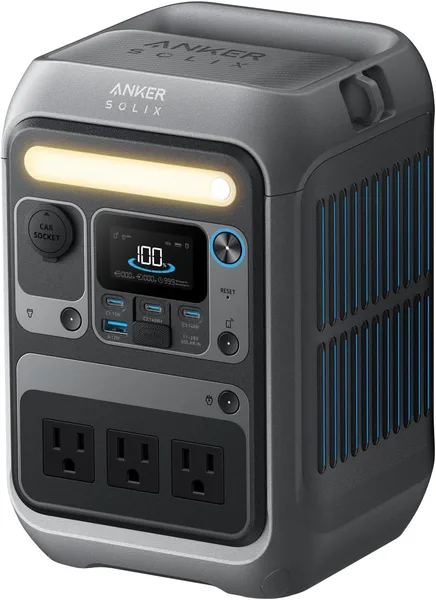
Anker SOLIX C300 288Wh Review: Worth It Instead of a Generator?
The Anker SOLIX C300 is a compact 288Wh station that will happily run a router, a lamp, and phone charging through an entire evening blackout — but it won't keep a fridge going for long. It's not a generator replacement, it's smart insurance for anyone without a garage or a jerry can of gas. Get it if your outages run 2-6 hours; look elsewhere if you need to babysit a fridge overnight.
The power goes out on a schedule, not on a whim — and you already know the ritual: candles, a power bank that was already at 90% drained by morning, and a router that dies at the exact moment you need to send something urgent. That's the whole reason "home power station" became a category, and the Anker SOLIX C300 is one of the cheapest doors into it.
Let's start with the honest part: 288Wh is not "save the fridge overnight" territory. It's math a lot of buyers skip before ordering, then feel burned by later. A compressor fridge pulls 100-150W at peak draw, and even in eco mode a unit this size gets you maybe two or three hours, not more. A router (5-10W), a lamp, a laptop, and phone charging, though? Completely different story — the C300 coasts through a whole evening on that load, sometimes a whole night, as long as you don't switch on anything hungry.
The real headline here is the battery chemistry. LiFePO4 instead of standard lithium-ion means the cell doesn't degrade after a couple hundred charge cycles the way cheaper no-name stations from marketplace bargain bins do — it's rated for roughly 3,000 cycles. In practice, that means if you're charging this thing daily during extended outages, you'll go a year, two, three, without noticing any real drop in capacity, while budget lithium alternatives are visibly sagging by the end of their first season. When blackouts aren't a one-week emergency but an open-ended way of life, that detail matters more than any single wattage figure on the spec sheet.
The second thing I actually like is the 140W bidirectional fast charging. The station tops up from a wall outlet in roughly two hours instead of overnight like older models in this class. That's a real deal if your power window is only 3-4 hours and you need to top the thing back up inside it, rather than catching your one shot per day. Paired with a solar panel (rated up to 300W input), it charges at a decent clip on a sunny day too — not enough to live off solar entirely, but a solid assist for a balcony or a country house.
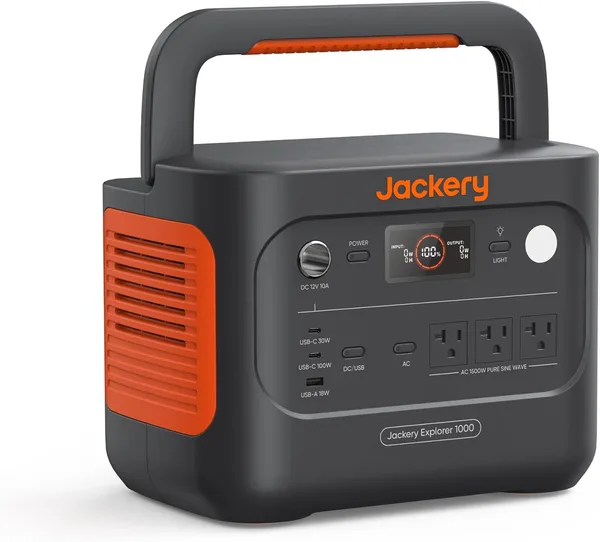
What should you cross-shop it against? The obvious rival is Jackery, and the catalog has the Jackery Explorer 1000 v2 at 1070Wh — nearly four times the capacity. If you genuinely need to run a fridge, router, and TV together for 4-6 hours, look at that class instead of the C300. But the price and the weight are a different animal entirely — this isn't something you just set on a hallway shelf, it needs a dedicated spot. The C300 is more of a "just in case" policy you can keep topped up in a closet than a full home power plant.
There's also a younger sibling in Anker's own lineup — the Anker 522 Powerhouse at 299Wh, almost the same capacity, an older series. If you spot a better deal on that one specifically, the real-world difference will be minimal — the C300 is just newer and charges a bit faster.
What's annoying? First, the cooling fan is audible once the load climbs — not a dealbreaker, but noticeable in a quiet apartment at night. Second, the display is informative but small — reading the charge percentage at an angle isn't exactly comfortable. And third, this isn't about the unit itself, but worth keeping in mind: the final price to your door is never just the sticker price on the store page — forwarding and import duty stack on top, and the landed total ends up meaningfully higher than the number you see on the US listing. That's normal for any cross-border order, and dede.sh shows you that full number — item, forwarding, and duty combined — before you commit.
Who actually needs this? Apartment dwellers who can't run a generator (neighbors, a balcony, no venting for exhaust fumes), and anyone who wants to charge their gear and have a light on in the evening without the smell of gasoline or engine noise. It's ideal if your outages run a few hours at a time, not a full day. If you're at a country house with a fridge full of meat and a freezer to keep running, you need something with meaningfully more capacity — or an actual gas generator — and the C300 will let you down.
Rather than quoting a single price tag that won't match your currency, check the full landed cost on the product page on dede.sh — item price, forwarding, and import duty rolled into one number for your country. It's noticeably cheaper than the entry point for "big" 1000+ Wh stations, which is exactly why the C300 often ends up as a second or third station in the house — one big unit in the kitchen, a small one like this in the bedroom or the kids' room.
FAQ
For a couple of hours in eco mode — yes. All night — no, 288Wh just isn't enough, the compressor will drain it faster than you'd like. If a fridge is the main reason you're buying, look at stations starting around 700-1000Wh.
The big one is AC output (a real 220V/120V outlet), not just USB. A power bank can't run a lamp or a router's wall adapter — this station handles it without a second thought. Plus LiFePO4 outlasts the cell in a typical power bank by a wide margin.
If your budget is tight and you just need to ride out short outages, get the C300 — it's smaller and cheaper. If long runtime for several devices at once is the priority, the 1070Wh Jackery will run far longer, though it costs considerably more.
Yes, if you plan to use the station regularly rather than once a year in an emergency. LiFePO4 handles many more charge cycles without losing capacity — over a year of daily outages, the difference is very noticeable.