ANYCUBIC PLA Filament Review: Worth Importing or Just Buy It Local?
ANYCUBIC PLA isn't the best filament on the market, and it isn't the worst — it's basically what "factory standard" should mean: consistent accuracy, almost no snapped filament, prints without drama on pretty much any FDM printer, not just a Kobra. Ordering it as a standalone purchase from abroad rarely pencils out — shipping eats the savings. But if a spool rides along with a bigger order, go for it.
You unbox a new printer, and the starter spool that came bundled with it runs dry before you've even gotten used to the extruder's whirring. Familiar story if you've ever picked up a Kobra or a Vyper and realized within a month or two that you're not printing rare collectibles — you're printing everything: cable clips, vacuum cleaner parts, toys for the kids. And then comes the boring but important question: which spool to buy next.
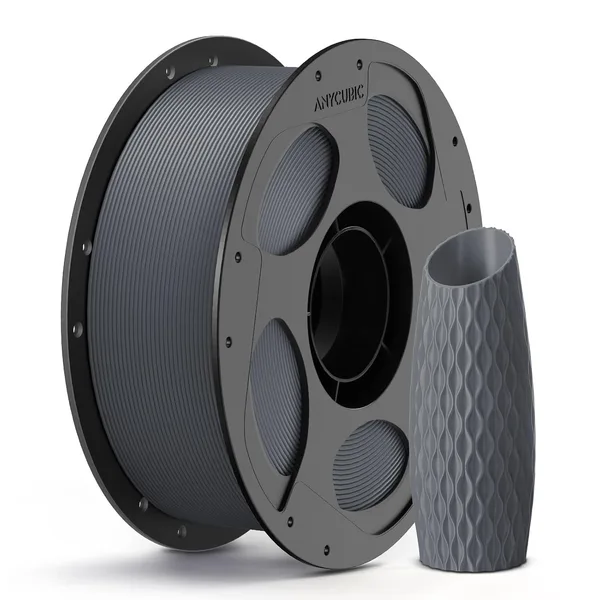
ANYCUBIC PLA is the obvious first candidate, since it's the "house brand" for the printer you already own. The logic checks out: if the manufacturer sells filament tuned for its own extrusion system, it should be dialed in for it. And that's partly true. I ran this filament on an Ender 3 (not even an ANYCUBIC machine, for what it's worth) and it printed almost without any fuss over temperature tuning — 200-210°C nozzle, 55-60°C bed, and that's it, off you go. No underextrusion surprises, no filament diameter wandering mid-spool, which happens more often than it should with cheaper no-name rolls off Aliexpress.
The claimed ±0.02mm accuracy isn't just a number for the spec sheet. In practice it shows up as less banding on vertical walls and more consistent extrusion line width, most noticeable on thin-walled parts like vases or enclosures. But honestly: most home printers can't physically extract that full accuracy anyway, because of slack in the mechanics, so for plenty of people the difference will be invisible. If you're running a stock budget Creality or an unmodded Anycubic Kobra, what you'll actually feel is batch consistency — fewer snapped strands, even winding — rather than micron-level precision.
What should you compare it against? Two honest benchmarks here. First is eSUN, the most popular "people's brand," which also prints decently but batches vary: one spool is flawless, the next is a bit more humid and starts popping little bubbles mid-print. ANYCUBIC is more consistent on that front, though not flawless either. The second benchmark is your local filament makers — the domestic brands sold near you, no customs clearance involved, with responsive support and fast delivery. And that's where the real question stops being about print quality and starts being about common sense.
Does ordering from abroad actually make sense
Listed prices on international offers for a single spool look tempting on the surface — filament is cheap per kilogram wherever you look. But filament is heavy and bulky: a one-kilogram spool of plastic costs almost as much to ship as the plastic itself, sometimes more, if it's a solo order. Once you add shipping, forwarding, and any import duty your country applies, the landed cost on a single spool often lands right around what a solid local PLA costs — arriving in two days, no tracking headaches for an international parcel, and no risk of the spool showing up crushed inside a flimsy cardboard mailer (which happens more often than anyone would like). You can check the exact landed price — item, forwarding, and duty combined — for your own country on dede.sh before deciding.
So here's my actual advice: ordering ANYCUBIC PLA as a standalone purchase is a dubious way to save money. But if you're already putting together an order with printer parts, electronics, or accessories, and the filament can ride along "for free" in the same package, then the shipping cost basically disappears and the math suddenly works. Especially if you need a specific color or a textured variant that your local shops just don't carry.
One more wrinkle on availability: at the time of writing, the US listing shows out of stock, while UK and German listings are live. That's normal for international marketplaces — inventory varies by region, so check the specific listing before ordering instead of trusting the first product card you land on.
Who should buy it, and who shouldn't
Buy it if: you already have an order coming from abroad and the spool can tag along; you need a specific color or textured finish that isn't sold locally; you want to test whether a printer's "house" filament genuinely performs better on that printer (spoiler: noticeably, but not dramatically). Skip it if: you just need PLA for everyday printing — a local spool will be cheaper and faster, with no customs risk or damaged-packaging lottery. The real trade-off here isn't about plastic quality — the filament itself is good. It's purely about shipping economics: whether the math works out if it travels alone.
FAQ
It's noticeable on thin walls and small detail work — less banding, more consistent line width. But on a budget, uncalibrated printer, you'll feel it more as batch consistency than as micron-level precision.
On raw print quality they're roughly neck and neck, both solid. ANYCUBIC tends to deliver more consistent batches, while eSUN can vary more spool to spool, but it's more widely available locally in a lot of markets.
Usually not — shipping heavy plastic eats up whatever you saved on price. It only makes sense if the filament rides along with another order in the same shipment.
Yes, it's standard 1.75mm PLA and prints fine on any FDM printer with a matching nozzle diameter. There's no lock-in to a specific printer brand.