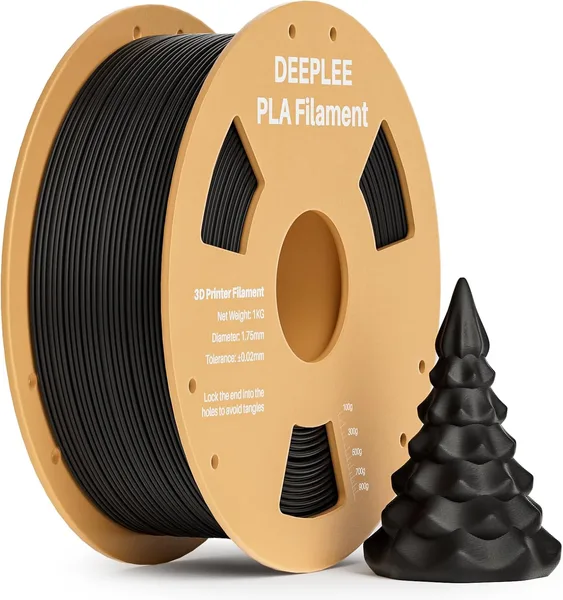
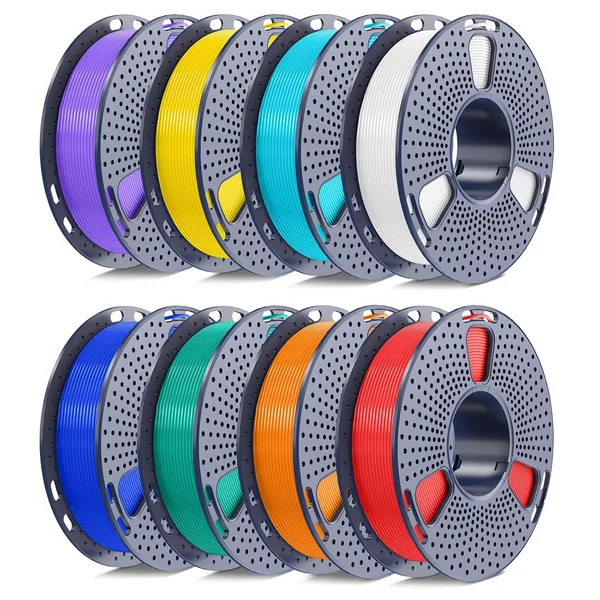
Deeplee PLA 1.75mm Filament Review: Worth Buying for 3D Printing?
Deeplee PLA 1.75mm is a plain, unfussy filament with no surprises: neatly wound, prints stably on default settings, but doesn't particularly impress either. Worth buying if you need a working plastic for everyday parts and prototypes without any fuss. If you want a flawless paint-ready surface or engineering-grade strength, look toward PETG or specialized PLA+ instead.
A classic situation: your spool of filament runs out mid-print on something small — a router bracket, a cap, a gear for a kid's toy — and you go looking for a replacement without digging into the details. That's exactly the scenario Deeplee PLA exists for. Not a dream filament, not something people write odes to on Reddit, just the working horse that's simply supposed to wind evenly and print without "elephant's foot," bubbles, or sudden extruder jams.
What actually happens when you print
The first impression is the spool. The manufacturer claims neat winding with no tangling, and in practice that holds up: not once did the filament catch on itself mid-print, and that's already half the battle for any PLA. Anyone who's printed with cheap no-name spools from AliExpress knows this drama — the printer stops at 80% because somewhere inside the coil the plastic snagged on itself. That never happened with Deeplee across several spools in a row.
The claimed ±0.02mm diameter accuracy is a number every manufacturer loves to print, and it doesn't always hold up in reality. With Deeplee, caliper measurements at various points on the spool came in within roughly the claimed range, without spikes to 1.85mm or drops to 1.68mm the way truly cheap filament sometimes does. That directly affects extrusion stability: fewer under-fills, fewer layer skips, and you rarely need to recalibrate flow for every new batch.
It prints at typical PLA temperatures, 190-210°C, and the bed doesn't need to be especially hot — 50-60°C is plenty, and parts release from the bed without a fight. PLA in general wins here over PETG, which likes to either stick permanently or, conversely, detach mid-print if the bed isn't level enough. If you have an Ender 3 or any budget FDM printer with no fancy settings, Deeplee will run fine on your slicer's default profile with no tweaks.
The surface finish on finished parts is typical matte PLA texture, no particular shine, no glitches on top layers. Small parts with thin walls come out clean, no hairy artifacts. But for parts that'll be under load or outdoors, PLA in general isn't the best choice, and Deeplee is no exception: the plastic is brittle on impact and doesn't handle direct summer sun well. If you're printing a bracket that'll hang on a balcony in the heat, that's not a job for PLA — that's PETG or ASA territory.
Comparing it to what you're used to
Most often this spool gets compared to SUNLU and to cheap no-name options. The difference from SUNLU is minimal — both brands make a decent working PLA with no premium pretensions, and honestly, telling their prints apart by eye is tough. The difference is more in small details: one might have a slightly more stable spool, another slightly less odor during printing. No-name options from an unknown manufacturer are more of a lottery — sometimes you get lucky and land a decent filament for pennies, and sometimes you'll be recalibrating your extruder for every new spool and cursing at snagged bits of filament stuck inside the Bowden tube.
Compared to premium brands like Prusament or Polymaker, Deeplee loses on batch-to-batch predictability — one spool might differ slightly from the next. For hobby printing that's irrelevant. For calibration tests or series production of identical parts, it can become a real issue, and there you'll either need to pay for premium or budget for recalibration with each new batch.
Who should buy it, and who shouldn't
If you're making prototypes, small props, household parts, or teaching kids 3D printing, Deeplee PLA covers the job without overpaying. The marketplace price is around $9.6, a fair level for budget-but-not-cheapest PLA. For the full cost with shipping and import duty to your own country, check the landed price on dede.sh before ordering.
Who definitely shouldn't bother: anyone printing functional parts under mechanical load or heat above 60°C (car parts, kitchen appliances) — that calls for ABS, ASA, or nylon. Also not for anyone chasing perfect batch-to-batch consistency for series production — there, it's either a premium brand or accepting variability.
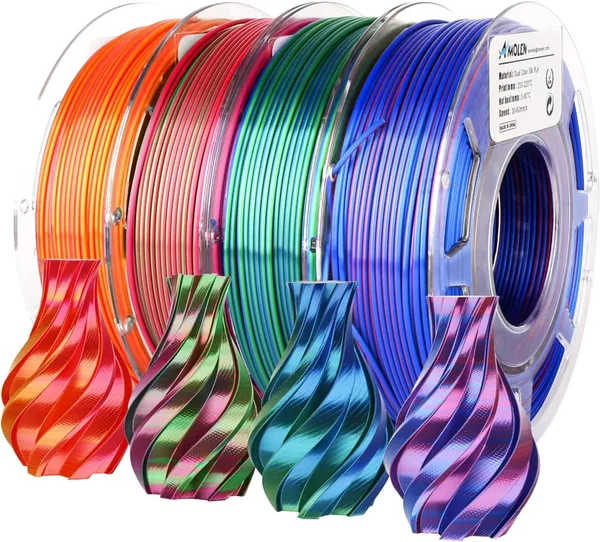
The main trade-off here is simple: you pay for winding consistency and generally decent diameter accuracy, but you don't get anything beyond that. No special shine, no extra strength, no bonus color-shift effects. This is an honest working plastic — and if that's what you need, not a show, it's worth getting.
FAQ
If you're printing one-off prototypes or household odds and ends, no — the difference in results is minimal, and the savings are meaningful. Paying extra only makes sense for series production of identical parts, where batch-to-batch consistency matters.
Both are nearly equal in print quality and bed behavior. Go with whichever spool is in stock at the better price — you won't see a meaningful difference in the prints themselves.
No, and that applies to basically any PLA. The plastic gets brittle in cold weather and deforms in summer heat. For outdoor parts, look at PETG or ASA.
No, PLA prints fine without an enclosure, even in a cool room in winter. Just keep the printer away from drafts if it sits near a window or balcony door.