Diveblues 3-in-1 Turbo Fan: Review—Should You Get It Instead of a Regular Fan?
Diveblues 3-in-1 is a small USB fan that you can hold in your hand, wear around your neck, or place on a desk, and it honestly delivers several hours on a single charge, though the advertised 12 hours is more "on the lowest speed and in theory." For a hot office without AC, a ride on a crowded minibus, or a summer shift on the balcony, it's a device that pays for itself in the first thirty-degree day. If you're looking for powerful air circulation across an entire desk, this isn't the tool for you—look at regular desktop fans instead.
July, a minibus, thirty-two degrees in the shade, and the AC is an urban myth passed by word of mouth like a legend. That's exactly when you understand why portable fans suddenly became summer must-haves instead of some AliExpress quirk. I tested one—Diveblues Portable Handheld Turbo Fan—for two weeks in three modes of use: in hand, around the neck, and on a desk. The impression is mixed, but mostly positive if you don't expect what it objectively can't deliver.
What this beast is and why "3-in-1"
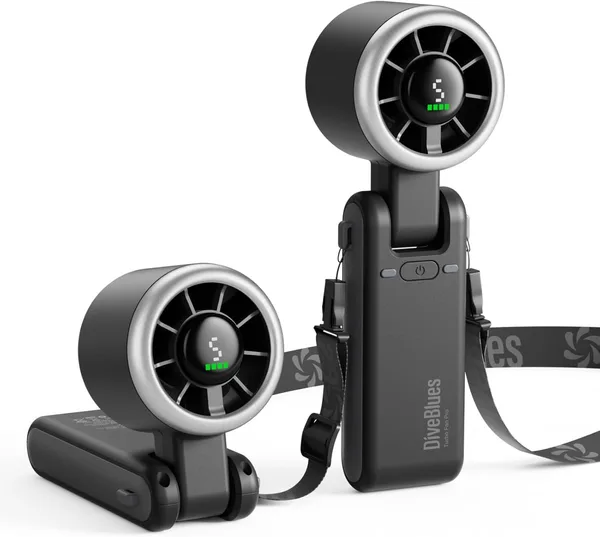
The idea is disarmingly simple: one box with blades that can be a handheld fan (hold it and blow on your face), a neck fan (hang it on your shoulders and it blows upward), or a desk fan (put it on a stand and it works as a mini-cooler on your work desk). Turbine design rather than classic blades—that's why the name has "turbo" in it: air gets forced through a narrow channel, so the stream is noticeably stronger than those flat "spinners" with two blades sold on every corner for pennies.
Charges from USB-C, like everything now, and this is where the first real advantage over old models appears: no need to carry a separate charging cable, the same one as your phone or headphones will work.
How it works in real life
Holding it in your hand is okay, but not for long. After fifteen to twenty minutes your arm gets tired—that's physics, not a manufacturer flaw. The Diveblues really shines in neck mode: hang it on your shoulders and air moves along your neck and face, leaving your hands free. Perfect for shopping, waiting in lines at the clinic, or walking with a stroller on a hot day—this is exactly the scenario for which such a device is worth buying.
Desktop mode is a nice bonus but not a replacement for a full fan. On a desk, it covers a zone roughly thirty by thirty centimeters, so if you have an open-plan office and your monitor is between you and the fan, there won't be much benefit. But for a small home desk, laptop, and the idea of "just want some air on my face while I work"—it works fine.
About the advertised 12 hours of runtime: honestly, that's a marketing figure for the weakest speed setting, when the fan barely stirs the air. On the medium speed you actually use in hot weather, I got closer to four to five hours of continuous operation—enough for a workday but not a full twenty-four hours without charging, as the packaging suggests. This isn't a lie, just the typical story that "up to 12 hours" means "in ideal laboratory conditions," not real usage.
Noise is present, and at top speed it's pretty noticeable—not white noise you can forget, but an audible turbine whine. At medium speed, it's completely tolerable, even in quiet spaces like libraries or offices.
What to compare it to
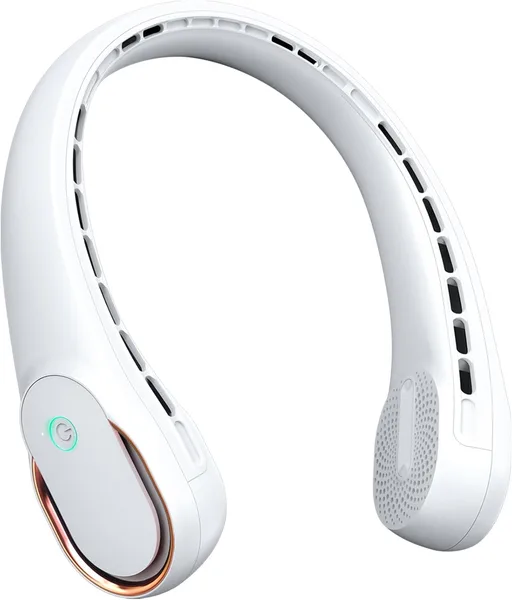
The obvious competitor in this niche is neck fans like FrSara: they focus purely on neck format without pretending to hand or desktop modes, and they're usually a bit more powerful in that one function because they don't try to be universal. Diveblues loses in specialization but wins in flexibility—if you're unsure which format you actually need and want to try one device in three roles before committing to something narrower.
Another camp is compact desktop coolers like EvaChill, which don't pretend to be portable in hand or around the neck, but give more stable and powerful airflow for one workspace, sometimes with humidification too. If a fan is needed purely for a desk and nowhere else, EvaChill-type solutions are stronger at that specific task.
Compared to old classic mini-fans with two open blades, Diveblues wins hands down—safer (closed turbine, won't suck in fingers or hair), and more powerful thanks to the design.
Who should buy and who shouldn't
Buy it if: you commute on public transport without AC, work or study in a place where summer means no air to breathe, spend time outdoors frequently in temperatures above thirty degrees, or want a gift that people actually use instead of a dust collector on a shelf. Versatility here is a plus, not a drawback: one device handles three situations at once.
Don't buy it if: you're looking for powerful air circulation across an entire room or office—then you need a proper desktop or floor fan, not a pocket turbine. Or if continuous 12-hour runtime without charging is critical—reality is a bit more modest, and it's better to know this upfront rather than learn it the hard way after your first day of use.
Price starts around $27-34 depending on the marketplace and ordering currency; with delivery to your country, the total is quite comparable to a midrange portable fan from a known brand in a local electronics store, only with the option to choose from several marketplaces for the best deal right now.
FAQ
On medium speed, which is what you actually use in heat, count on four to five hours, not the advertised 12. If you're planning a full day away from home, bring a power bank—that solves the problem completely.
If you need purely neck format and nothing more, a specialized model like FrSara is usually more powerful in that one role. Diveblues wins if you want one thing that works for three scenarios—hand, neck, desk—and aren't ready to buy separate gadgets for each.
You can, but keep in mind: the airflow zone is small, roughly thirty centimeters around it. Fine for a small home desk, but for a large open-plan office with a monitor in the way of airflow, you'll get little benefit.
Noticeably. At max, the turbine whines pretty clearly, and in a quiet room this is noticeable. Medium speed is the optimal balance between airflow and quiet for most situations.