ELEGOO Rapid PLA Plus 1.75mm Black Review: Worth It for Fast Printing?
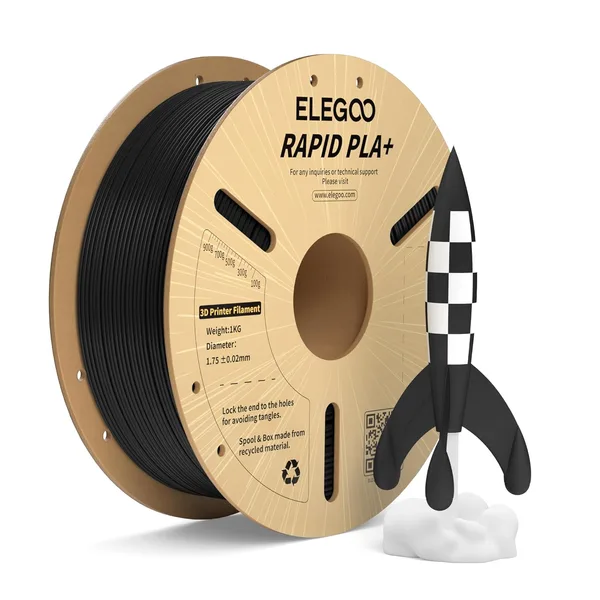
ELEGOO Rapid PLA Plus looks like an ordinary black PLA+, but it actually gets along with fast printers like the K1 or Neptune 4, without fraying into "hairy" corners or stringing the way cheaper filament does. For the price, it holds up reasonably well, though don't expect miracles — this is a workhorse filament, not a premium spool for display-shelf prints. Check the full landed price to your country — item, forwarding, and import duty in one number — on dede.sh.
The moment a spool says "rated for speeds up to 600 mm/s," the first instinct is to smirk and close the tab. Ninety percent of printers sitting in people's homes will never physically hit that number, and marketers love a big figure on the label. But after running ELEGOO Rapid PLA Plus on my K1 Max, I changed my mind — not because I'm actually pushing the printer to 600, but because this filament holds up well at any speed, including the 250-300 mm/s range where most modern CoreXY machines actually live day to day.
What changes when a filament is "built for speed"
Regular PLA+ starts showing its usual problems at high speed: under-extrusion on sharp corners, "hairy" top layers, and sometimes outright delamination if the printer can't cool a layer fast enough before the next pass lands on it. Rapid PLA Plus behaves differently — I ran test Benchy boats at 250 mm/s without touching my standard PLA profile, and there were no surprises. The surface stayed smooth, corners stayed crisp, and — most tellingly — none of that telltale crunching in the extruder that usually means the filament isn't melting evenly.
There's no real magic here, just a formula with a wider melt window tuned specifically for high-speed printing. In plain terms: the plastic is more forgiving if the printer slightly under-heats or under-cools it. For owners of Bambu Lab, Creality K1, or Anycubic Kobra 3 machines, this is exactly the situation where buying "regular" PLA stops making sense — you'd either have to slow down or live with defects.
Does it matter on a slow printer?
Honestly, not much. If you're running an old Ender 3 with no upgrades, printing at 60-80 mm/s, there's nothing to gain from paying extra for the "speed" formula — the result will be nearly indistinguishable from regular PLA+ from ELEGOO or any other brand. The difference shows up specifically when the printer can actually deliver high linear speed and acceleration and the filament becomes the bottleneck. On slow machines, the bottleneck is somewhere else entirely, and there's no point paying for potential you can't unlock.
Worth mentioning here: the real competitor to this kind of filament isn't really another brand — it's the same manufacturer's regular PLA+ without the "Rapid" label. The price gap is small, so if there's even a chance you'll upgrade your printer or flash Klipper with input shaping down the line, grabbing the fast version now makes more sense — the spool will run out either way, and it's better if it gets to prove its worth.
Print quality, color, and a bit of nerding out about adhesion
Black is about as practical a color choice as it gets — it hides small layer defects, shows up clearly on the bed, and doesn't get messy when rewinding or loading into a dryer. But black PLA often comes with one specific issue: pigment can make the plastic more brittle under tension. With Rapid PLA Plus, that's barely noticeable — thin-walled parts I printed (a few cable-management brackets) didn't crack under light flexing the way cheap unbranded "3D-printing ink" from random marketplace sellers tends to.
Bed adhesion is standard PLA+ territory — no surprises: a PEI plate, a swipe of glue stick just in case, and the first layer goes down flat. There is one catch, though: humidity. The spool arrives vacuum-sealed with silica gel, and that's not just a formality — ELEGOO's PLA+ noticeably degrades in print quality if you leave it exposed for a couple of weeks somewhere humid, like a warm summer indoors. Crackling in the extruder, tiny surface bubbles — straight out of the textbook. Keep it in a dryer, or at least a sealed container with silica gel, and the problem disappears.
Price, and whether it's worth ordering from abroad at all
The spool runs around 12 dollars on Amazon before shipping and duty. That's not the cheapest option out there, but it's not premium-priced either — for the actual bottom-line cost delivered to your door, including forwarding and import tax, check the landed price on dede.sh. For comparison, well-known PLA+ brands sold locally often cost more, while budget no-name spools, despite being cheaper, regularly suffer from inconsistent filament diameter that messes with extrusion. Diameter wasn't an issue here across the whole spool — I checked it with a micrometer at several points, and it stayed within the claimed 0.02 mm tolerance.
Who should buy it, and who should skip it
If you've got a fast printer and you're genuinely printing at 200+ mm/s on a regular basis, this is exactly the filament that lets you use that speed without quality trade-offs. If your printer is slow, or you print occasionally without any rush, paying extra for "Rapid" in the name buys you nothing — regular PLA+ will perform just as well and likely cost less. And one more thing: if you need a genuinely premium finish for display models or finely detailed miniatures, look toward specialized matte or silk filaments instead of a speed-oriented workhorse plastic.
FAQ
No. You'll notice the difference already at 150-200 mm/s — that's where regular PLA+ starts to "smear" on corners while Rapid holds its shape. The 600 mm/s on the label is more of an upper limit the filament was tested against, not a minimum speed you need to buy in for.
If your printer is fast, or you're planning an upgrade, go with Rapid. If you print slowly and infrequently, regular PLA+ will be cheaper and practically no worse in the results.
For a couple of large enclosures or a dozen small parts, yes. If you're planning something bigger, like a full printer housing or a batch of identical parts to sell, grab two spools at once — color can shift slightly between production batches.
Yes, arguably even more, because the dark pigment makes it harder to spot moisture on the filament surface by eye. A dryer or a sealed container with silica gel isn't a luxury here — it's a necessity, especially in summer.