ESR HaloLock MagSafe Car Charger Review: Is 15W Wireless Worth It?
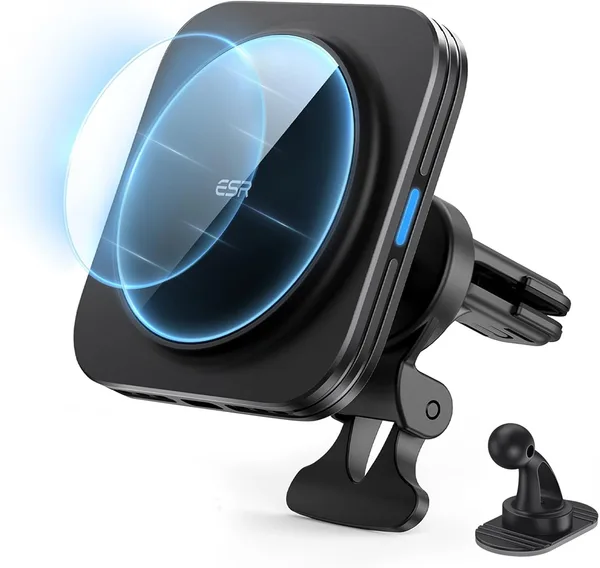
The ESR HaloLock is a magnetic mount with 15W wireless charging built in — it clips onto your vent or dash and charges an iPhone with zero cables to fumble for. If you've got an iPhone 12 or newer, it grips confidently and won't let go over potholes. If your phone doesn't do MagSafe, skip it and grab a plain wired mount instead.
I hate that moment when the light's about to turn green and you're still trying to jam your phone into the nav mount. One hand on the wheel, the other groping for the cradle, the cable tangled around the gearshift — sound familiar? I spent months with a basic clamp mount and a Lightning cable that twisted itself into knots and popped loose over the first pothole of the day. So when I put the ESR HaloLock MagSafe 15W in my car, my first thought was simply: finally.
Magnets do all the work here. Bring the phone near the vent — the mount itself clips onto the vent fins — and it snaps into place with a satisfying click, no aiming required, no "a little more to the left." That's the whole point of the MagSafe ecosystem: you stop having to line anything up.
There's a catch, though, and none of the marketing copy mentions it. The magnetic grip is rock solid — as long as the phone is light. A bare iPhone, no problem. But strap on a bulky wallet case, or worse, a battery-case brick, and the mount starts to sag under hard braking. On day two, my phone — in a thick case — slid clean off onto the passenger seat when I braked hard for a pedestrian. I swapped to a thinner, magnet-friendly case, and after that, two weeks of city and highway driving without a single slip.
HaloLock does hit its advertised 15W, but only with proper power behind it — plug it into a cheap 5W USB brick and you'll get exactly 5W, MagSafe branding notwithstanding. My car runs a 20W PD outlet, and the phone genuinely runs a touch cooler than it does on an equivalent wired charger, mostly because the heat sensors simply aren't sitting right on top of the coil. Over an hour's drive, a 40% battery climbs to roughly 75-80%, depending on how hard the nav app is working in the background.
Against a classic setup — a cheap clamp mount plus a Lightning or USB-C cable — HaloLock is obviously pricier, and it changes how you relate to the thing: you end up trusting a magnet more than the click of plastic jaws. I've run both Baseus and no-name magnetic mounts, and the difference in magnet strength is immediately obvious — ESR's pull is simply stronger, and the phone doesn't wobble over bumps. Compared with Apple's own MagSafe Car Mount, ESR is functionally near-identical but costs noticeably less, which is really the whole case for buying it instead of paying extra for the logo.
We're not going to quote a single price here, because it swings a lot from one country's marketplace and customs rules to the next — check dede.sh for the full landed cost to your country: item, forwarding, and import duty rolled into one number. It's not cheap next to a $7 clip mount, to be clear, and the gap is noticeable. But you're not paying for the plastic — you're paying to never fumble for a cable socket again.
There are really only two downsides, and both are real. First, compatibility: without a MagSafe case or a built-in magnet — which means iPhone 12 or later, or a separately bought metal plate for Android — the mount is just a shelf. Your phone will sit on it, not stick to it. Second, the vent-clip angle isn't always convenient if your dash has an unusual vent placement, low and out of your sightline. In my Skoda Octavia it fit perfectly; a friend with a Renault Duster had to reposition the clip twice before finding an angle that worked.
Who should buy it: iPhone owners with MagSafe who are done with wired mounts and want wireless charging without compromising on how fast it clicks into place. Who shouldn't: Android owners without a MagSafe adapter plate (paying extra makes no sense), and anyone who drives with their phone in a heavy wallet case — a plain mechanical clamp will serve you better there.
Frequently Asked Questions
FAQ
For keeping your battery topped up while running navigation and music, absolutely — it holds steady and even climbs. But it's not "fast charging" in the strict sense: you won't go from 10% to 80% in 20 minutes this way. For that you still need a wired PD charger at home or at the office.
On city potholes and speed bumps, yes, no complaints. On genuinely rough gravel with deep ruts, I wouldn't risk it, especially with a heavy case — either brace the phone yourself or switch to a classic clamp mount for that kind of drive.
If your Android phone doesn't have a built-in MagSafe magnet, HaloLock simply won't hold it securely without an added metal plate on the back. In that case, a regular mechanical mount with a solid clip and a USB-C cable will be both cheaper and more practical.
It warms up a little — that's just the physics of wireless power transfer, no way around it. In direct summer sun, it's worth shading the phone with a sun visor or a windshield screen; that applies to any wireless charger, not just this one.
![ANDERY Car Phone Holder for Magsafe [78+LBS Strongest Suction & 2400gf Magnetic] 360° Adjustable Car Phone Mount, Phone Holde](/img/products/andery-car-phone-holder-for-magsafe-78-lbs-1s1ylv/0-600.webp)