Meite 18 Gauge Brad Nails 1-1/4 Inches: Review, Worth Buying?
Meite 18GA—these are simple galvanized brad nails 1-1/4 inches for pneumatic nailers, and you should evaluate them exactly that way: not as a tool but as consumables. I had minimal jamming, the coating holds corrosion decently in dry interiors, and the price (significantly lower than what building markets sell under local brands) is compelling. Worth buying for those who already have a brad nailer for 18GA and do trim, molding, or furniture assembly regularly. For those who need 2-3 boxes once every five years—easier to buy at the nearest store.
Anyone who's ever installed trim by hand with a hammer and a nail set knows that feeling—by the tenth nail your hand is shaking and the wood still cracks near the edge. A brad nailer solves this problem in a second, but only if it has something to shoot. And that's where things get interesting: the gun itself is easy to buy once, but consumable nails run out constantly, and that's where people most often try to save badly—grab whatever's on the shelf and then wonder why the nailer keeps jamming.
I tested these meite nails on three real projects in a row: trim around doors, the back wall of a thin plywood bookshelf, and a couple of picture frames. Standard format—18 gauge, length 1-1/4 inches (roughly 32mm), galvanized coating against rust. Nothing exotic, and that's why this review isn't about innovation but whether these nails deliver on their promise.
How It Behaves on the Job
First thing that stands out—length calibration is stable. This sounds boring until you run into cheap batches where every tenth nail is a couple millimeters short or long and because of that either doesn't seat to proper depth or goes completely through the piece. Meite didn't have this through the whole box I shot through a pneumatic nailer. Jamming did happen, but rarely—I counted three cases out of several hundred shots, and all three were in places where the wood was harder than average, not due to bent nails themselves.
Galvanizing—it's not a cure-all. For indoor work—trim, furniture, decor—it's more than sufficient; the nail won't start rusting and leave stains on light wood. But if you're planning something on a balcony or in a garage where humidity is regular, better look at stainless steel—it's not here, and the manufacturer doesn't promise it.
The head on brad nails is minimal by design—they exist so the mark from them is barely visible and you don't need to putty every spot. Here everything meets expectations: after driving, you see a barely noticeable dot that's easy to cover or leave as-is on darker wood.
Comparison With What People Usually Take
The most obvious competitor—local brands from building megastores selling similar nails in boxes of 5000 at a price that after calculation isn't significantly cheaper than meite with shipping. The difference is that local batches more often "wander" in size—especially cheaper lines where quality control is cut. I've heard complaints from craftsman friends many times about exactly this: supposedly the same gauge, but then the nailer jams or drives too deep.
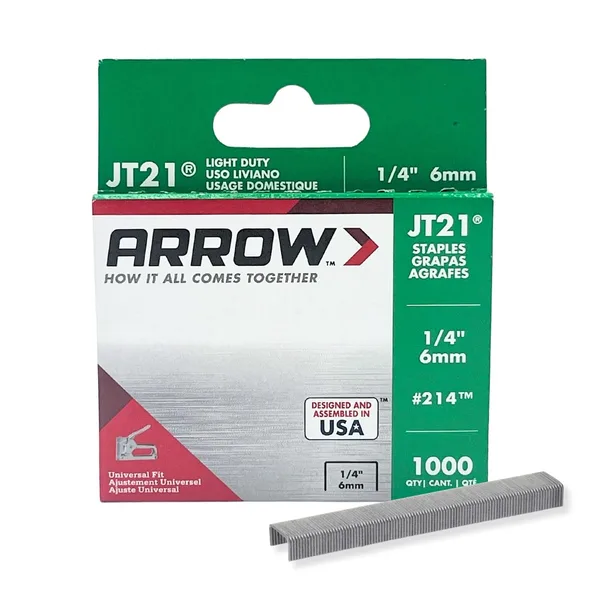
Another option—Arrow, also a popular brand in the fastener category, usually associated with staples for staplers rather than brad nails for nailers. If you have a stapler rather than a pneumatic nailer, look for that format of fastener—it's a different tool and different application logic, don't mix them up when choosing consumables.
Honest Summary
There's one compromise here, and it's the main one: these are just nails, no magic. If your nailer is picky about head size or wire diameter—which happens with some budget gun models—check compatibility before a big order, because returning an open box across borders is practically impossible. Second point—length is fixed at 1-1/4 inches, so this isn't a universal set for any material thickness, and if your project needs shorter or longer nails, you'll need a separate box.
But in short: for regular indoor woodworking and plywood assembly this is an honest working option without surprises, and it's specifically the calibration consistency—not the brand on the box—that you're paying for.
Who Should Buy, Who Should Skip
Buy if you already have a brad nailer 18GA and regularly install something—trim, molding, furniture backs, decorative strips. Then the savings on each box and consistent results add up to real difference over a year of work.
Don't buy if nails are needed one-time for one small project—easier and faster to grab a small box at your nearest hardware store than wait for international shipping for two hundred nails. Also skip if you're planning work in damp conditions—you need different coating, not regular galvanizing.
The full assortment of fasteners and related consumables can be browsed in the tools section—it's convenient to compare the full cost with shipping to your country there, not just the price on a store label.
Preguntas frecuentes
Mostly yes, 18 gauge standard is universal for most pneumatic and battery-powered brad nailers. But some budget guns are picky about magazine length, so check your tool's specs before ordering a large quantity.
For indoor work—yes, absolutely. For outdoors, garage, or balcony with humidity swings—no, stains might appear after a couple of seasons, and it's better to look for stainless steel.
If you need one small box for a one-time project—easier to get from a local store right now. If you work with wood regularly and are tired of inconsistent gauge in cheap batches, ordering pays for itself by the second or third project.
You can, but keep in mind 18GA is thin wire designed more for decorative and light fastening rather than load-bearing joints. For thick solid wood and loaded connections, look at wider gauge.