ANCEL AD310 OBD2 Scanner Review: Skip the Mechanic or Not?
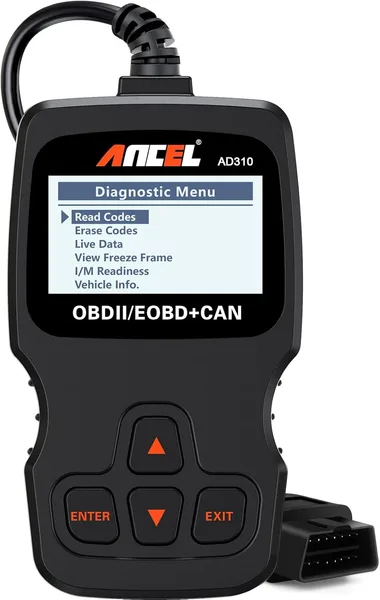
The ANCEL AD310 is a bare-bones OBD2 scanner that costs less than a single shop diagnostic: it reads and clears error codes, shows live sensor data, and does the one thing people actually buy it for — kills the Check Engine light once you've fixed the actual problem. It won't touch ABS, airbags, or transmission codes, and if your car is newer than roughly 2010, that's worth knowing before you click buy. But for what it costs — check the full landed price, item plus shipping plus duty, on dede.sh — it does exactly one job well: turns "panic" into "okay, we're fine, let's go."
The Check Engine light always picks the worst possible moment. Monday morning, a week before your inspection is due. Or halfway down a highway with the nearest garage forty kilometers away and closing at six. And there you are, wondering: is this actually serious, or is the oxygen sensor just being dramatic again? Paying a shop just to hear "your gas cap wasn't screwed on all the way" stings a little, if we're honest.
That's exactly the gap the ANCEL AD310 fills — a small box that plugs into the OBD2 port under your steering column and tells you, in seconds, why the light came on. It's not shop-grade diagnostics with an oscilloscope; it's a quick, honest gut-check that saves you nerves and a pointless trip to the mechanic.
What it actually does
Plug it in, turn the key to ignition, and a code pops up on the little monochrome screen — something like P0420 or P0171. The AD310 translates it into plain language right there: "catalyst efficiency below threshold" or "system too lean, bank 1." That alone is worth something, because a bare code is just letters and numbers you'd have to google anyway. Here the translation is built in, in English, no internet or phone required.
The second feature — the real reason people buy these things — is clearing the code and killing the light. Swapped the oxygen sensor, tightened the gas cap, cleaned the throttle body? Hit one button and Check Engine goes dark without a shop visit. For anyone who does even basic wrenching themselves, that solves two problems at once: no paying a technician to confirm what you already figured out, and no driving around with a light glaring at you every time you get behind the wheel.
There's also a live-data mode — RPM, coolant temperature, speed, real-time MAF readings. That's closer to "fun to poke around in" than serious diagnostics, but for basic monitoring — why is the car suddenly drinking more fuel, is idle actually stable — it does the job. And compared to pricier Autel or Launch units, everything here is simpler and more direct: fewer menus, less hunting through settings at midnight in the garage trying to find the one screen you need.
Where it stops
And there is a limit, one worth knowing before you buy, not after. The AD310 only talks to the engine — the powertrain module responsible for Check Engine codes. It can't see ABS, can't see airbags, doesn't read transmission codes on most vehicles, and it definitely won't show what a dealer-level scanner with access to every control unit can. If your ABS or SRS light is on, this thing just stays silent — it was never built for that job.
Second: the age and make of your car matters. OBD2 has been standardized since 1996 in the US and slightly later in Europe, so in theory the scanner works with almost any gas or diesel car built after 1996 (US) or 2001 (Europe). In practice, quirks in how different manufacturers implemented the protocol can sometimes produce odd codes or incomplete data, especially on older Asian-market vehicles. That's not an AD310-specific problem — any budget scanner runs into it — but keep it in mind if your car is a bit exotic.
And to be blunt: if you want deep diagnostics with graphs, data logging, and manufacturer-specific functions, the AD310 isn't that tool. This is a "know what's wrong so I can decide whether it's worth a shop visit" device, nothing more.
Who should buy it, who shouldn't
Buy it if you own a car (or two, or the whole family's fleet borrows it occasionally) and you're tired of paying for a five-minute diagnostic that ends with "eh, it's nothing." Buy it if you like understanding what's happening under the hood before trusting someone else with the repair — walking into a shop with a code already in hand makes negotiating a lot easier. And buy it, honestly, just for the peace of mind — being able to check the car yourself instead of driving blind every time the light flickers on.
Don't buy it if you're expecting full diagnostics across every system — that needs a pricier, multi-system tool. Don't buy it if your car is brand new and loaded with electronics and specialized control modules — a basic OBD2 reader will only show you the tip of that iceberg. And if you have no intention of dealing with codes yourself and you're heading straight to a mechanic anyway, it'll just sit in the glovebox.
Marketplace listings put it around the price of a fast-food meal — check the full landed cost for your country, item plus forwarding plus import duty, right here on dede.sh. It pays for itself the very first time the light comes on over something trivial.
FAQ
For reading and clearing Check Engine codes — yes, more than enough. For deep analysis with an oscilloscope or actuator-specific tests — no, that's the territory of pricier dealer-grade or semi-professional scanners.
If you like live graphs and a digital data log, yes, the difference is noticeable. If you just want to know the code and clear the light, the AD310's dedicated screen is arguably more convenient — no phone, no app, no dead battery on a cold night.
Autel reads more systems and offers a broader feature set, but costs several times more. For the everyday "check it and clear it" job, the AD310 covers everything you need, and the Autel premium only makes sense if you're diagnosing cars regularly, not just your own.
No, and that's the most common buyer mistake. The AD310 only sees the powertrain — ABS, airbags, and other systems are outside its reach.
Curious what else is worth keeping in the car for surprises like this? Take a look: