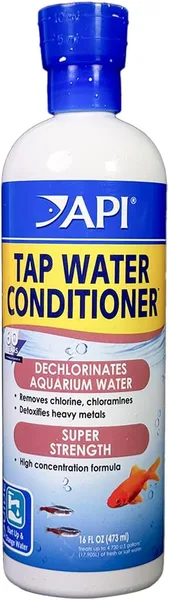
API Tap Water Conditioner Review: Is It Enough to Keep Your Fish Alive?
API Tap Water Conditioner strips chlorine, chloramine, and heavy metals out of tap water instantly — it's the baseline every fishkeeper needs. The 16 oz bottle lasts a long time, works fast, and has no smell, but the formula is simpler than Seachem Prime's — there's no ammonia detoxification here. For a normal home tank with a healthy filtration cycle, that's plenty, and it costs less.
The first fish I ever lost didn't die from disease or hunger. I just filled a bucket from the tap, let it "sit for a day," and figured that was enough. Chloramine — what most municipal water is treated with now — doesn't evaporate in a day the way plain chlorine does. It hangs around for days. That's when I first heard the phrase "water conditioner," which had sounded to me, up to that point, like a scam aimed at paranoid hobbyists.
Turns out it isn't. It's one of those things fishkeeping simply doesn't work without, no matter what the "mine's been fine for years" crowd on the forums says.
What it actually does
API Tap Water Conditioner is a liquid you add to water before pouring it into the tank during a water change. A few drops per gallon and chlorine and chloramine are neutralized in seconds, not the hour some competitors promise. One more thing that won me over: it also lays down a thin protective slime coat on the fish's gills and skin, which genuinely cuts stress during a rehoming or a big water change — exactly when fish are already on edge.
It works quietly, which is exactly what a good conditioner should do. No foam, no sharp chemical smell (unlike some cheaper knockoffs that reek like a public pool), and the water doesn't cloud up. You dose it, wait a minute, and it's ready to go in.
Where it genuinely saves you, and where it doesn't
If you're running a standard freshwater tank — 10 to 25 gallons, guppies, neons, even a few cichlids — one bottle will carry you through months of regular water changes and you'll basically forget it exists. Its biggest strength is speed, which makes it the go-to for emergencies: a pipe bursts, you need to swap out half the tank in a hurry, fish are stressed — you dose it, stir, and the water's safe within a minute.
Where I'd stop and think twice is a heavily stocked tank prone to ammonia or nitrite spikes. That's where the main competitor, Seachem Prime, genuinely pulls ahead: it doesn't just neutralize chlorine, it also temporarily detoxifies ammonia and nitrite, converting them to a less toxic form for 24-48 hours. API doesn't do that — it's a straight chlorine-and-chloramine conditioner, no extra "insurance policy" if your nitrogen cycle hiccups. If your tank is new and hasn't finished cycling, or you deal with ammonia spikes often, Seachem is the safer bet.
One more thing worth knowing: concentration. API is less concentrated than Prime, so you need more of it per gallon, and on a "cost per water change" basis it doesn't always come out ahead despite the cheaper bottle price. For a lot of people that's irrelevant. For someone running several large tanks with weekly changes, the difference adds up within a couple of months.
Versus doing it "the old way"
Plenty of people still just let water sit in a bucket for a day or two, and honestly, for plain chlorine that works fine. But chloramine, which more and more utilities use because it's more stable, doesn't just evaporate out with time. And a bucket is one more step in the routine — one more excuse to push the water change to tomorrow, then the day after. A conditioner removes that excuse entirely: fill, dose, pour in.
Compared to drinking-water filtration (reverse osmosis, carbon cartridges), a conditioner loses on water "purity," but wins on upfront cost and speed. Installing a whole filtration system just for a fish tank is a different scale of investment, and it's overkill for most home aquarists.
Who should buy it, and who shouldn't
Get it if: you run a standard home aquarium, you do regular water changes, and you want something reliable, cheap, and time-tested without extra bells and whistles. API is one of the oldest brands in aquarium chemistry, and the formula hasn't changed in years — because there's nothing that needs fixing.
Skip it if: you're running a cichlid tank or another setup with tricky biology where ammonia spikes regularly, or you just set up a new tank and are still cycling it — that's where Prime's detox properties actually save fish, not just a nice bonus to have.
As for what it'll actually cost you landed in your country — item price, forwarding, and any import duty all rolled into one number — check the full breakdown on dede.sh. Either way, it's not the kind of purchase that dents a budget. Buy it once and stop worrying about chlorinated water for a long while.
FAQ
For a 15-25 gallon tank with weekly water changes — easily a few months. How fast it goes depends on the volume of water you change, not the tank size itself: the more often and the more water you swap, the faster the bottle empties.
If your tank has been stable for a while with no ammonia issues, go with API — it's simpler and slightly cheaper per water change. If your tank is new, hasn't finished cycling, or you're running a heavily stocked setup, Prime's ammonia detoxification is worth the extra cost.
Don't overdose "just in case" — the manufacturer already builds in a margin for hard water, and there's no reason to exceed it without cause. That said, if you know your tap water specifically has chloramine rather than plain chlorine, lean toward the upper end of the recommended dose rather than the minimum.
Yes, the conditioner removes the same compounds that are harmful to invertebrates too. But if you're running a shrimp tank, you'll still want to track GH/KH separately — the conditioner doesn't regulate those.
Related products worth a look before you buy: