Diveblues Portable Turbo Fan: Should You Buy a Handheld Fan with 100 Speed Levels?
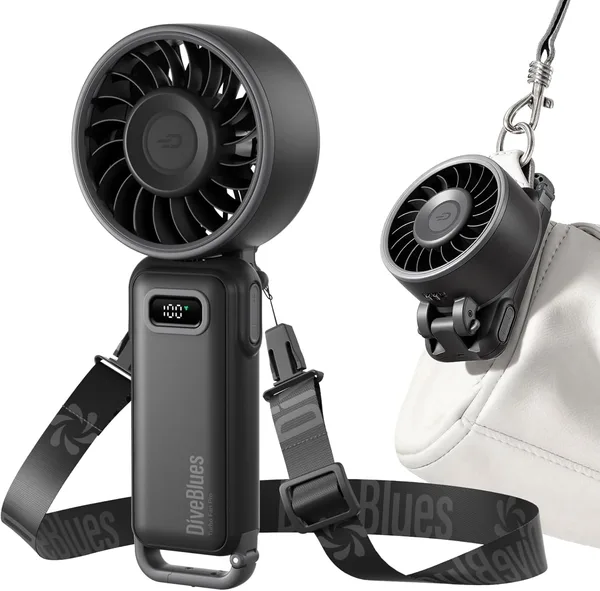
Diveblues Portable Turbo Fan is a small handheld fan with a turbine instead of regular blades and tons of speed settings. It blows hard, runs for several hours on battery, and packs down to the size of a thick USB stick. Get it if you really need to blow air on your face or dry something on the go; skip it if you want a quiet desktop thing for the office—the turbine whistles.
July, a minibus, +32 outside, the AC works somewhere in a parallel reality. Sound familiar? That's exactly when people start frantically searching "handheld fan I won't be embarrassed to pull out of my bag"—and usually land on something like Diveblues Portable Turbo Fan.
The idea isn't new—portable fans have been sold on every corner since 2018, when they boomed in Asia. But Diveblues went a different route: instead of classic blades, they use turbine construction, like a mini-engine. Sounds pretentious, but in practice it means one thing—the airflow is noticeably stronger than regular "three-blade" alternatives at the same price. Hold it right to your face and you realize: this is no longer that weak breeze from the three-dollar fan someone brought back from a business trip.
What actually happens when you hold it
They claim 100 speed levels—and yes, the dial is sensitive, turns smoothly, not in clicks between "quiet" and "hurricane." At the first 20-30% it's genuinely quiet, almost like something for the house, but at maximum it already has an audible turbine hum—uncomfortable to talk on video through it. This is the main compromise: want maximum airflow, prepare for sound like a hair dryer without heat.
The 4-in-1 here isn't a marketing trick for checkboxes. The fan really can stand on a desk (there's a stand), lie flat, be held as a handheld, and even work as a power bank for your phone—the battery is big, and Diveblues doesn't mind sharing the charge. This is that rare case where "4 in 1" doesn't mean "four half-baked functions in one body"—each mode actually works, though the stand wobbles a bit on uneven surfaces.
It packs compact—and that's the whole selling point compared to regular desktop fans like those sold under Honeywell or Vornado for home use. Those are more powerful and stable, but will never fit in a bag or even a big backpack pocket. Diveblues will fit anywhere, and that's why people take it to festivals, on business trips, to dorms where AC is a luxury, not an appliance.
Compared to classic "selfie fans" on batteries or mini-fans like JISULIFE—Diveblues wins on turbine power and speed levels. Loses on size: it's a bit bigger and heavier than the most compact keychain models, so it won't fit in jeans pockets, only a bag or backpack.
Battery and charging—no surprises, no miracles
On medium speed it lasts several hours of continuous use—really enough to survive a sweltering train ride from one city to another or a long warehouse shift without AC. On maximum turbine speed, the charge dies faster—physics, no getting around it, despite all 100 speed levels on the label. Charges via USB-C, which is already a plus—no need to drag around a separate micro-USB cable like older models.
Who it's for and who it's not
Get it if: you work or study where there's no AC, travel a lot in summer, like drying your hair fast without a blow dryer, or just hate the stuffiness in minibuses. Market vendors, couriers, construction workers, parents with babies in hot weather—this is your audience.
Don't get it if: you're looking for a quiet thing for your office desk where colleagues sit a meter away—the turbine at high speeds echoes through the room. Or if you expect the effect of a real room AC—physically, a small fan never cools a room, it only blows air on your face, and those are different things.
Price around $26 per unit on the marketplace, and with shipping to your country it comes to roughly $600+ depending on exchange rate and forwarder. Not spare change for a pocket fan, but not the kind of price you should agonize over if summer's already here and you never bought that AC.
Honestly: this isn't an industry revolution. It's a well-made version of something that's already existed in a thousand variations. But the turbine power and USB-C charging with "share power" cable—those details are why this specific model, not a nameless knockoff for five bucks, actually lasts a season instead of breaking in two weeks.
FAQ
If you're buying "for this summer and throw away," there's no point paying extra, any cheap one will work. But the turbine design really does give a stronger flow and lasts longer, so if you plan to use it for years, the price difference pays off.
Completely different categories. EvaChill is a stationary thing for your desk with cooling and humidifying effects, while Diveblues is mobile, for your pocket and travel. If you work at one desk all day—get EvaChill, if you're always moving—get Diveblues.
On minimum and medium speeds—totally realistic to stretch it to 5-6 hours with breaks. At maximum, the turbine eats the battery much faster, count on an hour to an hour and a half of continuous max-power use.
Yes, noticeably. On the first third of the scale—quiet, almost imperceptible. Closer to max it sounds like a compact hair dryer without heat, fine for outdoor space or street, but in a quiet office it'll draw attention.