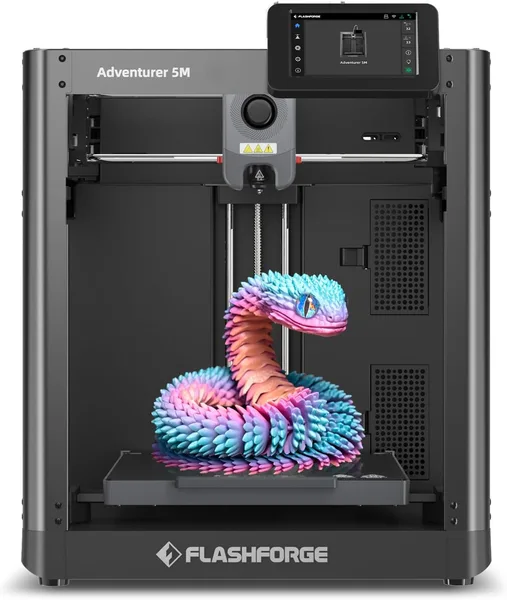
FlashForge Adventurer 5M Review: Is It Worth Buying?
The FlashForge Adventurer 5M is a printer you switch on, and it just gets to work: the bed calibrates itself, and ten minutes later you're printing. A claimed top speed of 600 mm/s sounds like marketing fluff, but in practice it genuinely cuts small-part print times by multiples. The trade-off is a closed enclosure with no heated chamber, so engineering plastics like ABS will fight you. For PLA, PETG, and fast prototyping, it's one of the best options in its price bracket.
Picture this: you order a replacement part for your coffee machine, wait two weeks for it to arrive from overseas, and it turns out to be the wrong size. Sound familiar? That's exactly why people buy a 3D printer for home — not to churn out keychains for fun, but to stop being at the mercy of someone else's warehouse and shipping schedule. The only question is which printer won't turn into an expensive hobby of endless recalibration and filament jams at 2 a.m.
The FlashForge Adventurer 5M tackles that problem head-on: automatic bed leveling, a closed enclosure, and print speeds that make older machines look like they're crawling. I ran it for several weeks straight, printing everyday small parts alongside deliberately tricky models with heavy overhangs — here's what I found.
Unboxing and first print — no drama
The big difference from budget printers in the Ender-clone family is that you don't spend an hour turning screws under the bed while squinting at a YouTube tutorial. The Adventurer 5M measures bed irregularities with a sensor and compensates for them in software. Power it on, give it a minute to calibrate, and you're already loading filament. For someone buying their first printer and worried they'll "never figure it out," that cuts the fear factor in half.
The closed enclosure isn't just cosmetic — it traps heat inside, cuts down on drafts from an AC unit or an open window (handy in summer), and quiets the noise. That matters in an apartment: a printer that whirs like a server fan gets old fast for anyone sharing the room, and this one stays fairly quiet even at top speed.
Speed isn't just a spec on the box — it's a real difference
A 600 mm/s top speed is, of course, a peak figure that rarely holds for an entire print. But even at a realistic 300-400 mm/s average, the difference versus a classic printer is something you can physically feel: what used to take three hours now takes an hour and a half. If you're prototyping against a deadline, or printing a part you needed yesterday, that's not a nice bonus — it's reason enough to buy this printer on its own.
There's a catch: at high speed, surface quality takes a small hit, especially on sharp corners and fine text details. Printing a display figure? Dial the speed down manually in your slicer and it snaps back into shape. Printing a shelf bracket? Crank it to the max and don't think twice.
Where it genuinely falls short
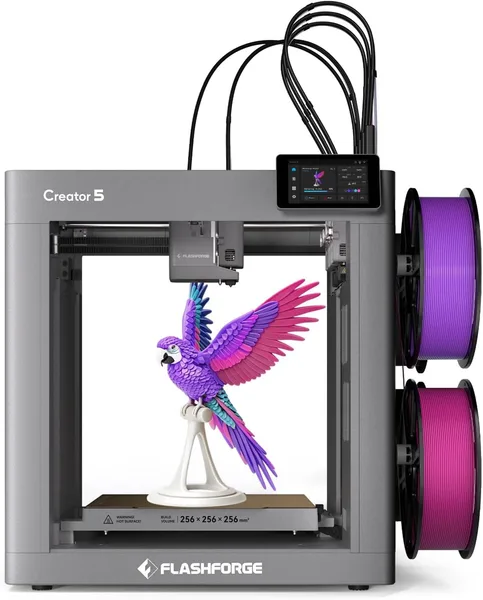
Let's be honest: a closed enclosure without active chamber heating isn't the printer for churning out ABS or polycarbonate parts at volume. Plastic will warp on larger flat surfaces, especially in a cold room in winter. If your main goal is engineering-grade parts in heat-resistant materials, look toward printers with a heated chamber, like the FlashForge Creator 5 — it adds multi-material capability and a completely different level of temperature control, at a correspondingly higher price.
For PLA and PETG — which covers 90% of what a home user actually prints: organizers, brackets, spare parts, prototypes — the Adventurer 5M is right in its element.
Who should buy it, and who shouldn't
If you want a printer that just works out of the box, without wrestling a calibrated bed into submission, and you're mostly printing PLA/PETG and care about speed — buy it without a second thought. The FlashForge Adventurer 5M sells for roughly $210 before shipping and duties — check dede.sh for the full landed cost to your country, item plus forwarding plus import duty in one number — and at that price, auto-leveling combined with this kind of speed is genuinely rare.
If you're planning to get serious about engineering plastics, or want a printer to "grow into" for multi-color printing, this isn't your machine — go straight for something with a heated chamber, because otherwise you'll be itching to upgrade later, and that's money wasted twice over.
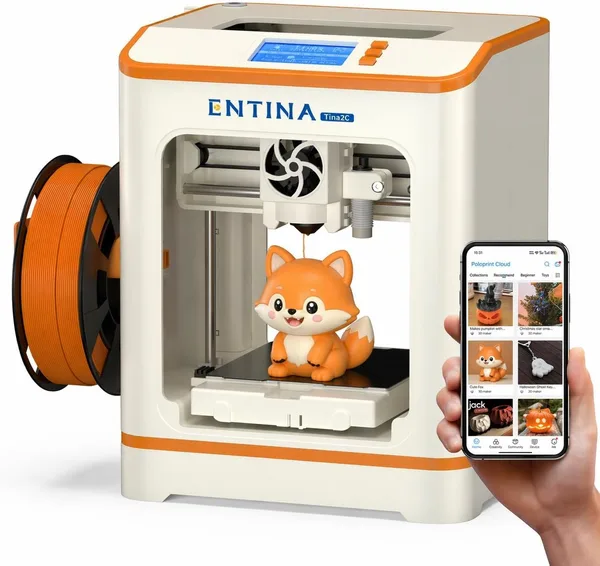
And if you're a total beginner unsure whether this hobby will even stick, consider starting with something simpler and cheaper like the Entina Tina2C, to find out if it's for you before committing to a speed-focused machine.
FAQ
If you're printing something small once a month, the premium won't feel like much of a premium — the price gap versus slower models is small. But if you plan to print regularly, that speed quickly becomes something you thank yourself for every single day.
It works, and that's not an exaggeration. The difference versus manual leveling is immediately obvious — no more chasing that perfect level every time you move the printer or swap a nozzle. The one caveat: check the bed manually every few months anyway, since the sensor can't always tell dirt or plastic residue from an actual bump.
If your budget allows it and you're confident you'll print regularly, get the Adventurer 5M — its auto-tuning forgives more mistakes. If you're not sure the hobby will survive past the first month, start with something cheaper, like the Entina Tina2C.
Occasionally, yes, for small parts. But for regular ABS printing — or other heat-resistant plastics — without active chamber heating, warping will be an issue, especially on larger models. For that, look toward printers with a heated chamber instead.