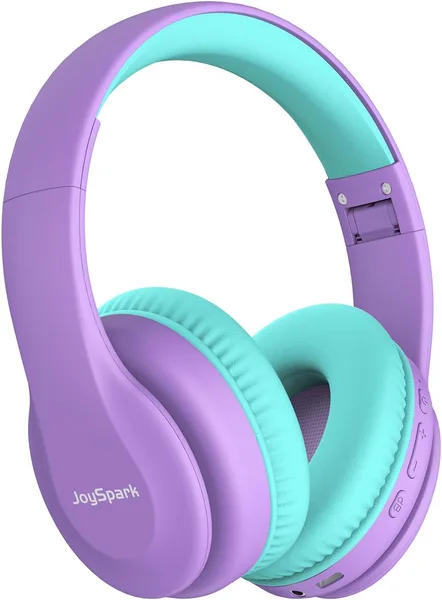
JoySpark Kids Bluetooth Headphones: are they worth buying for your kid
JoySpark Kids are simple, cheap Bluetooth headphones for children with a hardware volume cap at 85/94 dB. Sound quality is average, but they're safe for young ears and you won't lose sleep if they go missing at school. Get them as a workhorse for online classes and car rides — not as a gift for a music-obsessed ten-year-old.
Your kid cranks the volume all the way up and yells "I can't hear it!", and you're mentally counting how many decibels just hit their eardrums. Sound familiar? If so, you're already the target audience for this review.
Handing kids adult headphones is a bad idea for two reasons. First, they're physically too big and pinch. Second, there's no volume ceiling, and children's hearing is more sensitive to loud audio than most parents realize. That's why an entire category of "kids' Bluetooth headphones" exists — and JoySpark Kids sits squarely in it.
What this actually is
This isn't an audiophile product, and pretending otherwise would be dishonest. The plastic is light, the headband is soft and adjustable to fit a small head — anything from a preschooler to a young elementary-schooler will find a comfortable fit. The main feature is a volume switch with two settings: 85 and 94 dB. That's not a marketing gimmick — 85 dB is the threshold pediatric audiologists consider safe for extended listening, and 94 dB is the upper "okay, but not for long" limit. In practice, no matter how hard your kid cranks the volume on their tablet, the headphones physically won't let the sound get loud enough to hurt.
As for sound — this isn't a story about deep bass or a wide soundstage. Mids come through decently, voices in cartoons and podcasts sound clear, but anything with real low-end gets flattened. Honestly, for audiobooks, school video lessons, and cartoons on a tablet, that's more than enough. For a music-obsessed preteen, though — no, you'll want to look at something more serious.
The Bluetooth connection holds steady across a typical apartment, and pairing with a tablet or phone takes about ten seconds, no fuss. Battery life isn't a record-breaker, but it easily covers a full day of typical use — the commute to school, homework, an evening cartoon.
Where they actually earn their keep
The most common scenario is an online class or a video call with a teacher while two other kids and a TV are going in the same room. Here, any headphones beat no headphones, and a lightweight kids' pair you won't mourn if it gets dropped or chewed by the dog is exactly the right call. Second scenario: a long car ride or train trip — kid watching cartoons, parents enjoying the silence, everybody wins. Third: school, where headphones routinely get lost, broken, or sat on. Buying a premium pair for that environment is a bit like driving a first-grader to school in a luxury sedan — technically possible, but why bother.
Compared to what a lot of parents default to — handing down old adult headphones wrapped in tape — JoySpark wins on three counts at once: the volume limit, the kid-sized fit, and the fact that losing a $15 pair doesn't sting.
The honest downsides
The microphone is there in name only — calls and voice chats sound muffled, so if your kid needs something more capable for interactive lessons with live back-and-forth, look a tier up. Build quality isn't premium either: the hinges are plastic, and if your kid likes spinning the headphones around like a yo-yo, expect them to get wobbly within a year or two. This isn't something built to last for years or grow with the child — it's a consumable that does its modest job at a modest price and then retires gracefully.
Verdict
Buy these if you want simple, safe, affordable everyday headphones for a kid aged 4 to 10 — school, commutes, cartoons, audiobooks. Skip them if you're shopping for a teenager who's into music and wants something that looks the part — that's a different category entirely, and you'll both be disappointed. For the actual price plus shipping and import duty to your country, check the full landed cost breakdown on dede.sh — it's still solidly a budget buy, not a status purchase.
FAQ
Yes, it's not a number pulled out of thin air for marketing. 85 dB is the level audiologists consider safe for extended listening, and 94 dB is "fine, but not for long." A hardware limit built into the headphones means your kid physically can't push the volume higher, no matter how far they crank the slider on their phone.
For a child under 10, JoySpark — the size, the volume cap, and the price are all built for that job. Adult models like Skullcandy or Sony are designed for different ears, different heads, and a different tolerance for loss if they vanish into a school backpack.
For listening, yes — the teacher's voice comes through clearly. But the microphone is weak, so if your kid is actively speaking up on video calls or joining interactive sessions, it's worth considering a model with a proper boom mic.
Expect a year or two of active daily use out of these — think of them as a consumable, not an investment that grows with your child. A careful kid, and headphones that avoid the dog and the car seat, will get more mileage. Paying up for a premium pair really only makes sense once sound quality starts to matter to the kid using them, like with a teenager.
Similar options in the same category, if you want to compare: