Acer USB-C Kids Headphones with volume limit: are they worth buying for your kid
Cheap wired headphones with a hardware volume cap (85 dB by default, up to 94 dB in a "boost" mode) and USB-C instead of the old 3.5mm jack, for devices that actually need it. Not for audiophiles, not for adults — a strictly kid-focused tool for "stop them from blasting their ears during online class." For the price, it's an honest buy if your child's device genuinely needs USB-C rather than Lightning or a mini-jack.
You know the scene: your kid's got headphones cranked to max, you're yelling something from the kitchen, and the response is silence — because they simply can't hear you. Sound familiar? That's exactly the scenario kids' volume-limited headphones were built for. Not because manufacturers suddenly grew a conscience, but because pediatricians and parents have spent years complaining about how many children show up with ringing ears after hours of headphones maxed out.
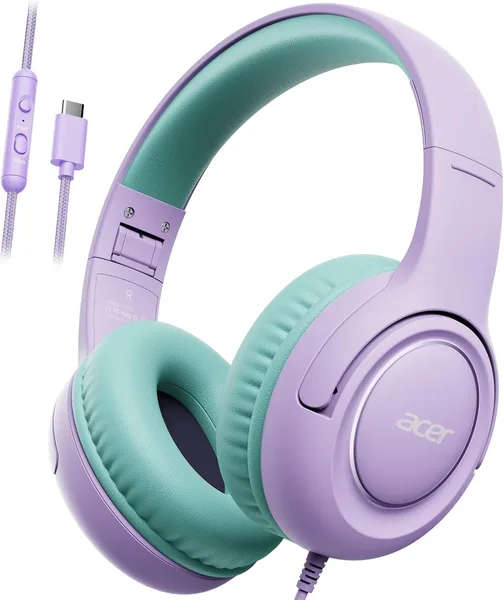
Acer USB-C Kids Headphones are exactly that kind of product: wired over-ear headphones with a hardware cap at 85 decibels (switchable to 94 for older kids who genuinely need more volume), a folding design that fits in a backpack, and USB-C instead of the usual 3.5mm mini-jack. That last part, by the way, is both the main selling point and the main trap — more on that below.
What's actually going on here
The volume limiter isn't a software toggle you can just override by cranking the volume on a tablet. It's a hardware restriction built into the USB-C adapter cable itself, so even if your kid maxes out the volume slider on a laptop during remote class, the sound physically can't go past the ceiling that's been set. If you've ever bought a kid regular headphones "to grow into" and then spent months hearing from the teacher that your child keeps asking people to repeat themselves — this is the actual reason to buy a purpose-built kids model instead of manually turning the volume down and hoping they won't just crank it back up five minutes later.
USB-C here isn't a whim — it's a direct consequence of laptop and tablet makers (including some school-issued Chromebooks) phasing out the 3.5mm jack entirely over the past several years. If your kid's main device at school or home is something with only USB-C, a regular wired "analog" headset simply won't plug in without an adapter, and adapters for kids are the kind of thing that goes missing faster than the headphones themselves. So if the tablet or laptop in your house has no mini-jack, this is essentially the only way to give your child wired headphones without a workaround.
On the flip side, if your kid's main device is an older iPad with a standard jack, or a phone with a 3.5mm port, these headphones simply won't physically fit without a separate USB-C-to-jack adapter, and there's no reason to buy them. Check the port on your child's device before ordering — it takes ten seconds and saves you a return.
The folding design is a nice, if unremarkable, bonus: the headphones fold flat and fit into a backpack side pocket without crushing the headband or rubbing against everything else in there. For adults that's a non-issue; for parents who fish kids' gear out of the bottom of a backpack every evening, it's a real reduction in aggravation.
The sound quality — and I'll say this plainly — is mediocre. This isn't a device to look at if you want something for music or movies with decent bass. It was never meant to be: the one job here is capping volume so a kid doesn't damage their hearing at a desk, not building a home theater. Comparing it to adult headphones, like the ones in dede.sh's headphones catalog premium segment, isn't really fair — it's a different weight class entirely, aimed at a different audience.
Who should buy these, and who shouldn't
Buy them if: your child is roughly 4 to 10-12 years old, their main device is a laptop or tablet with USB-C, and you want a genuine hardware volume cap rather than a "please don't turn it up" agreement. This is especially relevant for remote learning, when a kid spends hours in headphones on video calls and you can't monitor the volume knob every minute.
Skip them if: your kid needs decent sound for music or gaming (adult headphones with software-limited volume are the better call there), the device only has a mini-jack, or your child is already a teenager who cares more about looking cool than having a safe volume cap — teenagers, frankly, often just refuse to wear this kind of thing on principle.
There's one obvious trade-off here: you're paying for a limitation, not for sound quality. These are headphones bought for what they don't do, not for what they do. A second, less obvious one: it's a wired design, which means a cable that tangles, gets yanked, and eventually frays where it meets the earcup — the standard fate of kids' wired headphones regardless of brand.
The price doesn't bite too hard — the base listing runs around $16. Check dede.sh for the full landed price to your country, item plus forwarding plus import duty rolled into one number, across a few sellers. Honestly, for a kids' accessory that will probably survive being sat on exactly once, that's a reasonable range — don't expect premium build quality at this price, and don't pay double for a brand name for the same volume limiter.
שאלות נפוצות
The 85 dB hardware cap sits below the threshold the WHO considers safe for prolonged listening. It's not magic and it's no guarantee your kid won't perceive the sound as loud, but the volume physically cannot go past that ceiling — unlike a "just don't turn it up" agreement.
The boost mode is meant for noisy environments like a bus or a plane, where without it a kid wouldn't hear anything and would start reaching for the volume they're not supposed to touch. Using it constantly isn't a great idea — it's edging closer to the discomfort threshold for extended listening.
It depends entirely on your child's device. There's no universally "better" option — check which port the laptop or tablet they actually use every day has, and buy for that, not the other way around.
For classes and audiobooks, absolutely — the sound is clear and intelligible. For movies and music, it's a "just barely passes" situation, the bass is flat, and if sound quality matters more to your kid than volume safety, look at regular kids' headphones without a limiter, or adult headphones once they're older.