adidas FIFA World Cup 26 Trionda review: is the official match ball worth buying now
Trionda is the official match ball of the 2026 World Cup, and for some buyers that alone is reason enough to close the tab and hit "buy." Strip away the emotion, though, and here's the honest picture: it's a genuinely excellent, precise, good-looking ball for anyone who plays seriously or collects, and an unnecessary splurge for anyone who just kicks it around with friends on weekends. It earns its price tag — the real question is whether you actually need the official match ball rather than a replica at half the cost.
The 2026 World Cup is still months away, and the ball is already on shelves — which, if you think about it, is a bit of an odd situation. Official match balls for major tournaments usually show up a few months before kickoff, and about half the people buying one aren't planning to play with it at all — they're keeping it boxed as a collector's piece. Trionda is following the same script: some buyers want to actually put it through its paces on the pitch before it becomes "the ball of this World Cup," others want the genuine article on a shelf for when the tournament ends and prices for it jump.
What this ball actually is
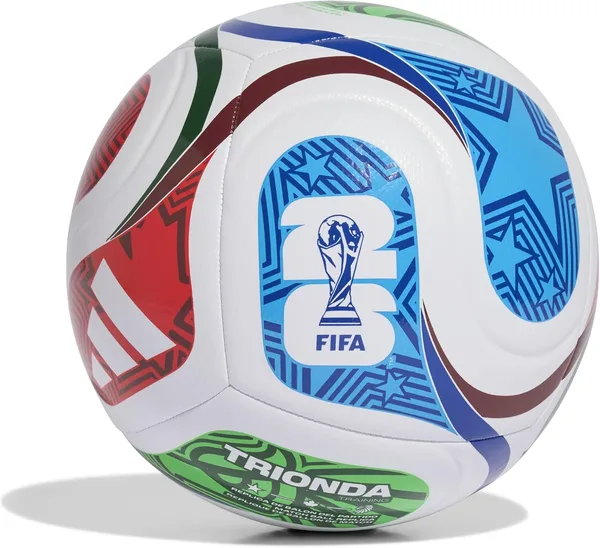
The adidas FIFA World Cup 26 Trionda isn't just another round toy with a tournament logo slapped on it. adidas has been making official World Cup balls since 1970, and that decades-long track record shows the moment you pick one up. The panels are thermally bonded rather than stitched the way budget balls are, which gives a more predictable, truer flight path and less wobble on a hard strike. Anyone who's ever played with a worn-out ball from a street stall that flies wherever it wants will feel the difference in the first five minutes.
The Trionda's design deserves its own paragraph. adidas puts as much into the aesthetics of a tournament ball as it does into the engineering, and this year is no exception: bold graphics that read clearly even on a mediocre broadcast feed, and a color scheme drawn from the host nations — the US, Canada, and Mexico. This isn't a ball that vanishes into the grass on a dull green pitch. You can actually see it.
Where it earns its keep, and where it's just marketing
The question worth asking yourself: are you playing soccer, or are you playing "owning the same ball as the national team"? If it's the former, the Trionda genuinely feels different underfoot compared to an $8-10 ball from the nearest sporting goods store. Passes are more accurate, the ball deforms less on impact and snaps back to shape faster, and the bounce is more predictable on a flat surface. For training, competitive amateur matches on real grass, or even good-quality turf, it's a noticeable upgrade.
On asphalt or a gravel lot, though, all that engineering is wasted effort. The thermal bonding adidas is so proud of wears down from friction against asphalt exactly like any other ball — it just costs several times more to wear out. If your "home stadium" is a courtyard with curbstones for goalposts, you'll be better off, and more honest with yourself, grabbing something simpler from the sports and outdoor catalog instead of putting a premium ball through punishment it was never built for.
Compared to its predecessors — Al Rihla from Qatar, or Oceaunz from the last Women's World Cup — the Trionda continues the same trajectory: lighter, more aerodynamic, built for the fast modern game with long passes rather than tight low-ball control. Old-school players who like a heavier, slower ball might find it takes some getting used to in the first couple of games. You adjust fast, but that first half can catch you off guard.
Who should buy it, and who should skip it
If you play regularly — in an amateur league, at youth training sessions, or you simply care about gear quality — buy it without hesitation. The difference on the pitch is real, and it's not the kind of purchase that will hurt your wallet; check the full landed price for your country right on the product page before ordering, since it bundles the item, shipping, and any import duty into one number. Collectors and fans who want the genuine article from this specific tournament shouldn't overthink it either — balls like this only get more expensive once the World Cup wraps up.
But if what you actually need is just "a ball for the yard" for the kids or for the occasional kickabout, this is a clear overpay. Get something simpler — it'll survive longer on asphalt and cost a fraction of the price. The other real catch: the Trionda's size and inflation are built to adult match-ball standards (size 5), so for younger kids you'll want to look at smaller sizes separately — this isn't the "grows with them" universal option.
Honestly, the biggest pitfall isn't the ball itself, it's buyer expectations. Some people buy a Trionda hoping for a miracle and get, instead, a very well-made soccer ball. No miracle needed here — just solid engineering refined over decades, which is exactly what adidas delivers.
The bottom line
The Trionda isn't trying to be everything to everyone. It's a targeted product for people who either play seriously or want the genuine tournament ball before the whole world starts talking about it. It earns its price honestly — but only if you actually use it the way it's meant to be used, not booting it around gravel outside your building.
שאלות נפוצות
Yes, and you'll feel it on the first few touches — more accurate flight, better bounce, a shape that holds up better under impact. But that difference only shows up on decent surfaces: grass, quality turf, indoor courts. On asphalt the advantages blur together, and it wears out just as fast as a budget ball would.
If soccer is just a weekly hobby with friends, the extra cost isn't justified — any decent cheaper ball will do the job. But if you genuinely love the game and can feel the difference in gear, then yes, it's worth it.
Historically, official balls for major tournaments get pricier and harder to find right before kickoff, and especially after the competition ends and production stops. Buying early is really about saving money, not overpaying.
By size and weight, this is an adult, size-5 match ball. For younger kids, you'll want to look at smaller balls separately — this one will feel heavy and oversized for a comfortable game.
Related products worth a look before you buy: