Amazon Basics Air Circulator Desk Fan review: is this compact fan worth it?
A compact desk fan for a single workstation or room corner — it does the job, tilts 90°, has three speeds, and nothing extra. But at the asking price you can get something far more powerful, or a full tower fan with a remote. Only worth buying on sale or if compact size and the Amazon brand are non-negotiable.
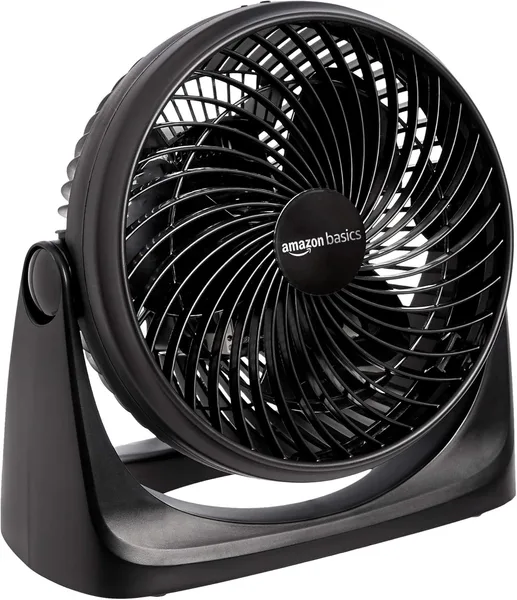
It's July, 90°F outside, no AC (or you have one but you're rationing electricity thanks to rates or rolling blackouts), and you're parked at your laptop like a boiled potato. Sound familiar? That's exactly the evening desk fans were made for — small, quiet, zero windowsill real estate. The Amazon Basics Air Circulator Desk Fan sits squarely in that category: not a towering monolith, not a three-blade floor behemoth the size of a dinner plate, just a modest box you park next to your monitor and forget about the heat, at least locally.
What this thing actually is
The word "circulator" in the name is a little misleading — this isn't the cult-favorite Vornado with its signature vortex airflow that tears across the room and mixes everything in its path. It's a simpler cousin: compact body, three speeds, head tilts 90 degrees up and down, and that's it. No remote, no timer, no horizontal oscillation — only the blade assembly spins, while the whole fan "stares" in one direction until you manually swivel the base.
That's fine for a desktop form factor — you're already sitting at a fixed angle to it, so why does it need to scan the whole room? The lack of horizontal rotation can grate, though, if your desk is wide and you shift from left to right.
Three speeds is exactly what a desk fan needs: first barely ruffles your hair, second is a comfortable working breeze, third is for when it's genuinely scorching and you stop caring about noise. And noise, by the way, is present — this isn't a bladeless Dyson that hums like a fridge. It's a regular little motor, audible, especially on speed three. For sleeping next to the bed that can be a minus if you're sound-sensitive, though plenty of people actually find that white noise helps them drift off.
Where it actually belongs
I'd honestly split the audience into two camps. Group one: people at desks. Writing code, drawing, building a deck, and you need a focused stream of cool air on your face and hands, not to air-condition the entire room. Here a small desk fan beats a tower simply by being close and precise. Group two: nightstand duty. Works there too, provided you tilt it at the right angle and remember it only pivots vertically.
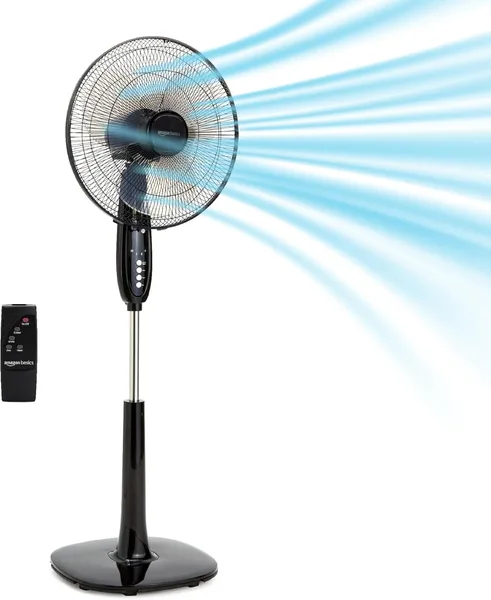
But if you've got a 200+ sq ft room and want air moving through the whole space — this isn't the tool. For that, look at tower models or classic floor fans with tilt and oscillation, like the older sibling Amazon Basics Air Circulator Desk Fan — the pedestal version on a stand with a remote, sold under the same brand.
Price — and here's where the conversation starts
Sellers are asking around $140 for it. Honestly, I paused when I saw that number. Basic desk fans are a category where $20–30 in the US gets you a perfectly decent no-name option, and $40–50 lands you a Honeywell TurboForce with a remote and oscillation. At $140 you expect either serious muscle or smart features — app connectivity, stepless speed control, whisper-quiet operation like premium models. None of that is here. It's a plain mechanical fan with a three-position toggle.
Maybe the price is temporarily inflated by demand swings or a stale listing — that happens on marketplaces. But if you're seeing that price tag, my advice is simple: wait for a sale or check alternatives in the same tier. Factoring in shipping to your country and import fees, the landed cost only climbs higher, and at that point "why not just buy locally" becomes a very fair question.
What's actually good, what isn't
The pros are real, if modest: compact, simple (nothing to break — three switch positions isn't electronics), stable head tilt that holds and doesn't sag over time like cheap Chinese clones. The cons are equally visible: audible operation, no remote or timer, limited rotation angle, and the big one — a price that doesn't match the feature set. For this money, competitors offer significantly more.
Frankly, I'd only recommend this fan in one scenario: when it shows up on sale at a genuine "desk fan" price, somewhere around $25–35. Then it's an honest work tool with no pretensions. At full price — no, there are far better ways to spend it.
שאלות נפוצות
No. It's a spot-cooling, desktop form factor — blows on a specific spot at your desk or bed, not the whole room. For 150+ sq ft spaces, look at tower or floor models with oscillation.
Nope. All control is a mechanical toggle on the body with three positions. If a remote is a must, look at step-up models or tower fans from the same brand.
At the current price — no, not much sense. Amazon Basics usually wins by being cheaper at decent build quality, but when the price jumps to premium territory, the brand advantage evaporates.
Not the quietest. On low it's perfectly acceptable; on high you hear a distinct motor drone. If you're sound-sensitive at night, test on the lowest speed or look for models with a dedicated silent "night" mode.
Similar products worth a look before you buy:
![Aecooly Slim Portable Fan, Thin Handheld Fan, USB Rechargeable Mini Personal [24H Max Cooling Time], Battery Powered Small Fo](/img/products/aecooly-slim-portable-fan-thin-handheld-fan-usb-fcn4j5/0-600.webp)