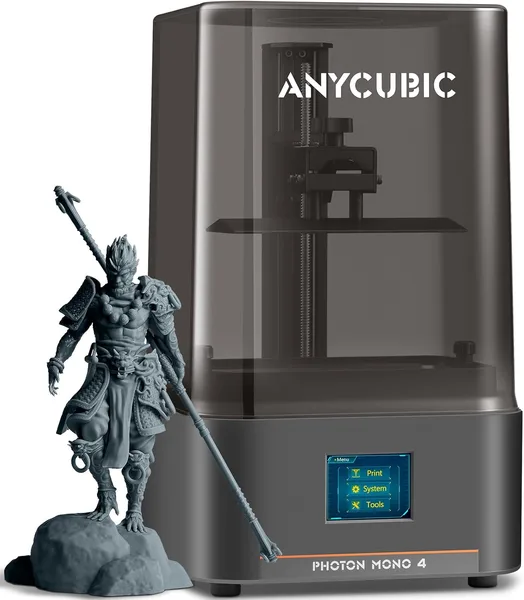
ANYCUBIC Photon Mono 4 review: is this resin printer worth buying
The ANYCUBIC Photon Mono 4 is a fast, sharp 10K printer for people who've already smelled isopropanol and know what a FEP film is. It's not a first date with resin printing — you need a fume vent, gloves, and patience for the smell. But if you print miniatures or jewelry on a regular basis, the detail and speed earn their keep.
There's a moment when an FDM printer stops cutting it. Usually it happens over some tiny tabletop miniature, when the figure's face looks like smeared mashed potato and even your thinnest layer is still thicker than a human hair. That's when people go looking for a resin printer. And they almost always land on ANYCUBIC — the brand that made resin printing accessible enough that people now run it in garages with zero ventilation (which, for the record, is a bad idea).
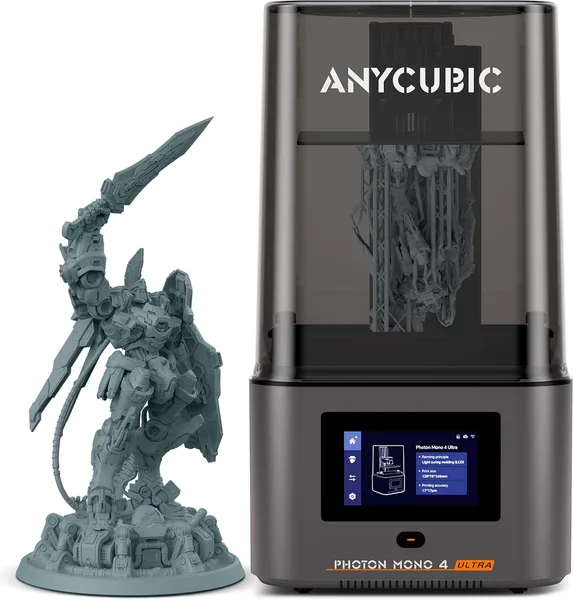
The Photon Mono 4 isn't the flagship of the lineup — that title belongs to the Mono 4 Ultra with its COB backlight — but it's not the budget entry model either. It sits in the middle, trying to grab the best of both worlds: a 7-inch 10K monochrome LCD and ANYCUBIC's proprietary LighTurbo light source, which the company markets on even illumination across the whole build plate. In practice that translates to this: fine details — gear teeth, chainmail texture on a mini, the threads on an M2 screw — come out crisp without the blur you'd get toward the edges of the plate on older models with less uniform LED arrays.
What it's actually like to print with
The claimed 70 mm/hour isn't a number pulled out of thin air for a spec sheet. A helmet model or a small 5-7 cm figure genuinely comes off the printer in 40-60 minutes, depending on layer height and how many models share the plate. Compare that to the previous generation of monochrome printers, which would chew through the same model in an hour and a half. The difference matters once you start printing in batches — and every resin printer owner eventually ends up batching, because running one model at a time on the plate is a waste of a print cycle.
The rigidity built into the frame (the "Li" in the naming) basically means a stiffer Z-axis and a frame with less wobble. Sounds boring, but in real use it means fewer layer shifts on tall prints and a lower chance of a model peeling off the plate in the middle of the night while you're asleep and the printer keeps happily extruding layers into empty resin. I've had that happen on cheaper machines — you wake up to a soup of half-printed resin at the bottom of the vat. This one is clearly built with that exact failure mode in mind.
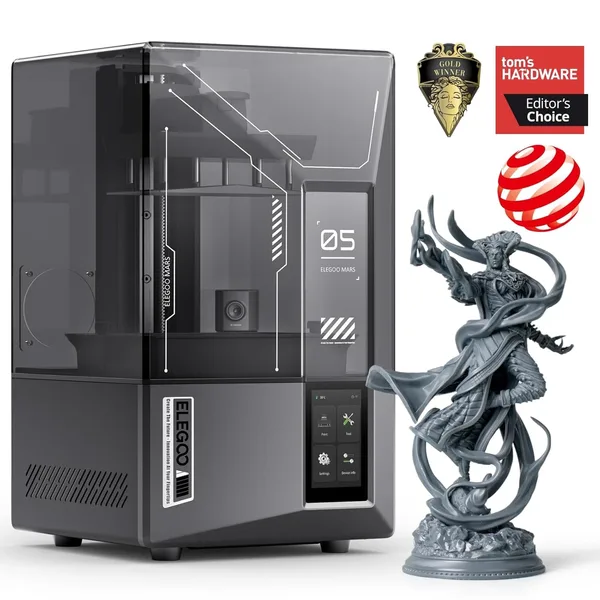
The real competitor here isn't the Elegoo Mars 5 Ultra with its similar 9K screen and near-identical price bracket — it's the printer's own older sibling, the Photon Mono 4 Ultra. The gap between them comes down to the light source (COB vs. LighTurbo) and a modest speed bump on the Ultra. If budget is tight, the plain Mono 4 without "Ultra" covers a hobbyist's needs just fine — the Ultra premium only really pays off if you're printing commercially and every hour of downtime costs you money.
Where it gets annoying
Resin printing is always a set of trade-offs, and the Photon Mono 4 doesn't escape that. You'll need to replace the FEP film eventually, and while the manufacturer touts improved durability, real-world lifespan depends heavily on your resin type and how carefully you pry models off the plate. The LCD panel isn't forever either — it's a consumable, and swapping the screen after a year or two of active printing is a cost nobody mentions in the marketing videos but you should budget for from day one.
Then there's the smell. Even with "low-odor" resins, the room still reeks of chemicals for an hour or two after a print finishes. Without a fume vent or at least an open window, that's genuinely unpleasant — especially in winter, when cracking a window for ventilation isn't exactly appealing. This isn't a flaw specific to this printer; it's just how the technology works. But product listings conveniently never mention it, so it bears repeating.
Post-processing doesn't go away either: isopropanol wash, UV curing, carefully removing supports. Anyone who thinks resin printing means "hit print, walk away, come back to a finished model" is in for a surprise. From the moment you hit start to a fully cured, painted miniature, you can easily burn half a day.
Who should buy it, and who shouldn't
If you're into miniatures, just starting out in jewelry making, or prototyping small parts, this is a smart purchase. Before you buy, check the full landed cost on dede.sh — item price, forwarding, and import duty rolled into one number for your country — rather than eyeballing the marketplace sticker price and getting surprised at checkout.
Skip it if you don't have a dedicated room or balcony to run it in, or if your only goal is printing a single figure "just to try it." For a one-off experiment, it's cheaper to use a print shop or borrow time on a friend's machine. And definitely skip it if working with chemicals makes you nervous — gloves, goggles, and ventilation aren't optional extras here, they're the price of entry.
To be blunt: this isn't a printer for people who want a cute gadget sitting on a desk. It's a working tool for people who already understand what they're getting into.
שאלות נפוצות
Only if you're printing commercially and every hour of plate downtime costs you money. For a hobby, the standard Mono 4 with LighTurbo gets you nearly the same result for less.
On paper they're very close: both have 9-10K screens and similar speeds. The real difference comes down to firmware quirks and slicer plugins — pick whichever ecosystem you find more comfortable, not whatever the spec sheet says.
For most hobby jewelry projects, absolutely. For industrial lost-wax casting at micron-level precision, you'll want to look at pricier specialized machines — but for home use or a small business, this has more than enough resolution.
Swapping the FEP film and cleaning the resin vat becomes routine within a couple of months. Budget for an eventual LCD panel replacement too — it's not a matter of if, just when.