BELLA 2 Slice Slim Toaster Review: The Narrow Toaster That Actually Fits
The BELLA 2 Slice Slim Toaster isn't about perfect toasting — it's about the inches of counter space you never seem to have enough of. It's narrow, the way a toaster should be, with six shade settings and a reheat button that genuinely work. If your kitchen is tiny, or you just want a toaster that doesn't eat half the counter, get it. If you want dead-even browning right to the edge of the slice, look at something wider.
There's a category of kitchen gear you don't buy because you love it — you buy it because you've already shuffled the microwave and the coffee maker around three times and there's simply no room left for a toaster. Sound familiar? This toaster was made for exactly that kind of kitchen: narrow, one cabinet run, stove jammed right up against the window.
First impression: it's genuinely thin
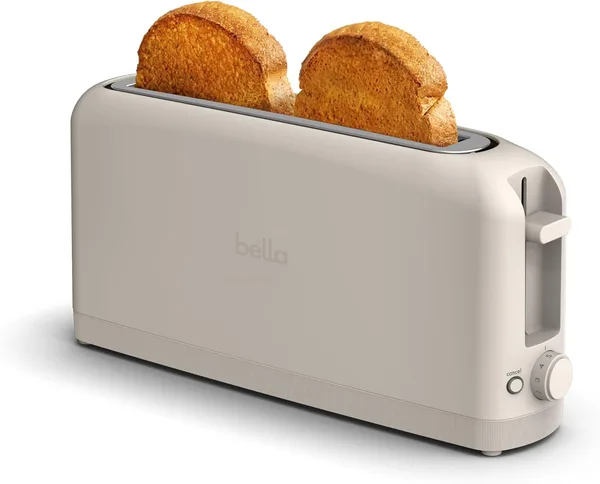
When you unbox the BELLA, you brace for the usual catch — manufacturers love slapping "compact" on something that still eats up a standard 12-inch depth. Not here. The body really is narrower than a classic toaster, and you feel it the moment you set it next to your old one. It slides into the gap between the fridge and the wall — the gap that used to hold nothing but dust. For anyone renting a place where the kitchen is basically a hallway with a stove bolted to it, that's not a marketing gimmick, it's reason number one to buy.
The housing is plastic with metal trim — nothing premium, but it doesn't creak, and it doesn't off-gas on the first few uses (well, almost — toss the first slice, that's standard practice for any toaster). The slots aren't the widest on the market, so a thick artisan loaf or a bagel will need trimming, or you'll want a thinner bread to begin with. That's the trade-off you're consciously making for the narrow body — physics doesn't bend, a slim toaster can't have wide slots.
How it toasts
Six shade settings aren't just numbers on a dial for show. The gap between level one and level six is real: one barely tans the bread, six gets you an almost charcoal crust, which apparently some people in my household enjoy (not naming names). The middle — three or four — is that classic crunchy-outside, soft-inside toast people actually buy toasters for.
The reheat button is the kind of thing you underrate until you start using it. Warming up toast that's gone cold while you were digging through the fridge for butter takes about twenty seconds, and the bread comes back warm instead of dried out from a second full cycle. Small thing, genuinely nice. There's also a defrost setting (standard for this class), and it does what it says — a bit slower than fresh bread, but no surprises.
What it doesn't do is toast dead evenly across the whole slice. The edges brown a touch less than the center. Next to wider four-slice models, the difference shows up if you compare side by side. Honestly, though, 90% of people won't notice this over their morning coffee.
Real-world use: who this is actually for
I'd split buyers into two honest camps. The first: people with a small kitchen or a studio, where every inch of counter matters. The second: people living alone or as a couple, making one or two slices at a time rather than a family breakfast for five. For both groups, this toaster is a smart buy.
If you've got a big household and toast is a daily assembly line for the whole family, though, the narrow format will start to annoy you — you'll be queuing for the slots. In that case, look at four-slot models instead, where compactness stops being the main selling point.
Compared with the classic wide toasters in the same price bracket — think the usual suspects like Hamilton Beach or Black+Decker — the BELLA loses on slot width but wins where it actually matters for a small kitchen: the profile. This isn't a toaster "for everyone," it's a toaster "for one specific problem." And it solves that problem honestly.
On price, it sits in the budget segment on the marketplace, so keep expectations in line: no touch panel, no backlighting, no smart features. Simple mechanics that do one job and do it consistently. Once you add in shipping and your own country's import duties, the total naturally climbs — you can check the full landed price to your country on dede.sh — but the unit itself is inexpensive.
The honest verdict
Buy it if your kitchen is tight, counter space is scarce, and you're not toasting for a football team. Skip it if you love thick artisan bread or unsliced baguette, you toast in big batches, or you're set on the most even browning possible — a wider body is the better physical solution there, not a fault of this particular unit.
There's one obvious compromise, right there in the name — narrow slots. A second, less obvious one is the baseline build quality typical of the whole budget tier, without much margin for years of heavy daily use. But if you're going in with eyes open, trading that for compactness, the BELLA 2 Slice Slim Toaster holds up its end of the deal.
If you're building out a kitchen from scratch or upgrading your appliances, it's worth browsing the full kitchen appliances catalog too — compare profiles and depths before you buy, so you're not rearranging everything for the third time.
שאלות נפוצות
For sliced sandwich loaf or standard store bread, yes, no issues at all. Thick slices of artisan hearth bread or a whole bagel will need to be cut thinner, or you'll want a toaster with wider slots. That's the main limitation of the compact format.
Depends on what matters more to you — counter space or perfectly even browning on thick slices. If your kitchen is small, the extra cost for width often isn't worth it: you'd get better browning, but the toaster would go back to eating up half the table.
A mini oven is more flexible feature-wise, but it takes up far more space and heats up much longer for a single piece of toast. If you just want a quick morning slice rather than an all-purpose appliance, the narrow toaster is more practical.
It's genuinely useful. If your toast has gone cold while you were spreading butter or hunting for jam, reheat warms it back up in seconds without drying it out, unlike running a full second toasting cycle.