BIQU CryoGrip Pro Frostbite for Bambu Lab: Review and Is It Worth Buying
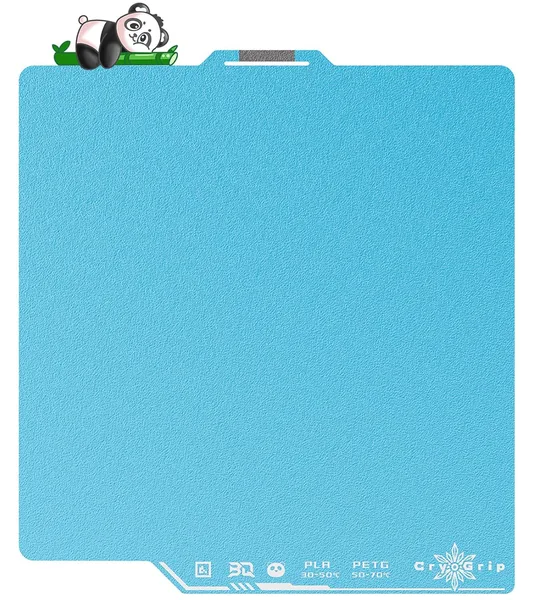
The stock Bambu Lab PEI plate holds fine — right up until it holds too well, and you end up chiseling off the first layer with a piece of the coating still stuck to it. CryoGrip Pro fixes exactly that: adhesion is more aggressive while printing, and removal is nearly effortless once the plate cools down. It's not an upgrade for everyone, but for ABS, PETG-CF, and big flat parts, it's a must-have.
You know the scene: you're printing something large and flat on an A1 or P1S, everything's going smoothly, and then right near the end a corner lifts a couple of millimeters — hello, warping. Or the opposite happens: the part bonds so hard to the stock plate that peeling it off takes a chunk of the textured coating with it, and three months later your build plate looks like it lost a fight with moths. Either way, it's a sign you need a new plate, not another glue stick.
BIQU (part of the BIGTREETECH lineup) went straight after this pain point. The CryoGrip Pro Frostbite is a spring-steel plate with a coating built on the classic "hot means it grips like hell, cold means it lets go on its own" principle. Nothing revolutionary here — Bambu's own Cool Plate and Prusa's Satin Sheet run on similar chemistry — but this coating pushes adhesion noticeably further. The claim is that it holds even ABS and polypropylene without a glue stick, which the stock Bambu textured plate frequently can't manage.
How it behaves in actual prints
The key word is "Frostbite." The plate is magnetic, drops onto any standard Bambu magnetic base (X1C, X1E, P1P, P1S, A1, and reportedly even the newer X2D), and you print exactly as before. The difference shows up immediately on the first layer: PLA lays down so tightly you can actually see it press into the texture. ABS and ASA are where it really shines — zero corner lift on 15×15 cm parts, which used to be my constant headache on the stock plate.
Here's the interesting part: once printing finishes, you're not supposed to rip the part off hot. Let the plate cool for five to seven minutes (you can speed this along by setting it outside in winter — yes, I actually do that), and the part practically pops off on its own once you flex the plate slightly. No spatula, no gouges on the underside. For thin, flat pieces — mounts, templates, covers — that's a real nerve-saver, since those are exactly the parts most prone to snapping when you force them off.
The flip side: if you're used to pulling parts hot to keep the print queue moving (common on farms running multiple printers at once), you'll either have to wait or actively cool the plate down. Not a dealbreaker, but a different workflow than what stock Cool Plate owners are used to.
Compared to the original Bambu Lab textured plate, CryoGrip Pro wins on coating durability — the steel is thicker, and the coating reportedly resists scoring from abrasive-filled filaments (carbon, glass) better. If you print PETG-CF or PA-CF regularly, the stock Bambu plate tends to degrade within three to four months of heavy use. The manufacturer promises longer life here — impossible to verify in a single review, obviously, but the steel thickness and the quality of the edge seam do feel a notch above the $10 no-name alternatives.
Who should buy it, and who shouldn't
Get it if: you print ABS/ASA without an enclosure and you're sick of corner lift-off; you regularly output large flat parts; or your stock plate is chewed up and you want a replacement that'll actually last. For small-batch print farms where consistent first-layer adhesion matters more than experimenting with glues, this genuinely solves the problem.
Skip it if: you mostly print small PLA parts — the difference from the stock plate will be marginal, not worth the premium — or if pulling parts off hot is a habit you're not willing to break. One honest caveat on compatibility: double-check the size against your exact printer model, since the X2D/P2S line is new enough that the magnetic base fit may have shifted slightly from the X1C.
For the actual price, check the full landed cost — item, forwarding, and import duty rolled into one number — on the product page on dede.sh; it varies by your country. Either way, it undercuts a genuine Bambu Lab replacement plate, and it's a lot cheaper than the glue-stick-and-spatula-and-frayed-nerves combo that comes bundled with ABS printing on the stock plate.
Bottom line
This isn't the accessory that changes your life if you're already happy with the stock plate. But if you're the type who curses at warping or wrestles parts off by force, CryoGrip Pro Frostbite solves both problems in one move — and it costs less than a pizza for two.
שאלות נפוצות
Yes, the magnetic base is identical across the whole P1/X1 lineup — AMS has nothing to do with it, since it only handles filament feeding, not the build plate.
For PLA the difference is negligible, so just buy whichever is cheaper. For ABS, ASA, or reinforced filaments, CryoGrip holds noticeably better and keeps its coating longer — that's where the premium pays off.
You can, but the whole point of this plate is cold removal — hot, it actually grips even harder than the stock plate, so forcing a part off becomes harder, not easier.
The manufacturer claims better abrasion resistance thanks to thicker steel, but it's still a consumable — plan on replacing it about once a year if you're printing CF/GF materials heavily.
Shopping for other consumables for the same printer? Here's what else is popular in the catalog: