Boon Trove Silicone Review: Is a Hands-Free Manual Milk Catcher Worth It?
The Boon Trove Silicone is a "manual" silicone milk catcher with no batteries and no motor — it suction-cups onto your other breast and collects the milk that leaks out anyway while you feed. Simple to use, few parts, washes in under a minute. But it's not a substitute for a real pump if you need to build a stash rather than just catch letdown — and the suction cup does pop off at the worst possible moment now and then.
It's 3 a.m., one kid is nursing, and milk is just dripping out of the other side onto the burp cloth — that's when you finally get why these silicone "catchers" exist. I used to eye them with plenty of skepticism: it's basically a rubber bulb, why would anyone pay for that. Then I did the math on how much milk was disappearing into the laundry every month, and my opinion did a full U-turn.
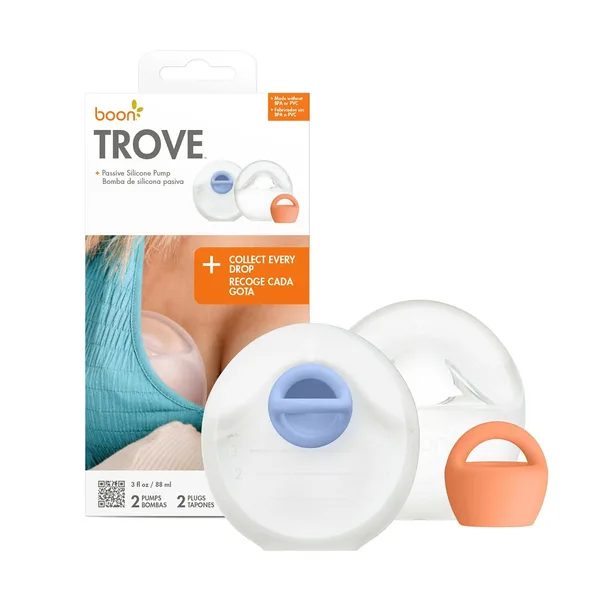
The Boon Trove Silicone is exactly that kind of product. A medical-grade silicone bulb you press against your free breast while nursing or pumping the other side — it holds itself in place with its own suction, no straps, no hands needed, hence "hands-free" in the name. The set also comes with a fabric travel pouch, so you're not stuffing this thing bare into your bag next to the diapers.
How it actually works
No buttons, no modes. You squeeze the bulb, press it to your breast, let go — it forms a vacuum and stays put on its own. Then you just feed on the other side or go about your business while the Boon quietly collects whatever your letdown reflex sends its way. That's a fundamentally different mechanism than an electric pump: nothing here is actively "pulling" milk out, it's purely passive collection, which is why the volumes are modest — 30-60 ml per feed at best, sometimes less.
The obvious rival here is Haakaa, which practically invented this category and became the generic name for it (people say "a Haakaa" the way they say "Kleenex," even when they mean any silicone catcher). The Boon Trove works on the exact same principle, and honestly, the difference in feel between the two is minimal: both silicone, both electronics-free, both suction-mounted. The real differences are in the details — the shape of the base, wall thickness, and the fact that this one ships with a travel pouch, whereas that's often a separate purchase with competitors' base kits.
For parents nursing on demand who don't want to deal with cords and batteries at four in the morning, this is genuinely more convenient than an electric pump. Grab it, squeeze, stick it on — hands free to hold the baby or scroll with one eye open. But there's a catch nobody mentions in the product listings: the suction only holds reliably on dry, flat skin. If you're lying on your side instead of sitting upright, it tends to pop off right when the milk is really flowing — and instead of saving milk, you get a puddle on the sheet. It'll happen at least a few times before you learn to hold the right position.
Who it's for, and who should skip it
If you deal with oversupply and milk practically streams out when you feed on the other side, get this without a second thought — it'll pay for itself in freezer stash within a week. It also works well if you're already combining breastfeeding with occasional pumping for a backup supply but don't want to haul out a full electric pump setup every time.
But if your goal is regularly expressing a full bottle's worth of milk — say, you're back at work and need to pump 5 ounces in fifteen minutes — this isn't that tool. Passive collection is slow, and you can't manually "help it along" the way you can with an electric pump or even a classic manual lever pump. For that scenario, look at full-fledged breast pumps in the baby gear category instead — there are electric options and manual lever pumps built specifically for active expressing, not passive collection.
On price: this is not the cheapest silicone catcher on the shelf, and at first glance it looks steep for a piece of silicone with zero electronics in it. But compared to what electric pumps cost, it's a reasonable buy for the specific job of "don't waste milk while I'm nursing." Just don't judge it by the listing price alone — check the full landed cost, item plus shipping plus any import duty, on dede.sh before you decide, since that final number depends entirely on where you're ordering it to.
Aside from the suction cup occasionally letting go, I've got two real complaints. First, it's not built for active pumping, and if you buy it expecting that, you'll be disappointed. Second, the bulb's capacity is limited — with a strong letdown it fills up faster than you'd expect, forcing you to pause and pour the milk into a jar mid-feed, which kind of defeats the whole "hands-free" point. You'll make peace with it once you accept the rule: check the fill level every few minutes instead of trusting it to hold everything on its own.
Overall, the Boon Trove Silicone is an honest, no-frills product without unnecessary flash. It's not a revolution, but it's not a marketing gimmick either — it fills its niche well, as long as you understand it's a "leak catcher," not a full pump.
שאלות נפוצות
There's no meaningful functional difference — both work the same passive way. Your choice comes down to price, whether you prefer this base's shape, and whether you want a travel pouch included out of the box, like you get here. The brand premium is minimal; this isn't a category where the brand name changes much.
No, and don't count on it. This is a leak catcher for the side you're not actively nursing on, not a tool for full daily expressing of large volumes. For work or building up a real stash, you need a proper pump.
It holds, as long as your skin is dry and you're sitting upright. Lying on your side or moving around can knock it loose, especially early on before you've learned the right angle to press it at. That's not a flaw specific to this product — it's true of every pump in this category.
The manufacturer states it's medical-grade, BPA-free silicone, which is the standard for this product category. The main thing is to wash it after every use and avoid drying it near direct heat, which can warp the base.