Bose Ultra Open Earbuds Review: Open-Ear Buds That Don't Block Your Hearing
Bose Ultra Open Earbuds are for people who are tired of missing their own lives because of the music in their ears. The sound isn't the loudest, bass is thin, but you'll always hear the car, the kid, the coworker, the siren. If staying plugged into reality matters more to you than maximum bass, buy them. If you're after a workout or flight companion to replace your regular TWS, skip it — there are better options for the same money.
Picture this: you're cycling through the city with music on, and suddenly there's a car horn behind you that you heard a beat too late. Or you're walking hand in hand with your kid, she says something, and you ask her to repeat it for the third time because Rick Astley is blasting in your ears. Bose built a pair of earbuds specifically for this problem — and named them exactly what they are: Ultra Open.
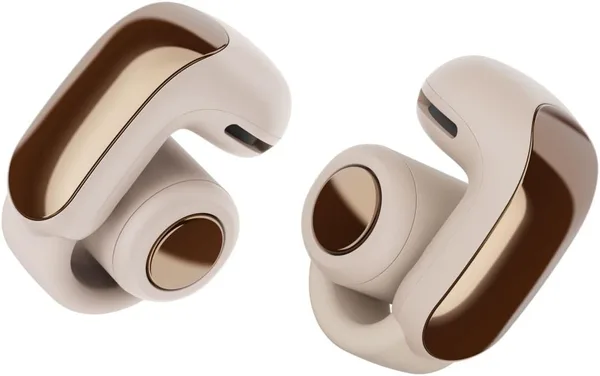
These aren't earbuds and they're not classic TWS with silicone tips sealing your ear canal. They're clip-on hooks that sit on top of your ear and aim sound straight into your ear canal without physically blocking it. Your ear stays open — you hear the music and the world at the same time. The tech is called OpenAudio, and for once it's not a marketing gimmick; it genuinely does what it says on the box.
What it's actually like to use
The first time you put on the Bose Ultra Open Earbuds, it feels strange. The sound seems to come from somewhere near your ear rather than inside it — a bit ghostly. Give it thirty seconds and your brain adjusts; after that it's just "music is playing and my ear is free." The clip holds on well — the shape is designed not to pinch and not to fly off during sudden head movements. You can run in them, headbang at a concert, no problem. But if you're the type who falls asleep with earbuds in, or likes lying on your side while listening, the clip will get in the way — it does stick out over the ear, this isn't an invisible design.
The main reason to buy these is safety and situational awareness. City cyclists, urban runners, parents with kids, people who talk to coworkers constantly and don't want to pop an earbud out every five minutes, rideshare drivers, couriers — that's the real audience. A friend of mine who commutes to work every day on an e-scooter through city traffic says these are the first earbuds where he can actually hear the whole flow of traffic while still not riding in silence. For him it's not a gadget, it's the difference between making it home in one piece or not.
Now for the thing the marketing brochures never mention: the bass here is thin. Physics is brutal — when sound doesn't travel through a sealed canal but is simply aimed into open air, low frequencies get lost. Bose threw a lot of engineering at compensating for this (there's even a proprietary bass-boost trick built specifically for the open format), but next to a Sony pair or even standard AirPods Pro, the bass is noticeably lighter. If you listen to techno or hip-hop and want your chest to rattle, this format just isn't for you — full stop, no open-ear earbuds from any brand will give you that.
Sound quality in loud places — the subway, a busy street, a gym blasting its own playlist — also takes a hit, because there's no noise cancellation by design. That's not a bug, it's the whole point: you're not supposed to isolate yourself, the entire product exists to do the opposite. But if you expect plane-cabin or open-office-level noise cancellation for this kind of money, you'll be disappointed instantly.
Against the most obvious rival in the category — Shokz OpenFit — Bose sounds a touch cleaner and more detailed in the mids and highs, and touch controls are more reliable with fewer accidental taps. But Shokz units are often cheaper and last longer on a charge. So if open-ear isn't a luxury for you but a necessity (you run at night on city streets, you cycle daily), it's worth genuinely comparing both rather than buying Bose on brand name alone.
What it costs, and who should say no
Rather than quoting one currency figure that won't mean much depending on where you live, check the full landed price on dede.sh — item plus forwarding plus import duty rolled into one number for your country. It's worth knowing upfront, because this isn't an impulse-buy gadget. For similar money you could get flagship TWS with noise cancellation, full-bodied bass, and a long feature list. So Bose Ultra Open isn't "everyday earbuds instead of regular ones" — it's a niche product built for a specific use case.
Honestly: if you've never tried the open-ear format before, think hard about whether you want to pay a premium for the Bose name when cheaper options exist for a first taste of the category. But if you already know this is your use case — you run, you cycle, you work in an open office and want to hear your colleagues — then Bose is genuinely one of the best options on the market for sound quality and fit.
Who should absolutely skip this: bass lovers, frequent flyers who want silence, anyone who listens to music in a loud subway and expects to actually hear it. Who should buy: cyclists, runners, parents, anyone living an active life in a city who values situational awareness over audiophile sound.
Before you decide, it's also worth browsing other models in the headphones catalog — you might find something closer to your use case and budget than this niche open-ear format.
שאלות נפוצות
At medium to high volume, yes, a bit — especially in a quiet room. These aren't earbuds for a library or a hushed open office. On the subway or a street, nobody will notice; it's loud enough there anyway.
If sound quality and fit are what matter most to you, yes — Bose is noticeably cleaner and sits more precisely. If all you care about is the open format itself and battery life, Shokz is the more economical pick without losing the core idea.
In a gym blasting its own music at full volume, you'll mostly hear the gym's playlist rather than yours. Open-ear loses to sealed TWS here — go with something that actually isolates sound.
For street running where hearing traffic matters, Bose is objectively the safer choice. For treadmill running indoors, where safety isn't a factor, regular TWS will give you better sound and bass for less money.