Creality Rainbow PLA+ Review: Is the Gradient Filament Worth Buying
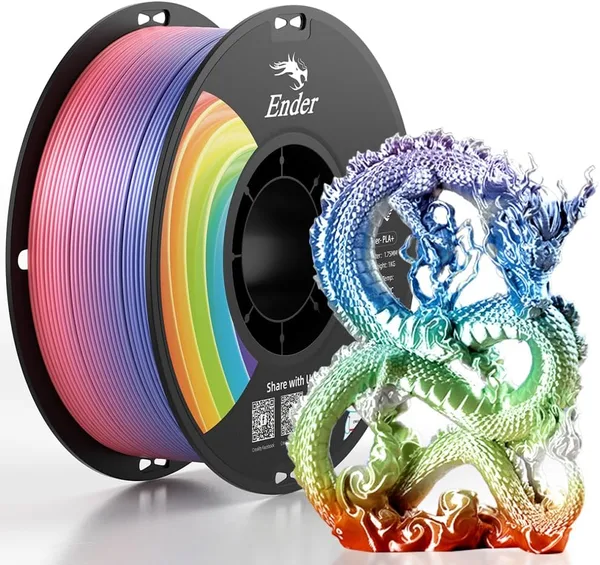
Rainbow PLA+ from Creality is regular, well-formulated PLA+ where the color smoothly shifts every few meters of the spool. It prints consistently, doesn't get brittle, and holds detail decently well. But buying it for "functionality" makes no sense — it's an aesthetic novelty for one-off models, figurines, and gifts, not a working material for production runs.
There's a category of purchases you make not because you need to, but because you're sick of staring at the same gray plastic box of a printer with the same gray PLA inside. Rainbow PLA+ is exactly that kind of purchase. You don't buy it for strength or dimensional accuracy — you buy it because you want the dragon on your shelf to come out with a gradient from purple to teal, not a flat single color, as if someone hand-painted each layer.
And here's the first thing worth saying honestly: this filament doesn't color your model layer by layer the way you'd picture from Etsy renders. The color transition happens along the length of the strand, not synchronized with print height. So on a small figurine you might get a clean gradient from bottom to top, while on a larger part you might get patches and abrupt color jumps mid-wall, because the spool "didn't have time" to transition smoothly over that length. This isn't a material defect — it's just the physics of rainbow filament in general, and you'd see the same effect from Hatchbox, SUNLU, or any other brand with a similar line. Product descriptions just rarely mention it.
The plastic itself is regular PLA+, meaning slightly less brittle than standard PLA and more impact-resistant. It behaves predictably while printing: on a Creality Ender 3 with default 200°C/60°C settings, the strand lays down evenly, no bubbling, none of that telltale crackle of over-dried filament. Retractions are clean, stringing is minimal even without a perfectly calibrated profile. If you're the type who only prints the same model once a year for a friend's birthday, this is exactly the material that forgives a poorly calibrated bed and still gives you a decent result.
Where it genuinely loses out is compared to plain single-color PLA+ from the same Creality or from eSUN. Rainbow lines always cost more per kilogram, while mechanical properties are the same or slightly worse, since more dye is added for a vivid transition. If you need to print a bracket, a cable holder, or any functional part, get regular PLA+ — paying extra for color here isn't justified by anything but aesthetics. But when it comes to a gift, a figurine for a D&D campaign, or something for a display shelf, that's where Rainbow starts earning its keep.
The price on this spool is around $19 for the current listing, a fair rate for a niche filament of this type — neither cheap nor a rip-off. For the full cost with shipping and import duty to your own country, check the landed price on dede.sh — and since shipping applies either way, it makes sense to order two or three spools of different colors in one shipment rather than chasing a single one.
Honestly, the main risk here isn't plastic quality, it's expectations. People see photos of finished models on social media and think they'll get that exact controlled "layer by layer" gradient. In practice, the result depends on the model's geometry, its orientation on the bed, and the length of the color transition on the spool itself. On a tall, narrow model (a statuette, a vase), the effect looks great. On a flat, wide part, you might end up with a chaotic blotch instead of a neat rainbow.
Who should buy it, who shouldn't
If you print figurines, collectible models, gifts, or just want to liven up standard test prints and benchies, go for it without hesitation — the effect is worth it. If you need predictable strength and color uniformity for functional parts (mounts, enclosures, mechanisms), this isn't your material — the extra cost buys you nothing but beauty you won't even see on a hidden part. One more thing: if you have an older extruder with a weak feed motor, rainbow PLA+ is no worse than regular PLA+ in that regard — stringing and nozzle clogging don't depend on color, that's a myth that somehow still circulates on forums.
שאלות נפוצות
Not always. The transition is tied to the filament's length on the spool, not the print height. On small, narrow models the gradient looks nice and controlled; on large, flat parts you might get an abrupt color jump mid-wall. This is a feature of all rainbow filaments, not just Creality's.
Only if aesthetics are the goal — figurines, gifts, decor. For functional parts (brackets, mounts, mechanisms), the extra cost provides no practical benefit; regular PLA+ handles it just as well or better, at a lower price.
No, a standard PLA+ profile (around 200°C nozzle, 60°C bed) works without changes. This is regular PLA+ in composition; the dyes don't affect the temperature settings.
For everyday functional printing — single-color, it's cheaper and more predictable in color across any geometry. Rainbow only wins where the visual effect matters, not consistency of shade across the whole part.
Similar items worth checking out: