Creality 6mm 3D Scanning Markers: Are These Scanner Stickers Worth Buying
Cheap round stickers that solve one very specific problem: a scanner losing tracking on smooth, symmetrical, or plain-colored surfaces. If that's your exact situation, buy them and the problem is solved. If you mostly scan figurines with detailed surfaces, you probably won't need them at all.
I once scanned a smooth plastic prosthetic housing, and the scanner just "floated." The point cloud would gather and then scatter like a jigsaw puzzle someone shook. A familiar story for anyone who's tried scanning something plain-colored, glossy, or perfectly symmetrical — a vase, a helmet, an engine part with no scratches on it. The scanner navigates by surface geometry and texture, and when there's none, it simply gets lost. That's where markers come in.
What this actually is, and why you'd need it
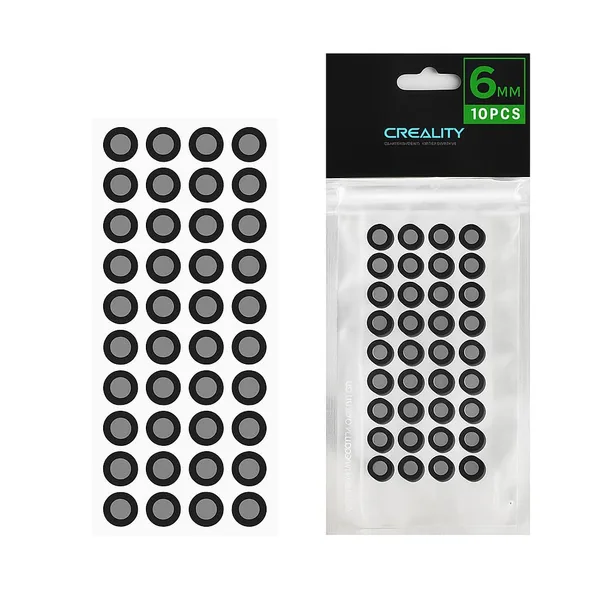
Creality 3D Scanning Markers are sheets of round stickers, 6mm in diameter, with a diffuse, light-reflective coating. Stick them randomly across the object's surface (or around it, on a base plate), and the scanner gets clear reference points to build and align the point cloud between frames. It's essentially a crutch for the tracking algorithm, and that crutch works surprisingly well for what it is.
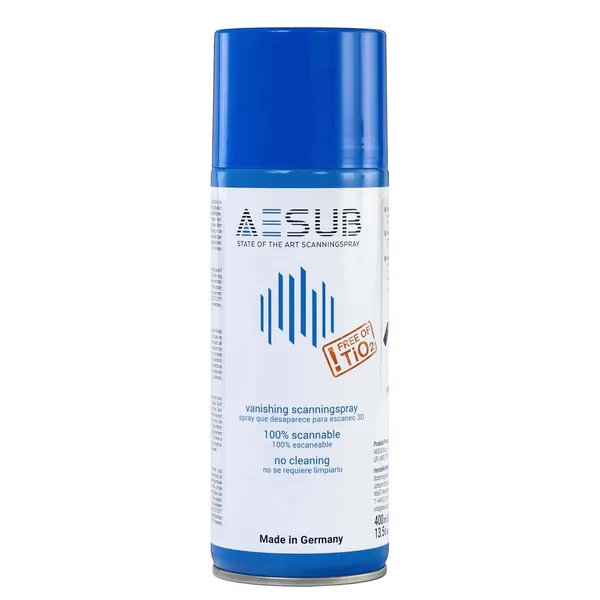
The difference from how people usually improvise is obvious right away. Some draw crosses on the object with a marker (then wash it off later), some stick random scraps of masking tape, some try to get by with a chalk spray like AESUB. There's also a 3D scanning spray in the catalog as an alternative approach — it coats the whole surface in a matte layer and also kills glare, but it doesn't give you point-based reference markers, just matte texture. For small parts, spray is often more convenient; for large, symmetrical objects, point markers are what save the scan, because the scanning software (Revo Scan, EXStar, or Creality's own) locks onto individual points, not overall texture.
How this plays out in real use
Stick them on randomly, without any pattern — and this matters: if you lay markers out in neat rows or symmetrically, the scanner will confuse them with each other and start "jumping" around the point cloud even worse than without markers at all. You need genuine randomness, varied spacing, like scattered stars rather than a checkerboard. Sounds counterintuitive if you're a tidy perfectionist, but that's literally how the software is designed — it needs pattern uniqueness to tell frames apart.
The stickers hold up fine on plastic, metal, and plaster. On fabric or porous wood, less so — there it's better to run a spray or at least some talc first, since the adhesive doesn't grip fibrous surfaces well. They come off cleanly on smooth materials without leaving residue, but on painted wooden parts they sometimes leave a mark — I once had to scrub off round stains with alcohol from a speaker housing I was scanning for a restoration project.
6mm is a compromise size: big enough for the scanner to reliably catch at a medium distance (30-50cm), and small enough not to interfere with detail on medium-sized objects. There's also a 3mm version in the catalog, which suits smaller items or dental impressions better, where every extra millimeter of sticker covers up useful geometry.
The main inconvenience is consumption. On something big, like a mannequin or an appliance housing, a sheet gets used up fast, and you end up buying in bulk. Price plays a role here too — a set costs around $6.29 at the base listing; for the full cost with shipping and import duty to your own country, check the landed price on the product page. It's not a dealbreaker, but if you scan regularly, it's worth grabbing two or three sheets upfront instead of running out mid-project every week.
Who needs this, and who doesn't
If you own a Revopoint, Creality CR-Scan, EinScan, or any structured-light scanner, and the objects you work with are often plain-colored, glossy, or symmetrical (parts, tableware, texture-free sculpture, car components) — this is a must-have accessory that costs pennies compared to the frustration it saves. Restorers, prosthetics casters, reverse-engineering specialists — markers pay for themselves on the very first successful scan.
But if you mostly scan organic shapes with natural texture — detailed figurines, faces, patterned fabric — you probably won't need markers half the time; the scanner locks onto geometry just fine without them. Stocking up "just in case" isn't very useful here: the stickers don't degrade critically over time, but there's also no point sitting on an unused stack if your typical subject already has plenty of texture.
Honestly, there's an alternative worth mentioning that people often underrate: reusable magnetic markers. They cost more per piece, but they don't get used up and don't leave adhesive residue. If scanning is your ongoing job rather than a one-off, it's worth calculating which option is cheaper long-term.
The main trade-off
This is a consumable, and second, you'll need to experiment with layout before getting a stable result on the first try. There's no universal "stick them like this" instruction, since it depends on object size, scanner model, and even room lighting. Your first two or three scans will likely be trial runs.
שאלות נפוצות
Yes, this is a universal accessory — works with Revopoint, EinScan, any structured-light or photogrammetry scanner. There's no brand lock-in; what matters is the diameter and diffuse coating, not the logo on the packaging.
For objects 15-20cm and up, get the 6mm — the scanner catches them more reliably at distance. For small items or places where every millimeter of geometry matters (jewelry, dental impressions), the 3mm eats up less useful detail.
For fully transparent glass or glossy black plastic, spray is often more effective — it kills glare across the entire surface at once. Markers alone don't always save the day there, since light still scatters around them. In practice, a lot of people combine both: matting spray first, then a few markers for reference points.
One sheet might not be enough if the object is large and needs multiple re-application passes. It's more realistic to buy two sets upfront so you're not interrupting the session midway to hunt for more stickers.
Similar products worth checking out alongside this one: