DEWALT Tire Inflator 20V MAX review: better than a cheap air compressor?
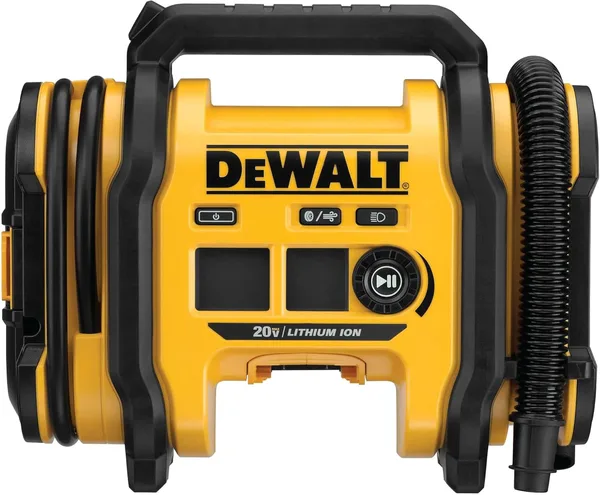
The DEWALT Tire Inflator 20V MAX isn't the cheapest way to air up a tire, but it's one of the few that does it without drama at six in the morning in the cold. If you already own DEWALT 20V batteries, buying this is a no-brainer. If you don't, paying $160 just for the pump makes less sense — a cheaper corded compressor will do the job just as well.
That familiar feeling: it's Friday evening, you start the car, and there it is — that same orange tire-pressure icon that somehow always lights up at the worst possible moment. The corded compressor is somewhere in the garage, there's no extension cord in sight, and the nearest gas station with an air pump is fifteen minutes away in traffic. This is exactly the scenario DEWALT built its cordless inflator for — so the fix is an arm's reach away, not a trip across town.
What this thing actually is
This isn't a mini-compressor like those cheap keychain-sized units sold for a few dollars on marketplaces that die after the third tire. DEWALT built this inflator on its 20V MAX platform — the same one behind the brand's drills and drivers. So if you already have a battery from the DCD or DCF lineup lying around your garage, this compressor just clicks onto it and gets to work. No cord, no hunting for an outlet in a garage co-op wired sometime in the '90s and eyeballed ever since.
The headline feature is auto shutoff. Set your target pressure (PSI, bar, or kPa — your choice), hit start, and go do something useful. The compressor shuts itself off once it hits the set value, and it won't overinflate the tire the way a person standing over a gauge, nervously eyeballing the moment, tends to. To some that's a minor detail, but for me it's exactly the reason I started trusting cordless inflators over cheap corded ones with an uncalibrated gauge.
How it behaves in real life
On a fully flat tire — winter rubber that lost half a bar overnight in the cold — the DEWALT Tire Inflator airs up a standard passenger tire to working pressure in about a couple of minutes. Not lightning fast, but nowhere near the misery of standing there listening to a tiny pump wheeze and overheat by minute five. For an SUV or trailer tire it'll take longer — physics doesn't care about your brand loyalty, the air volume there is simply bigger.
What's nice is that it's not just for tires. Balls, inflatable mattresses, kayaks, kiddie pools in summer — the same pump connects with adapters and happily doubles as a household compressor. Mine lived in the trunk for a year as insurance against a flat, and honestly got used more often for the kids' inflatable pool than for actual tires.
The real downside: battery life is decent while the battery is fresh, but it's still a separate power tool you need to remember to charge. Forget to charge it, and at the critical moment you've got a dead brick instead of a helper. A corded compressor will never pull that trick on you — plug it into the cigarette lighter, and it works as long as there's gas in the car.
What to weigh it against
The most obvious rival is a regular 12V cigarette-lighter compressor, the kind millions of drivers keep in the glovebox for years. It's cheaper, simpler, and doesn't depend on a separate battery. But it's also louder, slower, and almost always lacks a proper auto-shutoff — you have to stand there and watch the gauge yourself.
The second camp is compact cordless inflators not tied to any tool brand — a Ryobi, say, or a no-name unit with a built-in power bank. Those aren't bad either, but if you already have a fleet of DEWALT tools, adding yet another independent power system just doesn't make sense. That's the whole point of this purchase: it's not that the compressor itself is a work of genius, it's that it slots into an ecosystem you may already own.
The price on Amazon US currently holds at $159.49 — for the tool itself, without a battery or charger, which is important to understand upfront, since that's exactly where a lot of people trip up when ordering. Once you add international shipping and import duty to your own country, the total climbs noticeably, so it's worth calculating in advance rather than being surprised afterward.
Who should buy this, and who should save their money
Buy it if you already own DEWALT 20V batteries — then you're effectively only paying for the pump itself, not an entire power system, and it's a worthwhile investment in convenience. Buy it too if you're often somewhere without an outlet or cigarette lighter nearby — a trailer, a boat, a summer house with no electricity, or a big family with kids and inflatable toys every weekend.
Don't buy it if you have no DEWALT tools at all and only need a compressor for tires once a month — a cheaper corded option will do the exact same job for a third of the price. And don't buy it expecting the output of a garage compressor — this is a household helper, not a tire shop's air station.
The main trade-off is simple: you're not paying a premium for some unique inflating ability, you're paying for convenience and precise auto-shutoff within a specific brand ecosystem. That's a fair deal, but only if it fits into a tool system you already own.

שאלות נפוצות
No, and that's the most common reason for buyer disappointment. The DEWALT Tire Inflator is sold as "tool only" — just the compressor, no battery or charger. If you already have 20V MAX batteries from other DEWALT tools, that's great value. If you don't, factor in a separate battery and charger purchase on top of the compressor's price, or the surprise when you open the box won't be a pleasant one.
Yes, it'll air it up, just slower than a passenger car tire. This is a household inflator, not a 220V garage compressor with a tank, so for larger tires budget more time and expect the battery to drain faster than on a small tire.
If you already have DEWALT batteries, this option is more convenient and more precise thanks to auto-shutoff. If you have no DEWALT tools at all, a corded cigarette-lighter compressor is cheaper and doesn't need separate charging, making it the more logical choice for occasional use.
Personally, I'd pay for it again. Manually judging pressure by ear or with a cheap gauge always carries some margin of error, and an extra bar of pressure in winter isn't a great idea. Auto-shutoff removes the human factor from the process, and that's really the main reason this inflator is interesting at all, rather than just another compressor on the market.