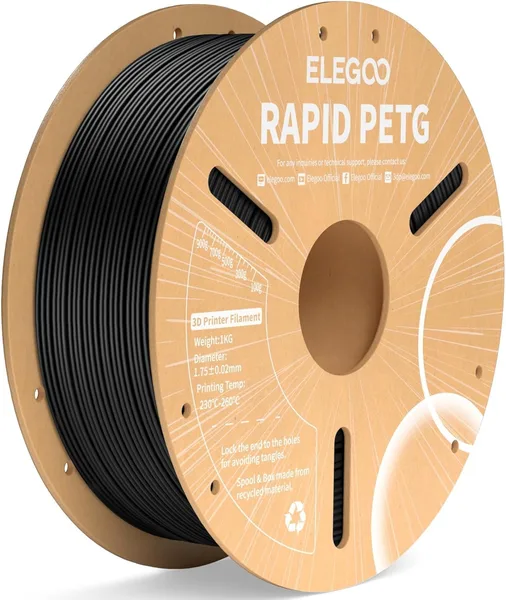
ELEGOO Rapid PETG 1.75mm Black: Worth It Over Regular PETG?
ELEGOO Rapid PETG is chemically standard PETG tuned for high-speed printing: fewer strings at speed, steadier flow even past 300mm/s. If you're running a Bambu Lab, a Neptune 4, or any CoreXY machine that can actually move fast, it earns its keep. If you're on a stock Ender 3, you're paying for headroom you'll never use.
Check dede.sh for the full landed cost to your country — spool price, forwarding, and import duty rolled into one number — before you order.
Anyone who's printed PETG above 60mm/s knows the drill: the nozzle drags fine strings between parts, the surface starts rippling, and on sharp corners the plastic seems to "lag" behind the print head. PLA barely does this. PETG has always had a reputation for being finicky — tastier in strength than ABS, easier to print than most engineering filaments, but slow and temperamental. Over the last couple of years, filament makers have been rolling out "rapid" or "high-speed" versions of familiar materials, and ELEGOO has jumped in too.
What actually changed in the formula
Chemically, this is still standard PETG — glycol-modified polyethylene terephthalate, the same trade-off between ABS-level strength and PLA-level ease of printing. But the formula's been reworked for speed. The claimed 600mm/s is, unsurprisingly, a lab number from ideal conditions on a top-tier direct-drive CoreXY printer, not something you'll see on your own desk. The real-world picture is tougher and more honest: on a Bambu Lab P1S or X1C, this filament genuinely holds 250-350mm/s without visible surface degradation — speeds where regular PETG would already be "swimming." On a Prusa MK4 or Neptune 4 Pro the gain is real too, if more modest.
The real practical win isn't raw speed — it's flow stability at that speed. Standard PETG at high speeds starts under-extruding walls, leaving micro-gaps between layers because the extruder simply can't push plastic fast enough. The rapid formula liquefies faster when heated, so flow keeps pace with the head. In practice that means fewer flow-rate recalibrations per speed setting — dial in a profile once and you're not fighting it every time you bump the print speed.
Printing, stringing, and that black finish
Black PETG is traditionally hard to judge for surface quality — everything looks decent on black, even when it isn't. But with this filament, the gloss came out even, without the blotchy "greasy" patches cheap PETG sometimes shows from uneven additive distribution. Stringing — those fine threads between parts during travel moves — is still there, as it is with any PETG, but noticeably less than standard variants at comparable speeds. Retraction of 0.8-1mm and a retraction temperature 5°C below print temp, and the wispy strands mostly disappear.
Bed adhesion is classic PETG: it grips like it's glued down, then pops off suddenly once cold. If you're printing on a bare PEI plate without adhesive, pull the part right after the print finishes while the bed's still warm — otherwise you'll be scraping it off with a spatula and cursing.
How it stacks up against what's already on the shelf
Compared with classic PETG (think Bambu PETG Basic or Sunlu PETG+), the difference only shows up once you're actually printing fast. At the default 40-60mm/s you won't notice anything, and you'll just be paying extra for the "Rapid" sticker on the spool. But if you've got a fast printer and you're churning out functional parts in batches, the rapid formula genuinely saves hours per project. It's not a material that makes prints better on slow printers — it's what makes fast printing possible without compromises.
Against pricier engineering PETG-CF (carbon-fiber filled), this one loses on stiffness and dimensional accuracy, but wins on simplicity — no hardened nozzle required, no abrasive wear on your extruder. For most home and semi-pro jobs, that's more than enough.
Who should buy it, and who shouldn't
Buy it if you own a fast printer (Bambu, a Sonic Pad-modded Ender, Voron, anything CoreXY with a decent direct drive) and you print functional parts — brackets, enclosures, anything that'll see moisture or mild chemicals where PLA just won't hold up. The black color isn't just aesthetics here — it hides minor surface defects better than clear or light colors, which is handy for show-and-tell prototypes.
Skip it if your printer is a stock Ender 3 with no upgrades, or anything running a Bowden extruder on factory settings. You physically can't push it to the speeds where this formula pays off, so the "rapid" premium becomes just a premium. In that case, regular PETG for less money gets you the same result.
Trade-off number one: it's still PETG, not PETG-CF — it flexes and stretches slightly under load, so for rigid, load-bearing parts look at reinforced options instead. Trade-off number two: it needs drying just as diligently as any other PETG. PETG pulls moisture from the air even inside a sealed spool, and if the filament's sat open for a week in a damp garage, you'll see bubbling and crackling at the nozzle no matter what "rapid" is printed on the label.
שאלות נפוצות
No. If your max print speed tops out around 40-80mm/s, you won't feel any difference compared to standard PETG. The premium only pays off on CoreXY printers or modded Ender/Prusa machines running 150mm/s and up.
Depends on the job. Rapid PETG prints faster and doesn't need a hardened nozzle, but it's less rigid. If the part is under bending load or needs tight dimensional accuracy, the CF version is the better call, even with slower printing and extra nozzle wear.
For one mid-size enclosure (say, an Ender top cover or a small electronics case), a kilogram is usually enough with room to spare. For larger parts with high infill, weigh the model in your slicer beforehand — PETG is a bit heavier than PLA at the same volume.
Yes, and that has nothing to do with the "rapid" label. PETG is hygroscopic by nature. If the spool has sat unpacked for more than a few days in a humid room, dry it before printing or you'll get crackling and bubbles on the surface.