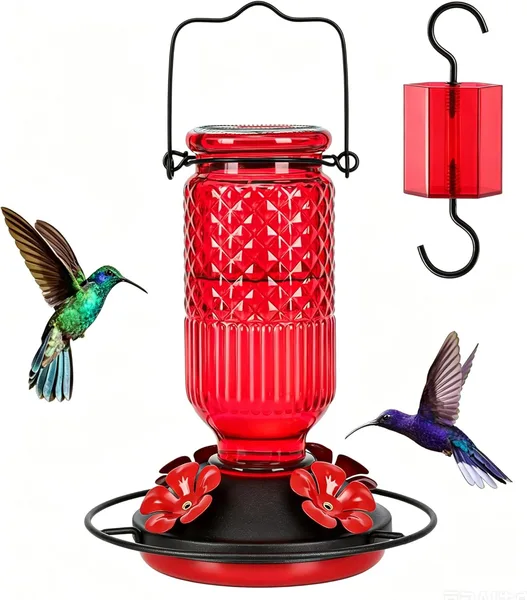
FEED GARDEN Glass Hummingbird Feeder Review: Does It Actually Not Leak?
The FEED GARDEN Glass Hummingbird Feeder is a 16-ounce glass nectar feeder that genuinely doesn't leak as long as you don't overfill it past the max line, and it's a breeze to clean thanks to the wide neck. It's a solid pick if you already get hummingbirds or other small nectar-lovers visiting your balcony or garden, or if you're buying it as a gift for someone who does. If your region doesn't have hummingbirds, treat it as a niche buy for butterflies, bees, or a decorative sugar-water feature rather than a must-have.
Picture this: you live somewhere with a yard, and instead of the usual pigeons or sparrows, you'd like to look out the window and see something a little more exotic. In the US and Canada, hummingbird feeders are about as ordinary as a bird feeder for chickadees is in winter elsewhere. Plenty of readers outside hummingbird territory still order these — either for relatives abroad, or because the exact same design works beautifully for butterflies, bees, or just as a decorative sugar-water fixture on a terrace.
Plastic feeders are almost always the first thing people try, and almost always a letdown: the plastic yellows in a season of sun, grows mold inside, and the nectar "ferments" faster because grime works its way into the microcracks. Glass wins here, no contest. The FEED GARDEN Glass Hummingbird Feeder is built with a genuine glass body — and that's the whole reason people pick this over the three-dollar plastic version sitting right next to it on the same marketplace.
How it holds up in real life
16 ounces is just under half a liter, and in practice that lasts a few days of heavy bird traffic, or a week or two if the feeder is more decorative and gets occasional visitors. The number one fear with anything like this is leaking. Nectar dripping onto the ground or windowsill attracts ants and wasps faster than it attracts any hummingbird, and that's exactly why half the reviews on feeders like this read like war stories about a sticky puddle under the window.
On this model, the lid sits on a rubber gasket, and as long as you don't overfill past the max line, it genuinely doesn't drip — confirmed by users who leave it hanging at an angle on a windy balcony. If you do overfill it, or hang it crooked on the hook, you'll get the occasional drop. That's not a defect unique to this feeder — it's just physics for any design with bottom feeding ports.
Cleaning the glass is a pleasure compared with narrow-necked plastic bottles that a bottle brush can't even fit into. Here the neck is wide enough for a hand to reach in, and the sticky sugar film that builds up after a week in the sun rinses off in a minute, no soap required. Honestly, that's the biggest practical win — and the actual reason to pay for glass instead of plastic.
How it stacks up against the obvious rival
The most popular alternative on the same Amazon listing page is the plastic Perky-Pet line, which is cheaper and lighter, so it's easier to hang from a thin branch. But after a season or two the plastic clouds over, and some owners report bees chewing through the feeding ports — a complaint that shows up again and again in reviews. Glass sidesteps that problem entirely: a bee can land on top, but there's nothing there to chew.
The obvious downside of glass is fragility. Drop it on a patio tile and that's it, you're sweeping up shards. If you're somewhere windy, or the feeder hangs at a height where cats or kids on a swing can reach it, keep that in mind. The second catch is weight — a glass build is noticeably heavier than plastic, so the hook and cord need to be sturdy, or after a rainstorm, when the glass is full of water on top of the nectar, the mount might not hold.
Who should buy it, and who should skip it
If you live somewhere hummingbirds are a regular sight and you want a feeder that'll survive several seasons without yellowing or cracking, this is a good pick — and the price doesn't sting, with the base listing starting well under twenty dollars, which is entirely reasonable for a glass piece. It also works for anyone who just wants sugar water for butterflies or bees in their own garden, even though the design is really built around small, long-beaked birds.
Who'll regret it: households with young kids or big dogs in the yard, where a fallen feeder isn't a minor accident but a real hazard from broken glass on the grass. Also skip it if you plan to haul it back and forth to a country house every weekend — glass doesn't enjoy riding around in a trunk next to your gardening tools.
For the exact landed cost in your own country — item, forwarding, and import duty rolled into one number — check the full breakdown on dede.sh rather than going by the US sticker price. For a single, standalone order the shipping math often doesn't favor a small glass item; it makes more sense as an add-on when you're already ordering something bigger from the same store.
FAQ
שאלות נפוצות
If it's just hanging on a hook and you're not dropping it, you won't have problems over a season or two. The real risk is a fall onto a hard surface or a hard knock from a branch during a storm.
Yes — in that case the nectar will outlast its own shelf life anyway. The main rule is to swap the liquid every 4-5 days in hot weather so it doesn't ferment, whether or not birds are actually drinking from it.
If you're buying for one season and planning to toss it, go plastic — it's cheaper and lighter. If you want something that'll last several years without yellowing or smelling, glass wins outright despite the fragility.
At a slight tilt, no — the rubber gasket holds. But overfill it past the max line and add strong wind, and you may see a drop or two form underneath.
Worth a look for more garden gear: