FlashForge Adventurer 5M Review: Is It Worth Buying Over an Ender?
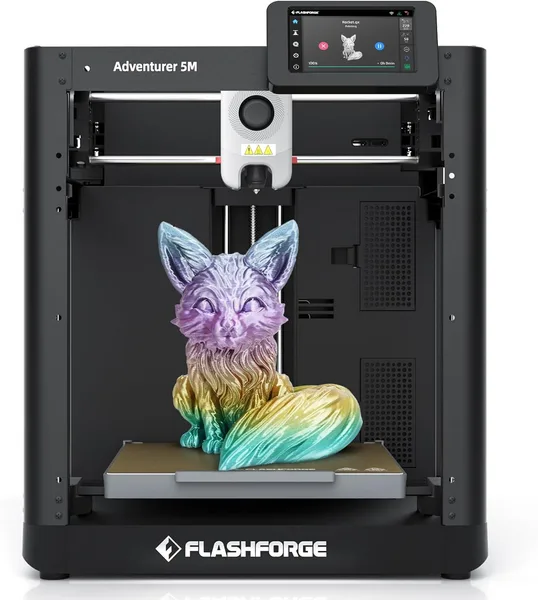
The FlashForge Adventurer 5M is a fast, enclosed printer for people who want to print, not tinker. For a price hovering around $217 on the source marketplace, you get auto-leveling, quiet operation, and genuine 600 mm/s speed without wrestling Klipper into submission. There are trade-offs, too: an economy-grade plastic frame and a filament system built for one spool at a time, despite the "Multi Materials" badge on the box.
A friend asked for advice recently: "I want a printer so I can print models for my daughter, not adopt a second job." Classic dilemma for anyone who got into 3D printing through an Ender 3 and spent the first month not printing, but tuning. Tightening belts, leveling the bed by feel with a sheet of paper, flashing firmware pulled from some forum thread. That's exactly the itch this whole wave of "turn it on and print" enclosed machines is scratching — Bambu Lab's X1C set the trend, and the FlashForge Adventurer 5M is the answer for people who want that same feeling without paying double for an X1C.
What this printer actually is
FlashForge isn't a newcomer — the company has been building printers since the early 2010s, and the Adventurer 5M shows it. Nothing here feels like a raw startup product. Enclosed frame, heated magnetic bed, automatic grid-point bed leveling — the baseline gentleman's kit that's now table stakes in this category. The advertised 600 mm/s top speed is a marketing number; real prints at decent quality run considerably slower. Even accounting for that, though, the printer is noticeably faster than budget open-frame machines. The detail you actually feel day to day is noise. The enclosure muffles sound enough that you can leave it running in a room where someone's sleeping or working, and it won't be torture.
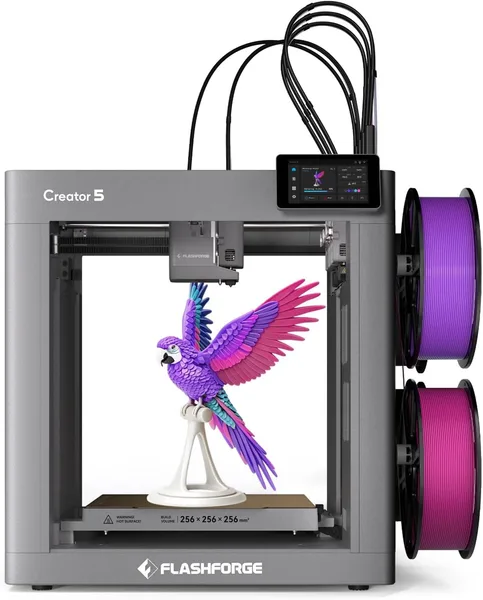
Now, the elephant in the room — that "Support Multi Materials" name. Worth tempering expectations here. This isn't IDEX, and it's not a four-toolhead system like the pricier FlashForge Creator 5 with its automatic toolhead swapping. The Adventurer 5M has a single extruder, and "multi materials" just means it handles different plastic types in sequence — PLA, PETG, ABS, TPU — with a matching bed surface and an enclosed chamber for stable temperatures. Want to print a two-color model simultaneously off two spools at once? That's a different weight class and a different price tag entirely.
What it's like in real use
Unbox it, let the automatic bed leveling run for a couple of minutes, first print within an hour of opening the box. That's genuinely what sells printers like this, not the spec sheet. The slicer behaves itself, material profiles are preloaded, and for the usual stuff — cable clips, small boxes, figurines, household spare parts — it just works. ABS and even mildly fussy nylon print more reliably than on an open frame, because the enclosed chamber holds temperature and kills the drafts that shred layer adhesion on an Ender sitting near a window in winter.
Where the printer stops feeling "magic" is long, unattended prints of complex parts with supports. You'll still need to get your head around settings, because no enclosed printer at this price exempts you from the physics of molten plastic. And cooling during high-speed printing is its own topic — sometimes it's smarter to deliberately dial back the pace for surface quality than to chase the marketing 600 mm/s number.
How it stacks up against what people already own
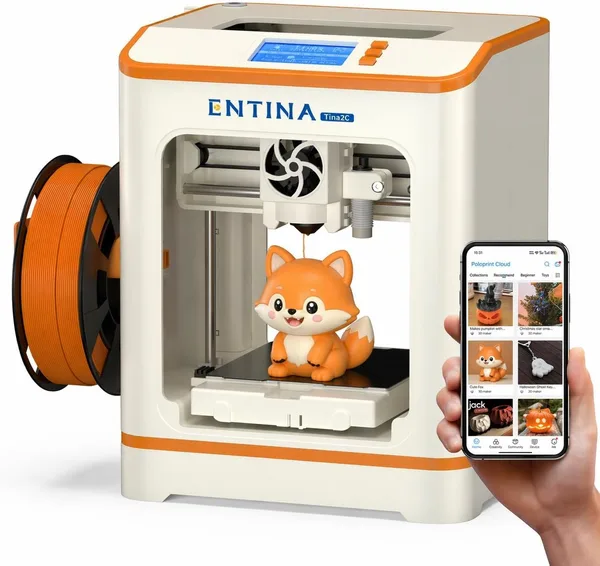
Against any generation of Ender 3, the Adventurer 5M wins outright — quieter, far less manual tuning, an enclosed chamber for finicky materials. Against the Bambu Lab A1 mini, it's more a question of taste and budget: Bambu has the wider ecosystem and bigger community, but FlashForge tends to show up cheaper on sale. Stack it against genuinely entry-level, budget models like the Entina Tina2C for kids and beginners, and you're comparing different weight classes entirely — that one is honestly positioned as a starter toy, while the Adventurer 5M is built for regular adult use.
The honest verdict
Buy it if you want to start printing without a month of calibration hell, and you're fine with "multi materials" meaning different plastics in sequence rather than simultaneous two-color prints. The source-marketplace price sits a bit above $217 — for an enclosed, auto-leveling, fast-printing machine, that's a fair ask. Just remember shipping and import duty will stack on top once it crosses into your country, so check the full landed price to your country on dede.sh before you buy, not after the box is already in transit.
Skip it if simultaneous two-color or two-material printing is a hard requirement — look at dual-extruder systems instead. And if you're planning to heavily mod the printer, flash custom firmware, or dig into the electronics, the economy-grade enclosed frame will fight you more than it helps. The housing plastic isn't premium either — it shows the moment you've held something metal.
שאלות נפוצות
No, and that's the most common confusion caused by the name. It's a single extruder — "multi materials" means it supports different plastic types in sequence: PLA, PETG, ABS, TPU. For simultaneous multi-color printing, you need a printer with multiple toolheads or an AMS-style feeder system.
If the goal is printing rather than fiddling with settings every weekend, the Adventurer 5M wins easily thanks to auto-leveling and the enclosed frame. The Ender is cheaper upfront, but the time you'll sink into tuning during month one usually outweighs the price difference.
It's a peak figure — real-world quality prints run slower in practice. But even discounting for that, the printer is noticeably faster than budget open-frame models, and you'll feel the difference on larger parts.
For pure PLA work, the enclosure isn't critical — what you're really paying for there is quiet operation and a tidier housing. But if there's any chance you'll want to try ABS or nylon down the line, the enclosed frame immediately removes the headache of drafts and part warping.