HP 14 Essential review: is it worth buying for home and office?
The HP 14 Essential with an Intel N150 and 128GB SSD isn't built to be worked to death — it's a quiet little helper for email, Zoom calls, and Google Docs. If that's your use case, buy it without a second thought; the price is fair. If you're planning to edit video or run heavy Photoshop sessions, look elsewhere entirely.
You know the scene: mom or grandma just needs a laptop "for Viber, email, and the odd movie," and instead her son or grandson shows up with a gaming rig that howls like a jet engine. That's wrong on every level — the money, the noise, common sense. This is exactly the gap the HP 14 Essential fills — a laptop that's upfront about its limits: turn it on, get your work done, turn it off. Nothing more, nothing less.
What's actually inside
Under the hood is an Intel N150, the successor to the N100 that quietly became the standard chip of the budget segment over the past year. It's not built for video editing or spreadsheets with half a million rows of macros. It's built for a stack of Chrome tabs, Word, Excel without the drama, and a YouTube video playing in the background while you type in another window. It runs cool, stays silent, and sips battery — and for an everyday laptop, that often matters more than raw benchmark numbers.
The 128GB SSD is where I raised an eyebrow. In 2026 that's an amount of storage you have to manage carefully: Windows 11 updates alone will eat a healthy chunk of it, and after installing two or three programs plus your phone's camera roll, free space gets tight fast. The fix is simple and well-worn — push photos and documents to the cloud (Google Drive, OneDrive) and keep only the OS and working files local. If you're the type who hoards thousands of wedding videos on the internal drive, this machine isn't for you — look at models with 512GB or a laptop that lets you swap in a bigger SSD later.
The chassis is thin, and the 14-inch screen is exactly the size that slides into a normal bag without dragging your shoulder down. Pull it out on a long train ride, set it on the tray table, and you're working — not wrestling with bulk.
What to weigh it against
The most obvious competitor is the whole catalog of budget laptops, where N100/N150 machines now number in the dozens, from Lenovo to Acer. The difference usually isn't performance — they're all running the same class of chip — it's keyboard feel, screen quality, and how seriously the brand backs its warranty. HP has an edge here: its service network reaches even smaller cities, and that's not a small thing when something breaks a year in.
If you're weighing "used business laptop for the same money" — something like a HP EliteBook 840 G6 — the choice gets harder. An older i5 in a used EliteBook is often faster than the N150 on heavier tasks and packs more RAM, but you're buying a machine with an unknown battery and keyboard history. The new HP 14 comes with a warranty and a clean slate — no surprises from a previous owner. For a student or an older relative, I'd personally pick the new, simple option every time — fewer things that can fail out of nowhere.
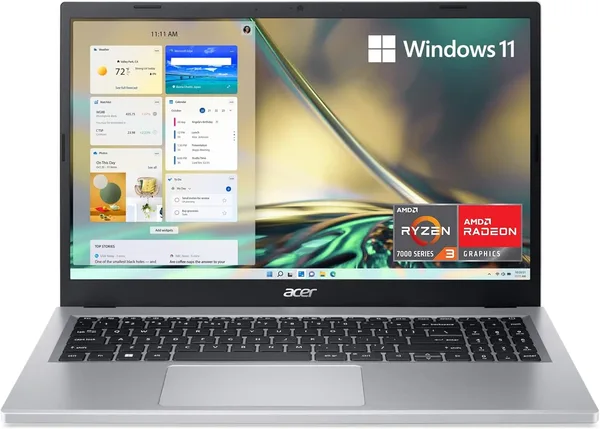
Against a classic "budget for everyone" pick like the Acer Aspire 3, the comparison is more even: the Acer runs AMD Ryzen instead of Intel, has a bigger 15.6-inch screen, and typically ships with more RAM out of the box. If screen size and a little extra headroom matter to you, the Acer is worth a look. The HP wins on portability — 2.2 kg against the 1.6+ kg typical of the bigger models, a difference you'll actually feel if you're carrying it around daily.
The honest verdict
Who should buy it: students heading to lectures, anyone whose job is mostly documents and a browser, and parents who want a simple, dependable second laptop for the house. Rather than quoting one price that won't hold across markets, check the full landed cost on dede.sh — item, forwarding, and import duty rolled into a single number for your country. At that price, this is a solid deal as long as you don't inflate your expectations.
Who should skip it: gamers, video editors, anyone running heavy CAD software or juggling 40 Chrome tabs alongside Photoshop. And one more group — anyone planning to keep a laptop for 5+ years as their needs grow more demanding: 128GB and a modest N150 will start showing their age sooner than you'd like.
Go in accepting two real trade-offs: the small SSD (set up cloud storage or an external drive from day one), and the fact that this machine has no headroom for the future — it handles today's tasks calmly, but tomorrow's heavier ones will make it strain. It's an honest tool built for a narrow, specific job, and if your job matches, it earns its price.
שאלות נפוצות
For the OS, browser, and office apps — yes, as long as you move photos and videos to the cloud right away. Keeping a large media library stored locally simply won't work; you'll run out of room within a few months of normal use.
If compactness and low weight matter most, go with the HP. If you want a bigger screen and a bit more performance headroom for roughly the same money, look at the Acer with its AMD chip.
No, and don't even try — that's not what it's for. The Intel N150 is built for office work and browsing, not GPU-heavy loads. For gaming, look at models with a dedicated graphics card.
If the price gap is small, yes — it'll save you a storage headache within six months. If the premium is steep and you're already comfortable relying on the cloud, staying with 128GB is fine.