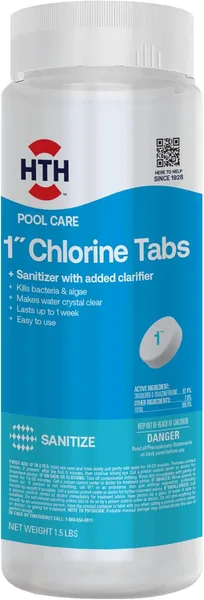
HTH 42049 Chlorine Tabs Review: Are These Pool Tablets Worth Buying
Classic stabilized chlorine tablets for a floater, skimmer, or feeder aren't some groundbreaking product — they're decades-old chemistry with a water clarifier mixed in. It works predictably, as long as you never just toss a tablet straight into the water by hand. Get these if you've got an above-ground or frame pool and you're tired of the water turning green every week. Skip them if you've got a small inflatable kiddie pool with no filtration, because there's nowhere for the chlorine to dissolve properly.
Our neighbor at the summer house spent two straight seasons trying to keep his frame pool clean using nothing but shock treatment from the shop down the road — once a week he'd dump some powder in a bucket, stir it, pour it in. The water stayed clear for maybe three days, then went green again, and he kept wondering why. The answer's simple: shock treatment is a one-time strike against bacteria, not ongoing protection. Without a baseline chlorine level that lasts days, not hours, the battle never actually ends.
That's exactly where tablets like HTH 42049 come in — stabilized trichlor in one-inch puck form that dissolves slowly, holding a steady chlorine level day after day instead of landing one hard punch and then fading out. There's also a built-in clarifier in the mix, the same kind of additive that makes fine haze clump together so your filter can actually catch it instead of just chasing it in circles.
What it's actually like to use
The one rule beginners somehow always ignore: never throw a tablet straight into the pool by hand, especially in a vinyl-lined or frame pool. Concentrated chlorine sitting on the bottom or pressed against the liner can bleach a spot into the material in about an hour flat. These tablets are built for a floater, a skimmer, or a feeder — meaning the chlorine needs to dissolve gradually, diluted, in moving water, not sitting in one spot.
A floater is dead simple: drop the tablet in, toss the device in the water, and it regulates the release rate through its vents on its own. Great for small frame pools in the 5-15 cubic meter range that don't have a dedicated chemical feeder. In a bigger pool with a skimmer, the tablet goes straight into the skimmer basket or a dedicated inline chlorinator, and the dissolving is even more even, since water from the pump is constantly running through it.
What you actually notice in practice: the water doesn't flicker between clear and green every few days the way it does with one-off shocks. The chlorine level holds a steady baseline, and algae simply doesn't get a window to take hold. The clarifier isn't a marketing bullet point either — it does real work. After a couple of days with the filter running, the water gets noticeably sharper, and you can see the bottom even on an overcast day.
Compared to unbranded tablets from a hardware store or generic ones off marketplaces, this formula is more consistent — fewer surprises like uneven dissolving or a sharp chlorine smell the second it hits the water. Next to a competitor like Clorox Pool&Spa, the difference mostly comes down to price and availability — chemically, both do the same job, since stabilized trichlor is stabilized trichlor no matter whose name is on the bucket.
Who should buy it, and who should walk past
If you've got a frame, above-ground, or small stationary pool with any filtration at all — even the cheapest cartridge pump — this is one of the silliest things to argue with your partner about "the chemicals cost too much." Basic chlorine costs pennies per day of the season, and the headache of green water and scrubbing the walls with a brush just goes away.
But if you've got an inflatable kiddie pool with no pump or filter, where the water gets swapped out every few days anyway — tablets have no business there, and they're actually risky: concentrated chlorine with nothing to dilute it in a moving current can irritate a kid's skin or burn a spot into the liner. For that kind of setup, either skip the chemicals entirely and just change the water often, or use a liquid product in a minimal dose.
The second real downside is the stabilizer — cyanuric acid — that comes baked into trichlor. It builds up in the water over time, especially if the pool sits all season without a full water change. Too much stabilizer starts smothering the chlorine's effectiveness even at a normal dose, so eventually you either partially drain and refill, or switch to an unstabilized chlorine form once a season. It's a detail most people only learn about the hard way.
On price: a basic batch starts at around $0.54 a piece — pocket change per tablet — and once you tally up the item, forwarding, and import duty together, the full landed cost to your country is easy to check on dede.sh, and for a season of pool upkeep it's simply not real money. Just remember this is a consumable you buy in batches for the whole summer, not a single tablet you grab as a backup.
Bottom line: predictable, no-surprises chemistry that takes the weekly "why is the water green again" panic off your plate. Not high-tech, not innovative, just something that actually works if you follow the instructions and never drop a tablet straight into the water.
שאלות נפוצות
Absolutely not for frame or inflatable pools with vinyl or liner surfaces — concentrated chlorine bleaches a spot wherever the tablet touches the material. Only ever use a floater, skimmer, or feeder, where the water dilutes the concentration right away.
They solve different problems, not interchangeable. Shock delivers one strong hit when the water's already green or after heavy rain, while tablets maintain a constant baseline level so it never gets to that point. The best setup is a combo: tablets running constantly, shock only when you need to bring the water back from the brink.
Depends on your pool's volume and the weather — the hotter it gets, the faster chlorine burns off. For a small frame pool at a summer house, one pack usually lasts with room to spare, and buying more later isn't an issue since this item is cheap.
For small inflatable pools without a pump or filter — no, there's nowhere for the chlorine to dissolve properly, and the concentration can irritate a child's skin. This is built for pools with water circulation, not a basin you fill up for a couple of days.