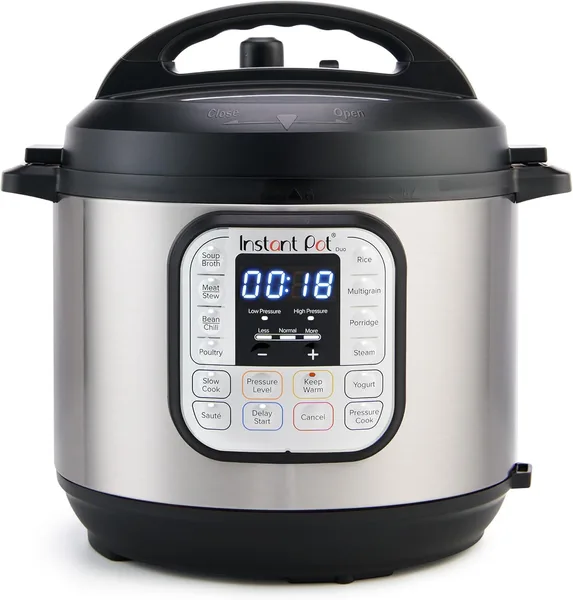
Instant Pot Duo 7-in-1 Review: Is It Worth Buying in 2026
The Instant Pot Duo isn't some miracle gadget that replaces your whole kitchen — it's a genuinely solid pressure cooker/multicooker that cuts cooking time in half or more on things like stews, pilaf, or bone broth. If you already own a decent multicooker, skip it. If you cook meat and legumes often and never have enough time, this is one of the rare appliances that actually changes how you cook at home.
Picture a Saturday: a frozen chicken sitting in the freezer, guests arriving in two hours, and you haven't started anything. In a regular pot, that's a recipe for disaster. In the Instant Pot Duo, it's 25 minutes under pressure, another 10 for the steam to release, and the chicken comes out tender and juicy, like it simmered for an hour on low heat. That's the moment people actually buy pressure cookers for — not the seven modes printed on the box.
What it actually is, versus what's printed on the box
On paper the Duo is a "7-in-1": pressure cooker, slow cooker, rice cooker, steamer, yogurt maker, warmer, and a sauté function. In practice you'll use two or three of those modes, tops. The pressure cooker is the whole reason to buy it, full stop. Sauté is a nice bonus — you skip dirtying a separate pan before you throw the meat in under pressure. The yogurt maker and the warmer, though, are the kind of thing you'll try once, snap a photo for social media, and never touch again. Honestly, that's true of nearly every multicooker with a pile of "modes" — manufacturers sell you quantity, not quality.
The 6-quart capacity (about 5.7 liters) is a family size. For two or three people it's overkill to haul that bowl out daily, but for a family with kids, or when you're batch-cooking for several days, it's exactly right. One pot of stew comes out to 6-8 servings, and that genuinely saves you weeknights when cooking is the last thing you feel like doing.
What it's like day to day, not in the ad
The biggest difference from a regular pot isn't speed by itself — it's that you can dump ingredients in and walk away. Frozen meat for a stew, potatoes, spices, water — lid closed, button pressed, go watch your show. No babysitting a boil-over, no burnt-bottom smell from forgetting about the stove. That's the real advantage over a regular stovetop, or even over slow cookers like the Crock-Pot — those are also "dump it and forget it," but you're waiting 6-8 hours instead of 25 minutes.
Compared to the more popular Ninja Foodi, or Instant Pot's own newer models (Duo Plus, Pro), the base Duo loses on screen quality and preset count but wins on price and simplicity. The Duo has physical buttons, a small display, and really just three things you're controlling: pressure, time, and steam release. For someone who doesn't want to wade through a 15-item menu, that's a plus, not a minus.
There are real downsides too. First, the lid becomes its own piece of furniture whenever you're cooking in slow-cooker mode without pressure — you need somewhere to set it down, and it eats counter space. Second, the sealing ring absorbs smells: cook curry once and it'll smell like curry for a week, even if you switch to rice porridge next. A second ring, kept separate for sweet versus savory dishes, fixes this, but that's an extra purchase. Third, the steam release at the end of a cycle isn't a gentle hiss — it's a fairly loud whistle for 20-30 seconds that will absolutely wake anyone sleeping in the next room.
Who should buy it, and who shouldn't
If you cook broths, beans, pilaf, or braised meat more than twice a week, the Duo pays for itself just in time and energy saved. If you already own a decent multicooker and you're happy with it, don't rush — the real-world difference isn't big enough to justify one more appliance crowding a cupboard that's probably already full. And if your kitchen is small and the counter is already cluttered, think twice: this isn't something you tuck away after every use, since it's on the heavy and awkward side to haul out daily.
Right now it's listed on eBay for well under the typical US retail price, where the Duo often runs well over $100 — check the full landed price to your country on dede.sh (item plus forwarding plus import duty) for the real number before you decide. Even after shipping and customs push the total up, this is one of the rare kitchen appliances where paying for the genuine article is worth it: cheap knockoff pressure cookers have a genuinely bad track record on pressure-release valve safety, and that's not a corner worth cutting.
שאלות נפוצות
If speed is what matters — cooking beans in 20 minutes instead of a two-hour soak-and-simmer — get the pressure cooker. If you just want to leave a dish cooking all day while you're at work, a plain slow cooker like a Crock-Pot is cheaper and simpler. The Duo does both, but it's far stronger as a pressure cooker than as a slow cooker.
Yes, with room to spare. Six quarts is the standard "family" size — it easily fits a whole chicken or a pot of stew for 6-8 plates. For one or two people it's actually too much; look at a 3-quart model instead.
Only if you want extra presets and a bigger screen — it doesn't buy you any real improvement in how the food turns out. The base Duo covers 90% of home cooking scenarios, and the price difference is better spent on a second interchangeable sealing ring so your food doesn't taste like yesterday's curry.
Modern electric pressure cookers like the Instant Pot have several layers of protection — the valve physically won't let the lid open while there's still pressure inside. This isn't your grandmother's stovetop pressure cooker with a single gasket. The risk is minimal as long as you're not buying suspiciously cheap, uncertified knockoffs.
More options to tame the kitchen clutter, worth a look: