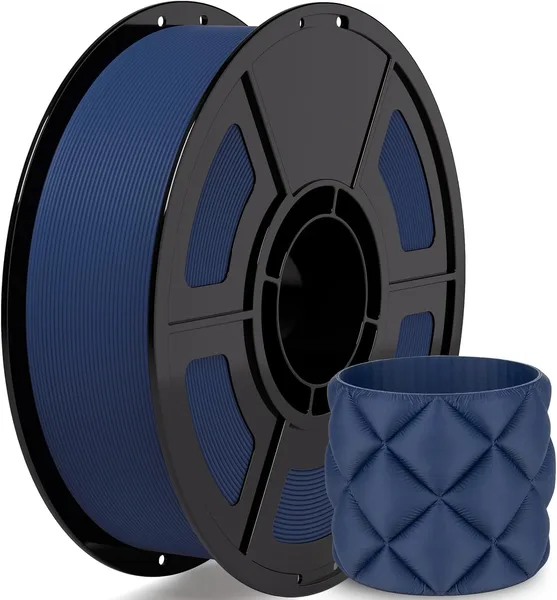
iSANMATE Matte PLA Navy Blue Review: Is It Worth Buying
iSANMATE's matte PLA in a deep "navy" shade prints cleanly even at high speeds and looks pricier than it is. It's not the pick if you need maximum strength or a glossy look, but as a workhorse spool for decor, enclosures, and prototypes, it earns its spot on the shelf. Check the full landed price to your country on dede.sh (filament + forwarding + import duty in one number) — it lands in the same ballpark as eSUN or SUNLU matte PLA, not the cheapest option but nowhere near a rip-off.
Matte filament is one of the rare cases in 3D printing where the compromise actually works in your favor. Glossy PLA photographs beautifully, but it rats out every layer line and every print artifact without mercy. Matte does the opposite — it hides the small sins — which is exactly why I've kept a spool of iSANMATE Matte PLA Navy Blue next to the printer for the past couple of months instead of my usual "showcase" glossy roll.
It started with a mundane need: an enclosure for a home router that shouldn't scream "3D-printed part." Gloss gives itself away instantly here — light catches every layer, and no amount of calibration saves it. The matte navy blue from iSANMATE laid down so evenly that in photos it's hard to believe it's printed and not injection-molded. The color, by the way, runs deeper than the name "navy" suggests — not sky blue, but almost ink-dark, a deep blue with a faint gray undertone. It lightens a touch in sunlight and reads almost black indoors.
How it behaves on the printer
The stated speed range is 30-300 mm/s, and that's not a marketing number thrown in for the spec sheet. On a Bambu Lab P1S I ran ordinary parts at 250 mm/s without any visible quality loss — though I'll be honest, the matte texture itself masks minor speed-printing flaws, so the effect here is doubled. At the slower 60-80 mm/s I usually dial in for final parts, seams are practically invisible, and the surface has exactly that "velvet" matte feel manufacturers of matte filaments like to advertise.
Stringing is minimal — 0.6-0.8 mm retraction on a direct-drive extruder is more than enough. What does annoy me: matte PLAs are often more brittle than their glossy counterparts, and this one is no exception. Thin walls under 0.8 mm tend to snap rather than flex. If you're printing functional clips or latches, grab regular PLA or PETG instead — matte isn't your friend here.
Against the obvious competitor, eSUN PLA Matte, iSANMATE behaves almost identically on temperature profile (200-220°C, bed 45-60°C), but eSUN's navy runs a touch paler, more "denim." SUNLU Matte tends to flake at sharp corners because of its looser pellet structure — I haven't seen that with iSANMATE across several spools.
Price and the reality of getting it shipped
The spool itself runs around $14 on the marketplace — a typical price for a niche matte PLA brand, not budget Prusament territory, but not Polymaker premium pricing either. Once you factor in forwarding, duties, and everything else, the landed price is exactly what dede.sh's full-price comparison is built to show you — check the number for your own country rather than trusting a single figure quoted elsewhere. Honestly, at this price point it's more economical to order two or three spools at once, since forwarding eats a disproportionate share of the cost when you're shipping a single 1 kg roll.
Who should buy it, and who shouldn't
If you print decorative pieces, enclosures, cosplay parts, or just want the finished object to not scream "I came off a 3D printer" — buy it without overthinking. The matte finish is genuinely good, the color runs deep, and the high-speed behavior is exactly what owners of Bambu Lab and other fast printers need when they don't want to trade quality for time.
But if you need a functional part under load — a clip, a bracket, anything that flexes or has to grip — matte PLA as a material class isn't the best choice here, and iSANMATE doesn't break that rule. Reach for regular PLA+ or, better yet, PETG.
The second catch: this is a niche brand without a huge library of slicer profiles behind it. Ready-made profiles for Cura or Bambu Studio have to be hand-picked or built from a generic matte-PLA baseline with some temperature tweaking. For a beginner who wants "load and print," that can be an extra hassle — in that case it's simpler to pick something with a built-in profile already in your slicer's database.
Bottom line
iSANMATE Matte PLA Navy Blue is an honest workhorse material without unnecessary pretense: a genuinely deep color, stable behavior at speed, a pleasant matte texture. It's not ideal for load-bearing parts because of thin-wall brittleness, and you'll need to fuss a bit with the slicer profile. But for the price and the finish quality it delivers, it's one of the few matte PLAs I'd keep in stock permanently rather than buying just for one project.
שאלות נפוצות
In practice it holds up well to about 250 mm/s; above that, small artifacts start showing on sharp corners, though the matte texture masks them better than gloss would. For everyday printing, 100-150 mm/s is the sweet spot between quality and speed.
For parts that flex or bear load, go with regular PLA+ or PETG. Matte PLA, iSANMATE included, is more brittle on thin walls and suits decor and enclosures better than mechanical parts.
Yes, if batch-to-batch color consistency and resistance to flaking at sharp corners matter to you — iSANMATE behaves more cleanly here than some budget brands like SUNLU. If you're printing a one-off prototype, the difference isn't critical.