JEEVONY Magnetic Dryer Vent Coupling DV180 Review: Is It Worth Buying
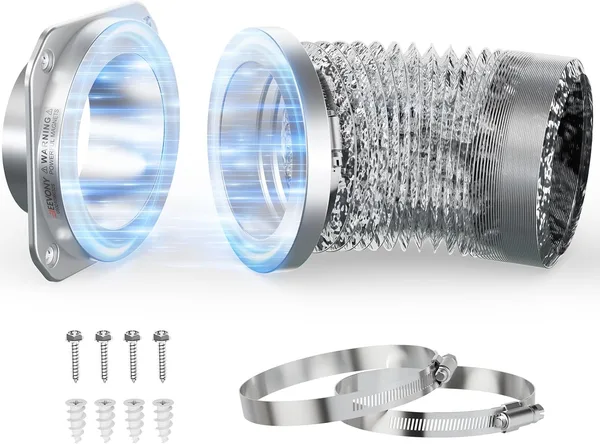
The JEEVONY DV180 magnetic coupling solves one very specific problem: having to unscrew a hose clamp every single time you want to pull the dryer out and clean the duct behind it. Click to disconnect, click to reconnect, airtight, no tools. It's not for everyone with a dryer — it's for the specific case where the duct runs right behind the unit and you actually clean it every few months.
Try pulling a dryer away from the wall when the flex duct is held on with a clamp somebody torqued down with a power driver three years ago and never touched again. Your fingers hurt, the clamp won't budge, and if it finally does, the duct usually tears exactly at that spot. Sound familiar? This thing exists for exactly that moment.
What it actually is. The DV180 isn't a duct itself — it's a pair of magnetic ring couplings that clamp onto the joint between two sections of 4-inch ducting, the standard size on most American dryers and a fair share of Korean ones too (the same size you'll see on the exterior vent caps sold everywhere). One ring goes on the dryer's own outlet, the other on the fixed section running to the wall or outdoor vent cap. Magnets around the rim hold the joint tight, and a rubber gasket keeps air — and more importantly lint — from leaking out.
The idea isn't new; similar gadgets have floated around under different names for a couple of years now. What sets this one apart is that "airtight seal" isn't just marketing copy — the gasket is noticeably thicker than on the cheaper knockoffs, and the magnets are genuinely stronger. Give the duct a light tug and it won't pop loose; you have to actually pull. That matters, because the worst-case scenario for a device like this is it disconnecting mid-cycle and dumping hot, damp lint straight into your laundry room.
Where it actually earns its keep
The obvious use case is anyone running a dryer with a short duct run to an exterior wall — a setup common with US-spec machines and long-vent combo washer-dryers. In an apartment that run is usually just three to five feet, and that's exactly where lint builds up fastest — right there, not buried deep inside a wall. With clamps, cleaning that section turns into a mini repair job every time: unscrew, pull, clean, screw back on, and by the third or fourth round the clamp itself is worn out.
With the magnetic coupling it's a ten-second job. Pull, and the duct's on the floor. Vacuum or brush it out, click it back. For anyone running a dryer in a garage workshop, where the vent clogs with sawdust twice as fast as in a normal apartment, this is close to a must-have — it pays for itself in saved nerves and duct sections alone.
On the flip side, if your duct is hidden inside a cabinet you can't reach without pulling furniture apart, the DV180 won't help — the problem there is access, not the connector itself. And if you've got a condenser dryer with no outdoor vent at all (a much bigger share of households outside the US than most people realize), skip this entirely — there's no ducting to attach it to.
What it's up against
The real competition here isn't another "smart" coupling — it's a plain metal hose clamp for a dollar, or the foil tape that half the world just wraps around the joint and calls it done. Tape is cheap and seals fine, but every time you need to clean the duct you tear it off and buy a new roll — it's a recurring cost, not a one-time purchase. A clamp is cheaper per unit but loosens over time, the screw seizes up, and eventually plenty of people just stop cleaning the duct because it's too much hassle — which is a direct path to a fire hazard, since lint burns extremely well.
Against both options, the JEEVONY wins on the long game: it's a one-time purchase, physically easier to open, so people actually clean it more often. It loses on upfront cost per connection — and fairly enough, for that money some people would rather just buy a fresh roll of foil duct every year and not think about it.
The honest verdict
Buy it if you've got a short, accessible duct run that genuinely needs regular cleaning and clamps genuinely annoy you. Especially if the dryer lives in a workshop, garage, or anywhere else with heavier dust and debris.
Skip it if you run a condenser dryer with no outdoor vent, if the duct is tucked away somewhere you'd have to move furniture to reach regardless, or if you honestly can't remember the last time you cleaned the duct at all — in which case the coupling isn't your real problem.
The main tradeoff is price for what's fundamentally a simple part: the JEEVONY Magnetic Dryer Vent Coupling DV180 runs about $45 for one pair of rings — check dede.sh for the full landed price to your country, item plus forwarding plus import duty in one number — and that's several times what a hose clamp costs. The second tradeoff is fit: it's built strictly for the 4-inch standard, and if your duct runs a nonstandard diameter (which happens with some European models), you'll need to source an adapter separately — the listing flags this clearly.
שאלות נפוצות
For a short straight section, yes, it holds firmly. But if you've got a long duct running at an angle with real weight to it, you should support or secure it separately — the magnets are built to hold the joint shut, not to carry the whole run.
The magnets are neodymium and handle a dryer's exhaust temperatures without issue — that's nowhere near the heat level that would demagnetize them. The actual fire risk is accumulated lint, not the coupling, and easier access for cleaning arguably lowers that risk rather than raising it.
One set covers one joint. If your duct has multiple sections, it makes sense to put the magnetic coupling at the joint you can actually reach and clean most often — usually the one right by the dryer. Leave the rest on regular clamps.
If you clean the duct once a year and don't mind a bit of hassle, tape is a perfectly workable, much cheaper option. If you're cleaning it monthly or the joint is awkward to reach, the coupling earns back the price difference in saved time pretty fast.