AUGO Magnetic Screen Door Review: Is a Magnetic Mosquito Curtain Worth It
The AUGO Magnetic Screen Door isn't really a door — it's a mesh curtain held together by magnets that you stick or tack around your doorway, and it snaps shut behind you every time you walk through. It genuinely works on standard balcony and patio doors, less so on wide sliding openings. For roughly the price of a couple of coffees, it's one of the smarter ways to get through summer without a bug problem in your living room.
Summer evening, you finally crack the balcony door for some air, and ten minutes later a whole delegation of mosquitoes has moved into the kitchen while something the size of a sparrow is parked on your table. Sound familiar? That's exactly the problem magnetic screen curtains were invented to solve. The concept isn't new — it's been in infomercials for years — but AUGO is one of the versions that actually delivers what the packaging promises, instead of falling apart at the seams within a week like the usual marketplace filler.
What this actually is
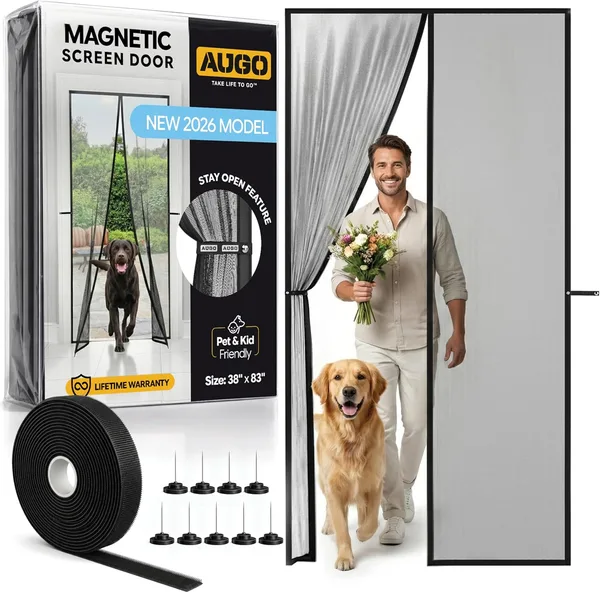
Forget the classic framed mosquito screen that needs measuring, cutting, and slotting into channels — this works differently. It's a polyester panel split down the middle, with dozens of tiny magnets sewn along the seam. You mount it around the door frame with the included adhesive strips or tacks (both come in the box), and it hangs like a curtain. Walk through, the two halves part, and a second later the magnets pull them back together on their own. Hands full of grocery bags or a kid on your hip? No problem — nudge it with your shoulder and it lets you through, then reseals itself. That's the "hands-free" bit in the name, and unlike most marketing claims, this one actually holds up.
Compared to an old-school screen in a rigid frame, the difference is obvious right away. A framed screen needs precise measurements, drilling, and — if your doorway isn't a standard size — cutting the frame profile down with an angle grinder, which isn't a job everyone wants to take on. AUGO trims to fit with a pair of scissors in about five minutes, and if you're off by a couple of centimeters it doesn't matter — just trim the excess or fold it under. For a rental, it's close to ideal: no drilling into concrete, the adhesive peels off without leaving marks, and if you move out, you just roll it up and take it with you.
How it actually behaves day to day
It stays put. Mine hung on a balcony door in a standard apartment for an entire summer and never once came loose on its own, even with a fan running a steady draft through the room. The magnets are strong enough that the two halves don't just brush against each other — they snap together with an audible little click, the same sound every single time someone walks through. It's mildly annoying at first, then you get used to it, and eventually it feels almost comforting, like the door is looking out for you.
The main weak point is width. On a standard balcony door or a single-panel patio door, the screen holds its shape perfectly. But on a wide sliding opening — two or three meters across, the kind you get in houses — the panel sags in the middle and the magnetic seam starts to flutter in the wind, which is exactly where gaps open up. For openings that size, you're better off looking at a rigid framed solution, or hanging two screens side by side, though the manufacturer doesn't officially endorse that workaround.
Cats and dogs walk through it just as easily as people do, which is why it gets the "pet-friendly" label. But if you've got a big dog that likes to squeeze through sideways or hook a paw on the fabric, the adhesive will gradually loosen and the edges start to peel away from the frame. Re-sticking it once a season isn't a big deal — the roll of adhesive tape that comes with it is generous — but it's worth knowing upfront rather than getting caught out in the fall.
One more thing nobody mentions in the listings: this won't hold up against strong wind or driving rain. It's fabric, not a rigid structure, so in bad weather you're better off shutting the actual door. But on a still, hot evening when all you want is a cross-breeze without the bugs, that's precisely the scenario it was built for.
Who should buy it, and who shouldn't
If you've got a standard-width balcony, patio, or cottage door, and you're renting a place where drilling isn't an option, this is probably the simplest, cheapest way to solve your mosquito problem for the whole summer. The AUGO Magnetic Screen Door is inexpensive to begin with — check dede.sh for the full landed price to your country, item plus shipping plus any import duty, all in one number — and it's cheaper than paying someone to install a framed screen, plus it goes up in one evening with nothing but a pair of scissors.
Skip it if you have a wide sliding opening or an unusually shaped doorway — arches, pointed tops, anything non-rectangular — because the magnetic seam simply won't line up evenly, and the screen will flap instead of seal. Also skip it if you're on the ground floor and want protection from more than just insects — some privacy or a windbreak in winter, say — because the fabric here is thin and see-through.
There's one honest trade-off: this isn't a "door" in the full sense, it's a light curtain. It won't match a framed screen for airtightness, but it wins hands-down on ease of installation and price. For most apartments with a balcony, that trade-off is more than worth it.
FAQ
It really does close itself — that's the product's biggest strength. The magnets running along the seam are strong enough to pull the two halves shut without any help from you. The one catch is on very wide openings, where the middle sags a bit and doesn't seal quite as tightly as the edges.
One or two cats just walking through, no problem — the fabric is tough and doesn't tear from casual contact with paws. But if your pet likes to hook its claws in or squeeze through sideways, the adhesive will weaken over time and the edges will start to lift, meaning you'll need to re-stick it about once a season.
For a rental and a standard doorway, the magnetic version wins outright — faster to install, cheaper, and leaves no marks. A framed screen seals better and lasts longer, but it needs measuring and drilling and costs more, so it only makes sense if you're planning to stay put for years and want a once-and-done solution.
Honestly, not the best option. On openings wider than a standard balcony door, the magnetic seam starts to sag in the middle and gaps open up there. You're better off looking for a framed solution or hanging two screens side by side.
Similar products worth a look if you're building out a home toolkit or gearing up for renovation season: