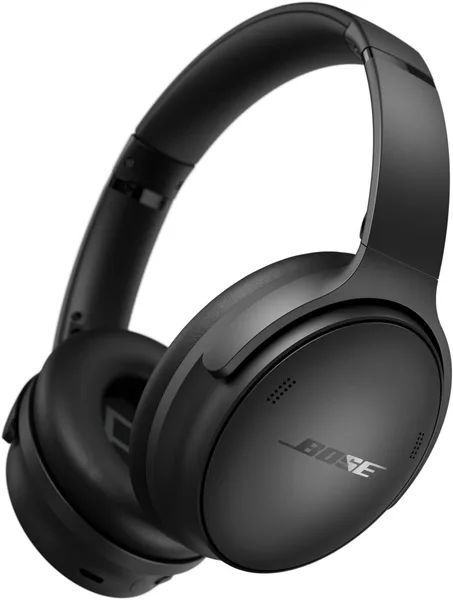
Bose QuietComfort Headphones Review: Are They Worth Buying?
The Bose QuietComfort is the "smart minimum" version of the flagship: the same soft, comfortable silence and cushy fit you get in Bose's pricier models, minus the fancy app and minus a chunk of the price tag that QuietComfort Ultra or Sony WH-1000XM5 charge. Get these if what you actually need is quiet and comfort on long flights or in an open-plan office, not audiophile fussing. Skip them if you want a top-tier sound signature with a full equalizer to match.
Picture it: a red-eye flight, the kid behind you has been screaming for forty minutes straight, the guy next to you is chewing with his mouth open, and all you want is to doze off or finish an episode in peace. That's the exact scenario Bose has been building headphones for — for something like fifteen years now — and along the way "QuietComfort" basically became shorthand for silence itself. The only real question is whether you need this specific model, the plain one without the Ultra badge and Ultra price, or whether you should just spring for the step-up version.
What these headphones actually are
The Bose QuietComfort Headphones run on the same formula that made the brand famous: soft, almost weightless ear cushions that don't dig into your jaw even after four hours straight, and active noise cancelling that doesn't feel "aggressive" so much as natural — like someone quietly turned down the volume on the world instead of slamming a wall of white noise over it. Compared to Sony, where the ANC can sometimes feel like a faint pressure on your eardrums, Bose wins on sheer comfort of the experience — especially if you have sensitive ears or just don't like that "vacuum-sealed head" feeling.
This isn't the flagship in the lineup — Bose kept the Ultra version for buyers willing to pay for spatial audio and the priciest materials. The base QuietComfort is essentially the same silence recipe without the extras: a simpler housing, less premium headband materials, and an app with barely any settings to speak of. And honestly, for most people that's plenty. You're not listening to a grand piano in a concert hall — you just want to stop hearing the office or the drone of a plane engine.
How it actually performs
First impression: you put them on and immediately forget they're there. That alone is rare — a lot of competitors in this price range either squeeze your temples or slide right off. The headband tension here is dialed in well, not too tight, not too loose. On a long connecting flight (a route a lot of people know all too well these days) it shows almost immediately: after three or four hours in the air, your ears aren't burning and your head isn't aching.
Noise cancelling is the strong suit here, though not an absolute one. Engine drone or subway rumble gets muffled almost completely, but sharp sounds — a phone ringing next to you, a dog barking outside — still cut through, just dampened. That's normal for any ANC headphones; think of it as a filter for monotonous noise, not earplugs. There's a transparency mode too, and it works reasonably well — you can hear a waiter at a café without taking the headphones off, even if the voice comes through a bit "tinny," as it always does in this category.
Sound is where the compromise starts. Bose plays it flat and clean, without the bass boost that, say, JBL loves to pile on. That's great for podcasts, audiobooks, and spoken-word content — voices sound natural and easy to follow. But if you're a music nerd who likes tweaking the EQ, dialing in bass, or switching to a high-end wireless codec, you'll come away disappointed. The Bose Music app is minimalist to a fault — no deep sound settings, no adaptive "listening mode" like the one Sony WH-1000XM5 offers. Bose basically says, "we already decided how your music should sound, trust us." Sometimes that's annoying. Sometimes it's a relief not to dig through menus.
Battery life is solidly decent — enough for several days of regular use before a recharge — and quick-charging is on board too: a short stint plugged in buys you a few hours of listening when you forgot to charge overnight. Multipoint pairing (connecting to two devices at once) is here as well, which is handy for switching between a work laptop and your phone without re-pairing.
The honest verdict
Buy it if: your top priority is a comfortable fit and natural quiet for daily commutes, flights, or working in an open office, and you don't need deep sound customization. These are put-them-on-and-forget-about-them headphones, and that's exactly their strength.
Skip it if: you're an audiophile who wants to tune the EQ and catch every nuance in a recording — look at Sony or the Sennheiser Momentum 4 Wireless instead, both with more serious codec support and far more tuning options. Also skip it if you're chasing the absolute best ANC on the market — for that you'll need to pay up for the Ultra version.
The trade-off here boils down to one thing: you're paying for comfort and quiet, not technical ceiling. Prices on current listings vary quite a bit by store and region — check dede.sh for the full landed price to your country, item plus forwarding plus import duty rolled into one number, so you know exactly what you're paying before you order. Is the premium over some no-name budget competitor worth it? Yes, if quiet and fit aren't a nice-to-have for you but a daily necessity.
FAQ
The difference is noticeable but not dramatic. The Ultra is a bit quieter and adds spatial audio, which the base model skips entirely. For daily commuting, the base model holds up just fine — paying extra for the Ultra only really makes sense for frequent long-haul flights or if spatial audio genuinely matters to you.
Depends on your priority. Bose is more comfortable for long wear and has a softer, more "natural" quiet. Sony gives you a deeper app with EQ control, LDAC support, and a slightly richer bass. If comfort is what matters most, go Bose; if you want control over the sound, go Sony.
Yes, this is actually one of the scenarios where they shine. The monotonous office hum — conversations, the AC, keyboard clatter — gets muffled well, and transparency mode lets you quickly hear a coworker without taking the headphones off.
If your budget is tight and you just need decent-sounding wireless headphones, a cheaper option will do the job. But if noise cancelling and comfortable fit over several hours straight is a genuine daily need, the difference between price tiers is obvious immediately, and Bose earns its premium here.