Creality Ender 3 V3 SE Build Plate 235x235mm: Is a Spare Bed Worth Buying
If your Ender 3 V3 SE's stock bed is already chewed up, glue-stained, or has just lost its grip, this replacement is worth the money almost every time. It's cheap, swaps in a second thanks to the magnet, and the double-sided epoxy coating gives adhesion no worse than the original. But it's not an upgrade to PEI-textured territory at $40+ — it's an honest "back to how it was" replacement, nothing more.
A familiar feeling: you print something big overnight, wake up, and the first layer detached around the three-hour mark, leaving half the model as a warped pancake. Or worse — the model stuck so hard you're scraping it off with a spatula and peeling a chunk of the coating off the bed along with it. Anyone who's lived with an Ender 3 V3 SE for even a month knows this. And sooner or later comes the question: replace the whole bed, or keep fighting the one you've got.
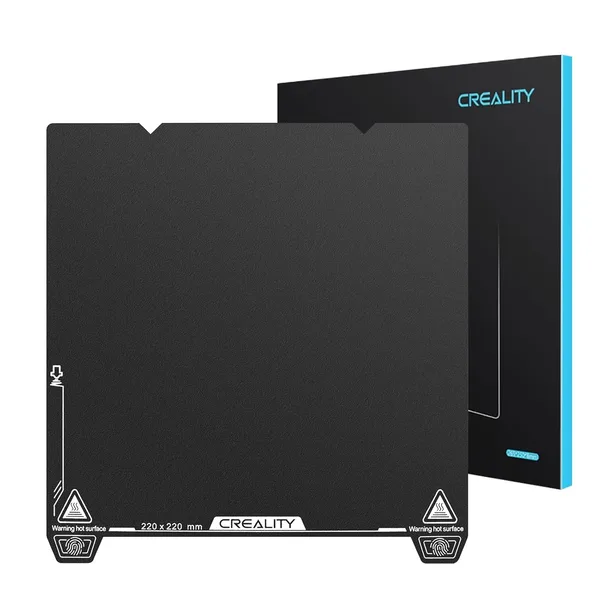
That's where this bed comes in — the stock 235x235mm geometry, spring steel with a magnetic backing, epoxy resin on both sides. Yes, both. And that's the real practical selling point: when one side wears out or gets gunked up with glue or acetone from ABS, you just pull the sheet off, flip it, and keep working. Essentially two beds in one, until you've worn through both.
What this looks like in actual printing
The magnetic base holds to the printer's bed the same way the factory one does — set it down and it sits flat on its own, no skewing. That matters, because a crookedly placed plate means calibration is off across the whole surface, and you end up chasing a 0.1mm discrepancy at the corners for hours. Not an issue here — the fit is clean.
Adhesion behaves exactly as expected for this type of epoxy texture: PLA sticks confidently even without glue, just wipe the bed with isopropyl alcohol before printing — not optional, since greasy fingerprints genuinely ruin the first layer. PETG grips a bit more aggressively than you'd like, and if you try pulling off a large model with a solid base before the bed cools, you'll need a scraper. With ABS and ASA, don't expect miracles without a glue stick or hairspray — standard practice for any epoxy coating, nothing new here.
Compared to the original bed that ships in the box, there's genuinely no difference — which makes sense, since it's the same coating technology. In other words, this isn't an upgrade in the sense of "printing got better," it's exactly a worn part swapped for a fresh one at the same level. If you're after something dramatically better, look toward textured PEI with a "porcelain-like" finish, or smooth spring steel with a double PEI-plus-smooth side — part removal is easier there and adhesion is more even across large surfaces. But that's a different price bracket, and honestly, for a home printer without commercial workload, it's overkill.
What genuinely gets annoying: the sheet's edges can curl a bit over time if you frequently bend the plate sharply to pop models off. Bend it gently along the diagonal and you're fine; yank one corner hard and you'll get a wave. Minor, but noticeable after six months of active printing.
Who should buy it, and who shouldn't
Get it if you have exactly an Ender 3 V3 SE (or a size-compatible model at 235x235 — check the magnet fit before buying, it's not always universal across Creality's lineup) and your stock bed has already given up: shiny worn patches, scraper scratches, glue stains that won't come off with anything. For the price of a movie ticket, you buy yourself at least another six months of stable printing, and that's a fair trade. Especially handy if you print in batches and want to flip the sheet instead of cleaning it every time.
Don't bother if you're expecting some kind of breakthrough in surface quality, or if you plan to print mostly ABS/ASA without additional adhesion aids — that needs a different coating type or glue regardless. And if your printer isn't an Ender 3 V3 SE and doesn't share that bed size, don't even look this way — the magnet simply won't fit.
The price here is symbolic — around $14 per unit; for the full cost with shipping and import duty to your own country, check the landed price on the product page. This isn't a purchase that requires much deliberation. Buy it and forget about the problem for the next several months.
Frequently asked questions
FAQ
By size, 235x235mm formally fits many models in the Ender 3 lineup, but the magnet seating and mounting points can differ between revisions. It's better to check your own magnetic backing's size before buying — if it's also 235x235 and a plain rectangle, you'll have no issues.
If you mostly print PLA and current adhesion is good enough, no — the premium won't show in noticeably better quality. Textured PEI makes sense if you frequently work with engineering plastics or want less hassle removing parts without a scraper.
In practice both sides perform identically — it's not a "main and backup" setup, just two fully functional working surfaces. The difference only appears over time with wear, once you start reserving one side for critical prints.
For PLA and PETG, usually not, if the bed is clean and properly calibrated. For ABS or ASA, a glue stick or hairspray doesn't hurt — standard practice for epoxy coatings regardless of brand.