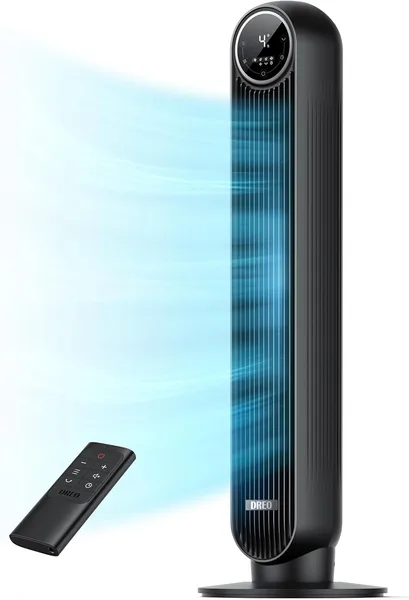
DREO Tower Fan for Bedroom (2026): Should You Buy This Quiet DC Fan?
DREO Tower Fan for the bedroom isn't about one massive hurricane blowing through the room—it's about making a fan stop being that thing that keeps you awake. The DC motor is genuinely quiet at low speeds, at high speeds it's no longer that "20dB," but it's not the hellish hum either. Get it if you sleep light and live without AC; if you need to blow out summer heat in a big living room in fifteen minutes, look for a more powerful tower fan.
Three nights in a row without sleep because a regular fan won't stop buzzing—sound familiar to anyone who's tried to survive a hot July in a no-AC apartment? Or you wake up alternating between freezing in direct airflow and sweating in dead air. That's exactly the frustration I started testing DREO from.
First impression—the box comes compact, assembly takes five minutes with zero instruction needed, just slot the tower into the base and click. No screwdrivers, no extra parts disappearing under the couch. This is already a plus because half the tower fans I've seen need an entire assembly quest just to attach the control panel.
Then comes the interesting part—the reason to even consider it. The DC motor here isn't marketing speak, it's the actual reason why this fan can sit next to your bed. Regular AC motors in tower fans still hum even on low speeds—low-pitched, monotonous, the kind that gets annoying after an hour even if you usually sleep through anything. The DC motor works differently: on the first two or three of six speeds, it's genuinely barely noticeable, you can actually forget it's on and only hear the air moving. The advertised 20dB at minimum is no fantasy—that's roughly the level of rustling leaves outside your window.
The catch, and I'll be honest here, is that those advertised decibels only apply to the absolute lowest speed. When summer truly hits and you want real airflow instead of a light breeze, you have to crank the dial to the fourth or fifth setting—and then the fan becomes audible, though without the metallic whine that cheap models have. It's honest noise, not torture. But the marketing "20dB" on the box makes you expect silence at all speeds, and that's not realistic—airflow can't be powerful and silent at once, physics doesn't allow it.
Airflow speed—another thing to discuss separately. The advertised 28 feet per second (just under 9 m/s) at peak is respectable for a fan this class, and in a small bedroom of 12-15 square meters it genuinely clears stuffiness in a couple minutes. But in a 25+ square meter living room or a kitchen where the stove adds heat, you feel the fan running out of power—you end up placing it closer or running it at max, and at max you're back to audible noise, as I mentioned.
The remote and timer function—a nice detail that manufacturer websites oddly leave out. You can set it to shut off after an hour or eight, and not wake up at 4 AM freezing because the fan's been blowing directly at you all night. Oscillation also works smoothly without jerky movements, though the sweep angle isn't the widest on the market—for large rooms better put it in the center rather than a corner.
Who should get DREO and who shouldn't? If you live alone or as a couple, can't sleep with sound, and the main goal is "stop this thing from being that noise-maker while I sleep," this is exactly it. Set it to speed two or three and forget it's running. But if you need to clear real heat from a large space, office, or fight 35-degree summer, DREO won't cut it—you'd need two fans or look at mobile AC or a more powerful industrial fan with bigger blades.
The second real compromise is price. They're asking a sum for this fan that would easily get you a simple mechanical fan with three speeds and buttons in a local electronics store. The premium here is purely for quiet operation and smooth DC motor, and if that's not critical to you, paying extra doesn't make sense. But if you've ever tried to fall asleep under a buzzing fan, you'll understand what you're paying for.
Questions people actually search before buying
FAQ
On low speeds—yes, it's almost imperceptible, and that's exactly why DC models are worth getting instead of standard AC fans. But if summer forces you to run the fan at speed 4-5 for serious airflow, expect normal noise—silence only works at weak breeze settings.
Bladeless wins on looks and safety for kids, but is almost always more expensive and weaker at airflow. DREO blows stronger and quieter than most bladeless models, loses on style—regular tower with visible blades inside the grille, safe for kids though.
No, and don't plan on it. In a 12-15 square meter bedroom it's ideal. 25+ square meters you'd need it on max constantly, which defeats the 'quiet' purpose, and it still won't cool like a real AC or mobile split-system.
If you sleep light and the fan sits next to your bed all night—yes, the difference in noise is felt right away. If the fan is just "something to blow air during the day" in another room, the cheaper AC version does the job fine.
The fan itself costs around $95 on the marketplace, before shipping and tax to your country, which adds to the total. If you're looking for bedroom or small living room cooling options, check out other air solutions below.