ELEGOO PLA+ White 1kg Review: Is It Worth Buying
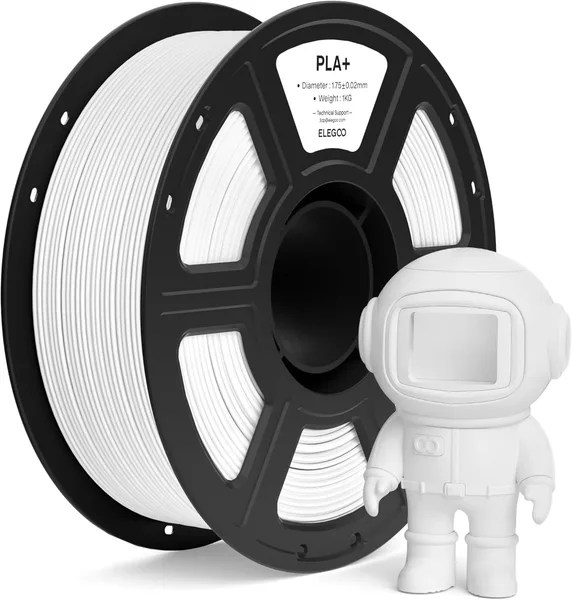
ELEGOO PLA+ White is a workhorse, not a fussy exotic: it prints cleanly on default slicer settings, snaps far less often than regular PLA, and barely smells. It's not the cheapest spool on the market, but if you're tired of digging out a fresh roll every morning because the filament snapped overnight, this is exactly the case where paying a bit more pays off.
You know the feeling: you're eight hours into a print, half an hour left, and the filament snaps right at the extruder entry. Again. With cheap no-name PLA it happens often enough that you start parking the printer near the door just so you can hear the click of the filament runout sensor the moment a new spool needs loading. That's exactly why I picked up ELEGOO PLA+ White — not because the brand is special, but because I was done taping broken ends back together at two in the morning.
How it actually behaves
PLA+ (also called PLA Plus, or "Pro" depending on the manufacturer) isn't a separate material — it's a formula with copolymer additives meant to make the filament less brittle. In theory. In practice, the difference shows up the moment you unspool it: no crunching, no snapping when you bend it around a finger to feed it into the Bowden tube. Small thing, but small things are exactly what wear you down in 3D printing.
I printed on an Ender 3 with the default profile — 200°C nozzle, 60°C bed — no fighting with settings, the first layer went down clean. I also bumped the temperature to 210°C to test layer adhesion on a tall, thin-walled part, and it held up better than standard PLA, with almost no delamination even on unsupported overhangs. The white, for what it's worth, is genuinely white — no yellow tint, which is something cheap budget spools tend to develop after a few months on the shelf.
The real practical win with PLA+ isn't print quality — it's that parts survive a fall off the desk without snapping in half. Regular PLA shatters like a cracker for me; PLA+ bends and only then breaks, if at all. For functional parts — brackets, cable management clips, electronics enclosures — that's a genuinely different strength category.
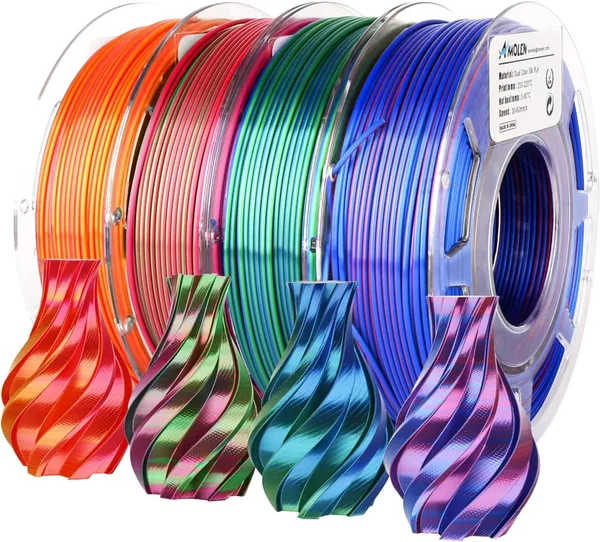
Against the competition — and I'll say it straight — ELEGOO PLA+ isn't revolutionary. SUNLU does roughly the same thing for similar money, and AMOLEN's silk line is aiming at a completely different niche — there, surface aesthetics matter more than strength. ELEGOO plays the reliable middle ground: not the cheapest, not the most premium, but predictable. And predictability is something I'm personally happy to pay for when the printer is running unattended overnight.
What's annoying
Moisture absorption is the Achilles' heel of any PLA+, and ELEGOO is no exception. The silica-gel packaging holds it off for the first couple of weeks, but if you're in a humid apartment or garage, within a month or two you'll start hearing that telltale crackling during extrusion — that's water boiling off right inside the nozzle. Small bubbles and "whiskers" start showing up on the surface. The fix is simple — a filament dryer, or at least a few hours in an oven at 45°C — but it's extra hassle you'd rather know about in advance than discover the hard way.
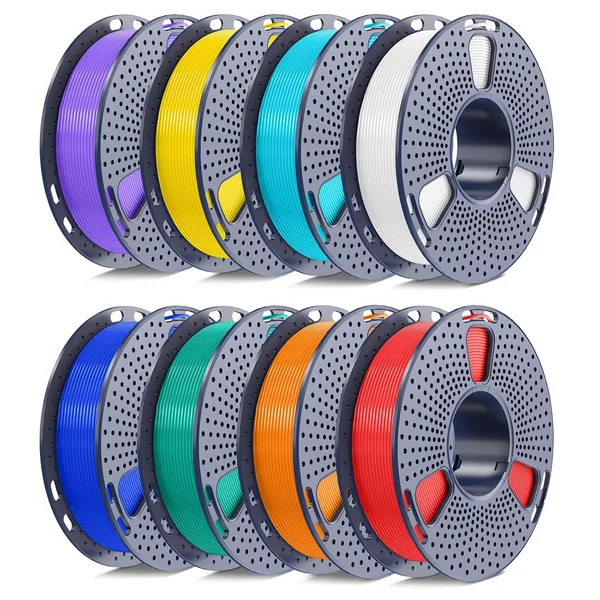
Second gripe: the spool itself is plastic, not cardboard, and takes up more shelf space than you'd like if you're juggling a lot of colors. Minor, but if you're running a rack of 20+ spools, it genuinely affects how many fit.
Who should buy it, and who shouldn't
If you're new to this and roughly understand that PLA is the default plastic for 90% of home printing, ELEGOO PLA+ White is a safe pick — it barely needs tuning and forgives bed-calibration mistakes. If you're already experienced and chasing maximum dimensional accuracy or a specific surface finish, look at engineering materials or silk PLA for decorative pieces instead — that's not what PLA+ is built for.
Skip it if your space runs humid and you have no way to store the spool airtight — the strength advantage will evaporate faster than it pays for itself. And don't expect miracles: it's still PLA, meaning it'll happily deform next to a hot cup of coffee on a sunny windowsill. Heat resistance was never the point here.
Rather than quoting a single price that won't hold across markets, check the full landed cost on dede.sh — item, forwarding, and import duty rolled into one number for your country.
FAQ
Genuinely stronger, but not dramatically so. The difference shows up most in impact resistance — a PLA+ part tends to bend and partially crack rather than shatter into pieces the way regular PLA does. For frames, brackets, and enclosures, that's noticeable. For decorative figurines, you'll barely tell the difference.
If the no-name spool already prints reliably on your machine, not necessarily. But if you're dealing with snapped filament, clogged nozzles, or color drift between batches, a branded spool like ELEGOO or SUNLU is cheap insurance against the headache — not just a status purchase.
For functional parts, PLA+ wins hands down — it's stronger and less brittle. Silk PLA looks great, with that distinctive pearlescent shine, but the surface is softer and scratches more easily; it's really a material for keepsakes and decor rather than load-bearing parts.
No — for the first week or two, the moisture-barrier packaging with silica gel handles it on its own. But if the spool sits open in a room for longer than a month, especially in summer humidity, a dryer or the occasional oven session will extend its life and save you from bubbling in your prints.
A few alternatives worth comparing before you buy: