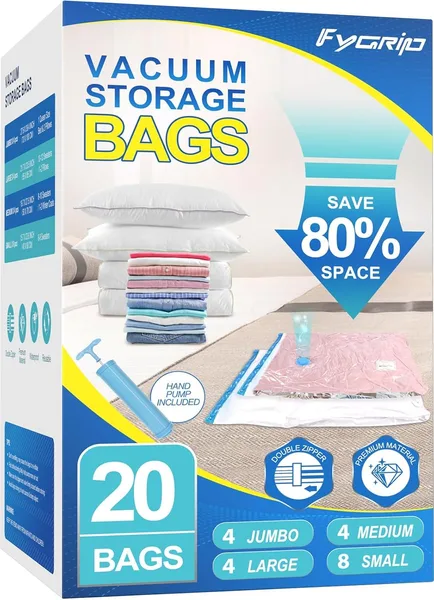
Fygrip Vacuum Storage Bags With Hand Pump: Review — Worth Buying?
Fygrip is a basic set of vacuum bags with a valve for a hand pump — no electricity, no miracle promised on the box. Down jackets and duvets compress beautifully; wool sweaters, less so than the packaging suggests. For the price, it's a solid pick for a closet or a suitcase, but it's not a replacement for a real vacuum cleaner if you're packing dozens of items every season.
Anyone who's ever wrestled a winter duvet into a studio-apartment closet knows the feeling — the door won't shut, and the duvet just sits there looking smug about it. That's exactly the situation I was in when I picked up Fygrip's vacuum storage bags with hand pump, hoping to find out whether you can really shrink your stuff by 80%, as the manufacturer claims, or whether that's just another exaggerated number lifted from the packaging art.
What this thing actually is
These are heavy-duty bags with a membrane valve and a separate hand pump — think of the kind you'd use to inflate an air mattress, only smaller and working in reverse, sucking air out instead of pushing it in. You load your stuff in, zip the top seal, press the pump against the valve, and start pumping. No vacuum cleaner required, which is the entire reason people buy this kind of kit instead of the standard bags that clip onto a household vacuum's hose.
And here's the first honest truth about it: a hand pump is manual labor. On a big bag stuffed with a winter coat, it took me about ninety seconds and felt totally fine. But when I tackled a bag with two duvets in it, that stretched to five minutes and left my palms a little sweaty. Not a dealbreaker, but if you have arthritis or just hate manual effort, the electric pump that sometimes ships with pricier kits is the more pleasant option.
How well it actually compresses things
The down jacket and the synthetic-fill coat compressed pretty much as promised — volume dropped by a factor of four or five, which does look like that advertised 80% at a glance. Nearly all the air came out, the valve held its seal, and nothing had puffed back up a week later.
Wool sweaters and a throw blanket told a different story. Wool just doesn't "give" the way synthetics do — it's springy, and no matter how much you pump, past a certain point the bag stops shrinking further even though air is still visibly leaving it. That's not a flaw specific to this product; it's wool physics, and you'll see the same thing with pricier brands like Space Bag or SpaceSaver — they're just more upfront about it in the spec sheet, whereas here you find out the hard way.
One thing nobody mentions in the listing: the valve is the weak link in the whole system. If you pack anything sharp — winter boots, for instance, often have stiff soles with ridges — you risk puncturing the film, and the whole effect disappears within an hour. That happened to me with a bag holding sneakers: the puncture was microscopic, but the vacuum was gone by morning. Wrap shoes or anything pointy in something soft before you pack them.
When this actually makes sense to buy
If you already own a vacuum cleaner with a hose attachment, honestly, the standard bags that hook up to it are cheaper and work instantly, no hand-pumping required. Fygrip's hand-pump version wins in exactly one scenario: when there's no vacuum cleaner nearby. On a trip, at a summer house, staying with relatives, mid-move when the vacuum itself is already packed in a box while your clothes aren't. Or simply when you don't feel like hauling a full-size vacuum out just to deal with one bag of blankets.
The second spot where the hand pump wins is a travel suitcase. You can't bring an electric vacuum with you, but a small hand pump weighs almost nothing and takes up about as much room as your palm. If you fly budget airlines and count every centimeter of carry-on space, this genuinely helps — a compressed jacket or a spare set of clothes frees up half a packing cube's worth of room.
The honest verdict
Worth buying if: you're packing seasonal items — coats, duvets, pillows — for storage in a closet or under the bed, you travel often and want to shrink your suitcase volume, or you're moving and want to save box space without buying a dedicated vacuum cleaner.
Skip it if: you already own a vacuum cleaner with attachments — standard bags will be both cheaper and faster in that case. Or if most of what you plan to pack is wool sweaters, throws, or down jackets with a lot of natural feather fill — the compression there is noticeably more modest than the advertised 80%, and you may end up disappointed.
Rather than quoting a single price tag here, check the full landed cost to your country on dede.sh — item price, forwarding, and import duty rolled into one number, so you know exactly what you're paying before you order. It's not a one-winter purchase, either: handled carefully, these bags last several seasons, which brings the per-use cost down to almost nothing. The main rule is simple — don't puncture the valve, and don't pump in sharp jerky strokes, since the seam around the valve is the weakest point in the whole design.
FAQ
On dense synthetic items — coats, pillows, bedding — yes, roughly that. On wool, bulky down, and throws the number is smaller, realistically closer to 50-60%. It's not a scam, just a marketing figure for the best-case scenario.
If a vacuum cleaner is always within reach, get the bags that attach to its hose — faster and cheaper. The hand pump only makes sense when there's no vacuum nearby: travel, a summer house, moving day, a suitcase on a flight.
You can, but be careful and wrap the sharp parts in fabric first. The valve and film puncture easily, and once that happens the vacuum seal lasts a few hours instead of a few months.
No — if you have a big family and a mountain of winter gear, you'll need several sets or larger bags bought separately. For one or two people, a standard set is plenty.
Other things worth a look alongside vacuum storage bags — handy for a closet or a workshop: