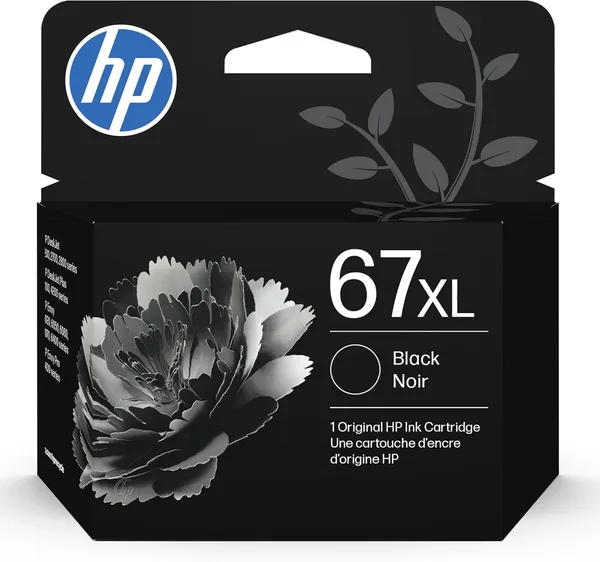
HP 67XL Black: is the high-yield cartridge worth it?
HP 67XL Black is the exact same black cartridge as the regular 67, just bigger — it costs more per unit, but it prints noticeably longer, so the cost per page ends up lower. If you've got a home DeskJet, Envy or similar model and you print regularly rather than once a quarter, going XL makes sense. If your printer sits idle for months at a time, genuine HP ink can dry out inside the cartridge before you ever get through it.
You know the drill: the printer sits in the corner, gets switched on once every couple of months to spit out a receipt or a form from your kid's school, and every single time it throws up that irritating low-ink warning. You run out, buy a cartridge, and two months later you're doing it all again. Which raises the obvious question — why not just buy the one that "prints more" and forget about this cycle for half a year?
That's basically the entire pitch behind HP's XL version of the 67. The idea is dead simple: same ink chemistry, same chip, same print head — just a bigger tank. HP doesn't hide the numbers: by their own testing methodology (ISO/IEC 24711, for anyone who cares), the black XL version prints roughly double the pages of the standard 67. In practice that figure swings depending on what you're printing — solid text versus graphics with heavy fills — but the direction holds.
What it's actually good for
This cartridge is compatible with a fairly wide range of HP printers — DeskJet 1255, the 2700 series, the 4100 series, Envy 6000 and related models. So it's not some niche accessory locked to one specific machine, it's a typical "household" cartridge that fits most budget HP inkjets from the last few years. If that's your printer and you print at least once a week — bills, school assignments, work-from-home forms — the XL earns its keep. Fewer store runs, fewer moments where you need to print something right now and the ink's just died on you.
But if your printer is the kind of device that gets turned on twice a year, honestly, the high-yield cartridge isn't the smart pick. Here's the catch with inkjet printing in general: water-based ink slowly dries out even inside a sealed cartridge, especially if the printer sits idle for long stretches without running its nozzle-cleaning cycles. A bigger ink reservoir in that scenario just means more ink drying out unused, not more pages printed. In that case you're better off with the standard 67 (less money tied up and wasted), or honestly consider a laser printer if your printing is rare and mostly text.
Genuine versus compatible — and why it matters
The main reason to buy genuine HP rather than a no-name cartridge for half the price is the chip and the calibration. HP locks compatibility down hard through printer firmware, and cheap alternatives regularly run into bugs — the printer refuses to recognize a refilled cartridge, or colors start drifting after a few weeks. With genuine HP, that kind of surprise is rare — HP has spent years tuning its ink chemistry to specific print heads. That doesn't mean compatible cartridges are always a bad idea, it's just a separate conversation about risk versus savings, not about quality right out of the box.
Compared with something like Canon PG-245XL or Epson 202XL — typical rivals in this same home-printer segment — the HP 67XL doesn't do anything extraordinary. It's just a solid, predictable option with no surprises. Text printing is crisp, blacks are rich, and there's no smearing on standard office paper. It obviously handles photos and graphics worse than three-color systems with separate cartridges per color — but that's not really its job. This is a home-office cartridge, not a photo-studio one.
The price question
This cartridge runs around $31 in the US — not exactly cheap for a single "ink bottle," but that's a normal price for a genuine HP high-yield in this category. Once you factor in shipping and all the duties and fees that apply once it lands in your own country, the real number changes — you can check the full landed cost (item plus forwarding plus import duty) for your country right on dede.sh before you buy. And it's worth doing that math honestly: does double the page yield justify roughly double the price versus the standard cartridge? In most cases, yes — because shipping and logistics are fixed costs regardless of cartridge size, so the XL version is actually where you save on a per-page basis.
The honest verdict
Worth buying if you have a home or small-office HP printer on the compatibility list and you print regularly — once a week or more. At that pace, the XL genuinely saves you both money and hassle: fewer low-ink warnings, fewer reorders. There's one real trade-off, though, and it's a fair one: if your printer sits idle for long stretches, a big ink reservoir might not get used up before it dries out — and then the XL premium becomes pure waste. One more thing to plan around: this cartridge is black only, so you'll still need to buy a separate tri-color cartridge for color printing.
FAQ
Honestly, no. If your printer only gets switched on once a month or less, the standard 67 will cost you less and the ink won't sit around drying out unused. The XL only pays off with regular printing.
Mostly predictability: the chip and ink are calibrated for that specific print head, so there's no risk of the printer refusing to recognize the cartridge or colors drifting after a few weeks. Compatible cartridges are cheaper, but you're gambling on quality.
HP's compatibility list is pretty strict — check your exact printer model before buying rather than hoping it "should work." The 1255, 2700, and 4100 series, plus the Envy 6000, are confirmed compatible.
No, this is a black-only cartridge. You'll need a separate HP 67 tri-color cartridge for any color printing — without it, the printer can't produce color at all.
Similar picks for home and office — worth a look before you buy: