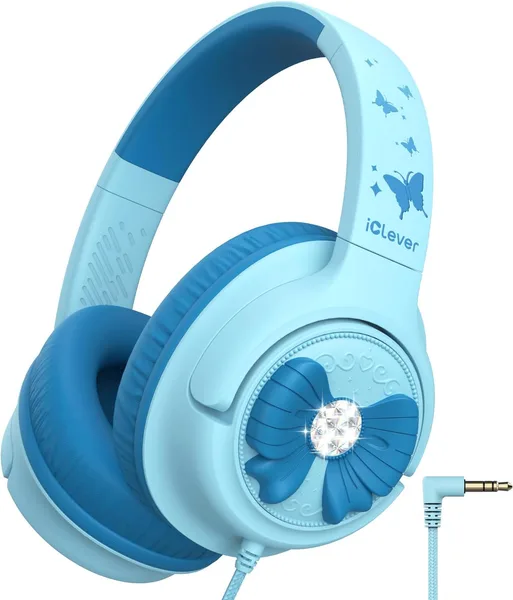
iClever C371 Kids Headphones Review: Are Volume-Limited Ones Worth It
The iClever C371 is a basic pair of wired kids' headphones with a hard 85dB volume cap, soft ear cushions, and a price around ten bucks. It's not an audiophile product and was never meant to be one: its only job is to stop a kid from blowing out their hearing during an hour of cartoons on the tablet. It does that job well. Everything else is a C-minus, and at this price, that's fine.
Full landed cost — including shipping and import duty for your country — is on the product page.
You know the scene: kid's got headphones on, volume cranked to the max, you're yelling something about "turn it down" — and silence is the answer, because she genuinely can't hear you. At some point I just stopped fighting it and started looking for headphones that physically can't go too loud. That's how the iClever C371 ended up on my list.
What these actually are
These aren't some wireless gadget with blinking cat ears — they're plain wired over-ear headphones with soft cushions and an adjustable headband. The headline feature is a hardware volume limiter capped at 85dB. That's not a marketing number slapped on the box; audiologists genuinely recommend that threshold as safe for extended listening in kids' ears, versus the 100+dB that "adult" headphones can push at full volume. So even if your kid cranks the tablet's volume slider all the way up, their eardrums stay intact.
The cord is, on one hand, a reason for skepticism these days when everyone's used to Bluetooth. But for kids' headphones it's actually a plus: no charging, no dropped connections, no temptation to fiddle with pairing buttons in the middle of a Zoom class. Plug it in and it works. The downside is obvious too: cords tangle, catch on cupboard doors, and if your kid is the active type, sooner or later that cable either knots itself up or gets yanked off her head by the kid at the next desk.
How they hold up on a kid's head
The headband folds flat and slides into a side pocket of a backpack — genuinely useful for school runs. No need for a separate case; just toss it between the notebooks and go. The cushions are soft and on-ear rather than in-ear, so kids who hate the feeling of something jammed into their ear canal usually tolerate these far better than earbuds.
Sound is the weakest link here, and I won't sugarcoat it. Bass is thin, detail is thin, this is average budget sound tuned for audiobooks, school videos, and cartoons — not for music with any real ambition. If you're hoping your kid will appreciate soundtrack nuance, look elsewhere. But honestly: a nine-year-old watching Gravity Falls on a tablet in the back seat doesn't care about the difference between "good" and "fine." She cares that it's audible and doesn't hurt her ears after two hours on the road.
Passive noise isolation is weak — the cushions just rest over the ear without a tight seal. In a quiet room that's a non-issue, but on a plane or train your kid will crank the volume up to the maximum allowed limit to drown out engine noise — and that's exactly where the 85dB cap turns from a restriction into a lifesaver.
What it's up against, and why
The obvious rival in this space is Puro Sound Labs, which does much the same thing but costs more and leans into the "premium kids' audio" angle. The sound difference is noticeable but not enough to justify double the price for headphones your kid will absolutely chew on, drop, or leave on the school bus within the first year. There's also the option of just buying regular cheap adult headphones and hoping your kid self-regulates the volume — but ask any parent, that's a fantasy. A hardware limiter is the only thing that reliably works, because it doesn't depend on a seven-year-old's self-discipline.
The iClever C371 runs about ten dollars at the listing, and this is one of those rare categories where paying for a brand name gets you almost nothing extra — the core function, volume limiting, is implemented at the same level here as in models three times the price. The extra money mostly buys design, color options, and slightly better sound your kid won't notice anyway.
Who should buy it, and who shouldn't
Get it if you've got a kid between 3 and 10 who's constantly on a tablet or phone for cartoons and audiobooks, and you want to stop worrying about their hearing. Get it if you want a backup set for the car or a trip — the price lets you buy two or three pairs without stressing over losing one. Get it if your kid hates in-ear buds.
Skip it if you're shopping for a teenager who's already into music and cares about sound quality — look at regular, non-limited headphones instead. Skip it if wireless is a dealbreaker for you — with a cord, you'll be dealing with the occasional tangle and the risk of someone yanking it off their head. And be honest with yourself: if your kid destroys and chews through everything, nothing here will save these headphones from physical destruction — the cord will snap just like any other.
The one real trade-off here: you're consciously giving up sound quality for hearing safety and price. To an adult, that sounds like a bad deal. To the parent of a seven-year-old, it's the only deal that makes sense.
FAQ
It's a hardware limit — volume physically can't exceed that threshold, no matter how far the source device's volume slider is pushed. It's hard to verify by ear, but this is a standard, well-established technology for kids' headphones, not a marketing gimmick.
Physically, yes — the build is foldable and not fragile. But wired headphones in a kid's backpack statistically don't last as long as you'd hope, so at this price it's smart to just buy a spare pair up front.
If your kid is under 8 or 9, wired is simpler and more reliable — no charging, no connection issues to manage. Bluetooth starts making sense for older kids who need to avoid tangling cords during breaks.
Only if design or slightly better bass matters to you. The core safety feature — volume limiting — is implemented the same way in both budget and pricier models in this category.
Related products worth checking before you buy: