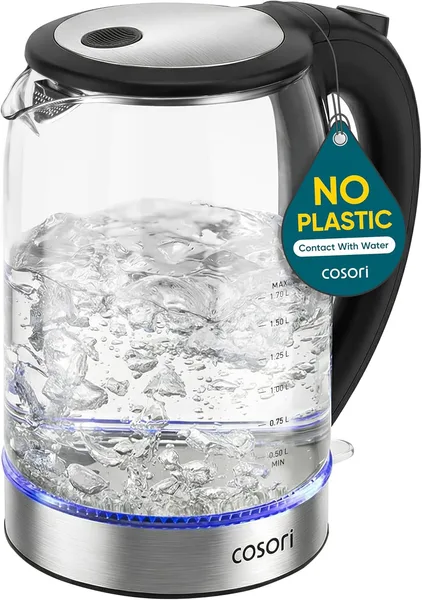
Cosori Electric Kettle No-Plastic-Contact Review: Worth Importing
A good kettle — glass plus steel, no plastic near the water, a wide neck you can actually reach into with your hand to clean. But this is a US appliance running on 120V and 1500W, not the 220-240V most of the world uses, and that's where the story ends for most buyers outside North America. Only buy this if you already have, or definitely will get, a transformer rated for that kind of power draw — otherwise it's a pretty box that'll sit on a shelf.
For the full cost with shipping and import duty to your own country, check the landed price on dede.sh.
How many times have you poured hot water from a cheap kettle and caught that specific aftertaste — like licking a plastic ruler? Cosori sets out to fix that immediately and decisively: nothing inside touches the water except glass and stainless steel. Lid, spout, inner wall — glass and steel throughout. Sounds minor until you go two weeks without that aftertaste. After that, you don't want to go back.
What this kettle actually is
The Cosori Electric Kettle is a clear borosilicate glass carafe holding 1.7 liters, with a metal heating base and a lid free of plastic inserts on the water side. The neck is wide — not a marketing gimmick, your hand with a sponge genuinely fits inside, and limescale is visible and scrapes off in a minute rather than soaking overnight in vinegar. Auto shut-off is standard: it boils, the relay clicks, the kettle turns itself off, no risk of forgetting it and burning out the element. Compared to something like the Comfee Stainless Steel Electric Kettle at 1500W, the specs are nearly identical, but Cosori clearly wins on neck width alone — many competitors, including Comfee, have a narrower opening that needs a bottle brush rather than a hand to clean.
Design-wise, this isn't a fancy device with backlighting and temperature presets like the Chefman with its five presets — it's simple: turn it on, it boils, it shuts off. For some, that's a plus — less electronics, less to break. For anyone used to picking a specific temperature for green versus black tea, this will be a letdown: there's nothing like that here.
Now, the elephant in the room
Here's where the most important part of this review starts, and honestly, it's the whole reason to read to the end. This kettle is rated for 120 volts and draws 1500 watts. Most of the world runs on 220-240V mains. This isn't a minor detail like "buy a plug adapter for pocket change." We're talking about a full step-up transformer capable of sustaining 1500W without overheating. Units like that cost as much as the kettle itself, often more, weigh several kilos, and frankly hum unpleasantly.
Compare it this way: take a 1500W hair dryer and plug it into a cheap consumer voltage converter rated for 300-500W "for electronics" — it either won't start, or it'll fry the converter within minutes. Kettles have the same problem, except there's also water involved, and the cycle repeats daily, multiple times. This isn't an appliance you can "just plug in through an adapter and forget about."
Who can genuinely buy this kettle with a clear conscience: people moving to the US or Canada who want something nice for their new home there; anyone who already owns a heavy-duty transformer for other American appliances (say, for a coffee machine or a stand mixer) and can plug in one more device; or anyone bringing it as a gift for relatives living in North America. If you're planning to use it in an apartment running standard 220-240V mains without additional equipment, this isn't the product for you, no matter how good it looks in photos.
Why it's still worth knowing about
Even with the voltage warning, this review isn't "don't buy anything American." It's specifically about high-power heating appliances — kettles, irons, hair dryers, toasters. Low-power electronics (chargers, power banks, some kitchen gadgets under 100-200W) run just fine through a decent converter. So Cosori is useful as an example: before adding anything marked "120V" from a US catalog to your cart, check the wattage. The higher it is, the less sense it makes to ship it across an ocean for daily household use.
If you want exactly this kind of kettle — glass and steel, no plastic touching the water, a wide neck — but need it to work in your local outlet straight out of the box, look at brands rated for your region's standard voltage instead. This is one of those rare cases where paying extra for the "right" voltage is fully justified: no fiddling with wires, no hoping a transformer doesn't start smoking at night.
Bottom line
The kettle itself is well made: good materials, a comfortable neck, honest auto shut-off, no unnecessary plastic near the water. If it were sold with the right voltage rating for your region, I'd recommend it without hesitation — it's one of the simplest, healthiest options in its class. But buying one from a US marketplace to use daily for tea somewhere with different mains voltage is a bad idea unless you're ready to separately invest in a heavy, pricey transformer. Honestly, for most people, it's simpler and cheaper to find a similar kettle with the right plug and voltage and skip this headache entirely.
FAQ
No. An adapter only changes the plug shape, not the voltage. The appliance is rated for 120V, and if your outlet runs 220-240V, without a transformer it either won't work or will burn out almost immediately.
No, absolutely not enough. The kettle draws 1500W continuously while boiling, and cheap consumer converters are built for electronics, not high-power heating appliances. You need a dedicated heavy-duty transformer rated for that load.
They're close in materials and the "no plastic touching water" principle, both well made. But since this particular Cosori listing ships as 120V, always double-check the voltage marking on the specific OVENTE listing before buying — that decides everything for a buyer outside North America.
If you've ever noticed a plastic aftertaste in boiled water, yes, absolutely. The price difference is small, and the daily comfort is noticeable.