Creality PETG 2kg (Black + White) Review: Worth Buying for 3D Printing
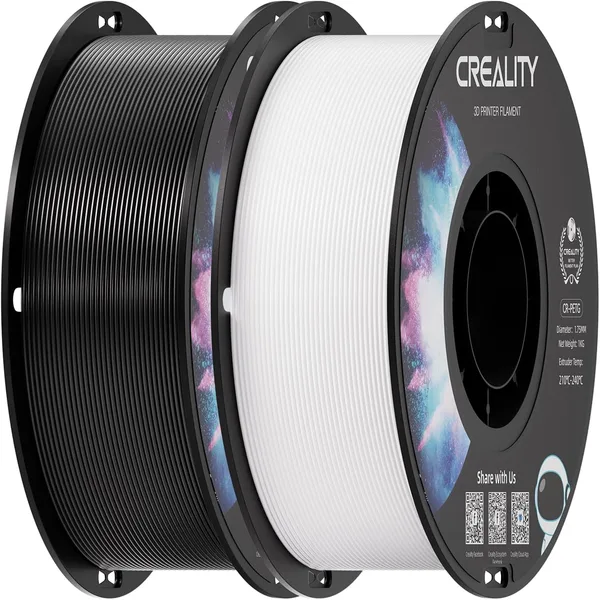
Two kilograms of PETG from Creality (black + white) for a price barely above what one regular kilogram costs at local shops. Prints consistently, handles impact better than PLA, and isn't nearly as moisture-sensitive as it first appears. Worth buying if you have a Bowden extruder and a bit of patience for calibration — for a direct-drive extruder with retraction, it's even easier.
There was a period when I swapped PLA spools every couple of weeks — I was printing brackets for a solar panel setup that kept cracking in the summer heat on the balcony. PLA simply can't handle temperatures above 55-60°C, and a south-facing window in summer easily exceeds that. Then a neighbor in a 3D printing Facebook group put it bluntly: "just switch to PETG already, why are you torturing yourself." That's how I ended up with this set.
First impression — the spools are smaller than you'd expect from "2kg." Creality split the weight across two 1kg spools, black and white, rather than one giant reel. That's actually a smart decision, not a marketing trick — a large 2kg spool often simply doesn't fit budget printers like the Ender 3 without modifying the filament holder. Here you just load a regular spool as usual, no jury-rigged brackets needed.
How it behaves under the nozzle
PETG is a material with character. It flows more than PLA at the same temperature, so if you just copy your PLA profile, you'll get stringing on outer walls and "whiskers" between elements. It took me about three test prints to dial in retraction speed and bump the bed temperature up to 80°C. After that — silence, layers lay flat, and adhesion to the glass bed is so strong you sometimes need a scraper rather than just peeling it off by hand, unlike PLA.
The black filament turned out slightly darker and glossier than in product photos — normal for PETG, which always has a bit of a sheen unlike matte PLA. White prints slightly worse, with a faint yellowish tint on thin walls at high temperatures — a typical issue with white PETG filaments in general, not just Creality's.
The main reason people buy PETG at all is impact strength and heat resistance. The brackets I used to break on PLA have survived a second heat wave on this material without a single crack. Printed containers for the garage don't deform either, even when a car interior hits 50°C in summer. This is exactly the scenario where PLA loses by definition, and ABS demands an enclosed chamber and stinks up the whole house — PETG sits somewhere in between: less smell, less warping, easier to print than ABS.
Compared to Creality's own PLA — probably the most common comparison people search for — PETG clearly loses on fine detail and wins wherever durability matters. If you're printing miniatures or figurines for gifts, stick with PLA. If you're making functional parts, brackets, handles, anything that'll live outdoors or in the sun, PETG is the clear favorite here.
Moisture — a real problem or just a scare story
I went in skeptical, having read forum posts claiming you basically need an industrial dehydrator for PETG. In practice — yes, the material is hygroscopic, and if a spool sat open for a month in a damp basement, prints start "crackling" and bubbling on the surface. But under normal apartment conditions, keeping the spool in a bag with silica gel between print sessions, I had zero issues over two months of use. Just don't leave the filament lying on a balcony in winter, and you're fine.
Who should buy it, who shouldn't
If you have a Bowden printer (the Ender 3 and most budget Creality models), this set fits almost perfectly — there are fewer retraction issues with PETG thanks to the longer feed tube. Direct-drive extruder owners are fine too, just expect the first dozen prints to go toward dialing in the profile — a normal cost of switching from PLA.
Skip it if you need perfect detail for miniatures or cosplay props — resin or even quality PLA beats PETG there. And skip it if you don't have a proper storage box for filament — moisture will eventually show itself, especially in humid autumn weather.
The marketplace price is around $22 for the whole set, roughly $11 per kilogram, which is fair for PETG and even a touch below market average. For the full cost with shipping and import duty to your own country, check the landed price on dede.sh — but compared to local shops where a kilogram of unbranded PETG costs similar money, here you at least know the material is consistent batch to batch, which for 3D printing often matters more than the name on the label.
Overall, this PETG set from Creality doesn't try to be revolutionary. It's a workhorse that simply delivers what it promises: holds its shape, isn't afraid of heat, prints without surprises after a short calibration. Honestly, for most home projects — brackets, mounts, containers — this is enough, and there's no real reason to spend more.
FAQ
For your first prints, go with PLA, no question. It forgives sloppy temperature and retraction settings and prints with almost no fuss. Save PETG for your second spool, once you've got the basic profiles down and want a part that won't crack in the sun.
Two kilograms is genuinely a lot for home use — enough for dozens of small parts or several medium-sized enclosures. If you're planning one big single print (say, a meter-sized electronics enclosure), calculate the weight in your slicer ahead of time — you may not have time to order more mid-project.
For everyday printing in an apartment — no, a bag with silica gel between sessions is enough. A dryer becomes necessary if the spool has sat open for a few weeks in a humid space and prints start showing crackling or surface bubbles.
The difference isn't that cheap plastic doesn't print at all — it does. But no-name brands can vary batch to batch in diameter and melting temperature, meaning every new spool requires re-dialing your profile. Creality barely has that problem, so the extra cost pays off if you print regularly, not just once a year.