Creality K2 Plus Ceramic Hotend Kit Review: Worth Buying?
The original ceramic hotend for the K2 Plus with swappable nozzles isn't an upgrade for the sake of upgrading — it's basically insurance against the exact "nozzle clogged at hour 40 of a print" scenario that drives speed-printer owners up the wall. If you own a K2 Plus and already burned through your patience on clone hotends, buy this without a second thought. If you own a different printer, this kit simply won't fit, full stop.
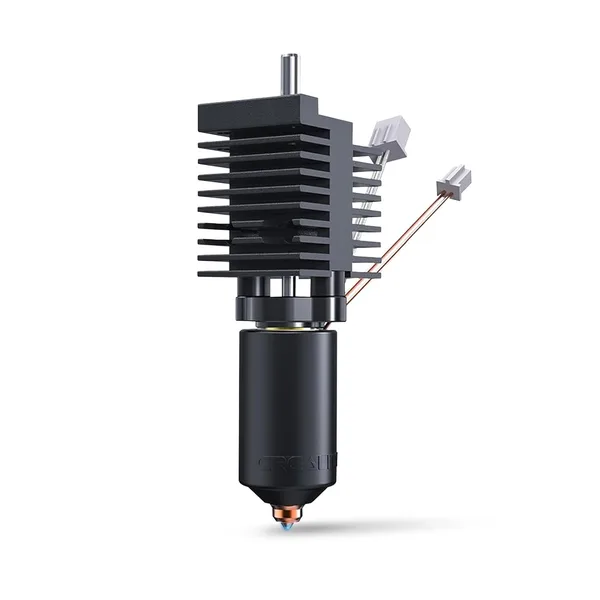
There's one thing about running a K2 Plus that Creality's promo videos are quietly silent on: the stock hotend doesn't last long at high speed with abrasive filaments — carbon-fiber nylon, any of that glow-in-the-dark stuff loaded with glass filler. First you get mild under-extrusion on fine details. Then a clogged nozzle in the middle of an overnight print, and you wake up not to a finished model but to a stalagmite of half-printed plastic sitting on the bed. Sound familiar? That's exactly why the original Creality ceramic hotend with a quick-swap nozzle kit exists.
What this actually is, and why it matters
This isn't "another copper tube with the word upgrade slapped on it." A ceramic heater block holds temperature more evenly than metal — fewer thermal dips under fast filament flow, which is exactly what the K2 Plus builds its "300mm/s in real life, not just on benchmarks" reputation on. Then there are the quick-swap nozzles. Changing a nozzle on the K2 Plus used to mean tweezers, a hot block, singed fingers, and thirty minutes of praying you don't strip the threads. Here it's seconds: unscrew, screw in the new one, keep printing. For anyone who prints PLA in the morning and switches to ABS for a functional part in the evening, that genuinely saves an entire evening.
Honestly, the first time I swapped a nozzle in 15 seconds without holding a hot block in my hand, I was a little stunned this hadn't been standard five years ago.
How it actually behaves in real prints
This is where the difference from Ender-style machines shows up. On a classic brass hotend with a copper block, abrasive filaments are a gamble: today you'll breeze through a spool of wood-fill PLA without a hitch, tomorrow you'll clog on layer three. The K2 Plus's ceramic block holds up longer precisely because the thermocouple and heater work more precisely, without the micro-swings in temperature that trigger filament partially melting where it shouldn't.
Compared to the cheap no-name K2 Plus hotends flooding AliExpress these days, the difference doesn't show up on day one — it shows up around week three or four of active printing. Clones tend to either weep at the threads or hold temperature with a spread of several degrees — invisible on PLA, but it shows up fast as seam lines or warping on ASA or PC. The original is just boringly reliable here. And that's a compliment.
There's a downside, and an honest review has to include it. The price stings compared to those clones: the kit runs $23.28, while an unbranded equivalent on the marketplaces can be found for half that. Second — this is a part built for one specific model, the K2 Plus, and "maybe it'll fit something else" doesn't work here: the fit, the heater connector, the geometry are all tailored to a single printer.
Who should buy it, and who shouldn't
Get it if you own a K2 Plus and have already been through the pain of swapping nozzles on the stock kit, or if you print abrasive materials regularly and see clogs more often than you'd like. This is that rare upgrade that isn't about looking cool — it's about fewer nerves and fewer ruined nights.
Skip it if you have a different printer — it physically won't fit, end of discussion. Also skip it if you only print PLA occasionally for kids' craft projects: the stock hotend will handle that with room to spare, and the reliability difference won't have a chance to show itself.
For the full cost with shipping and import duties factored in, check the landed price for this kit on dede.sh before ordering — it's not pocket change for a spare part, but it's also not the level where it makes sense to gamble on an unknown supplier to save a bit of money.
FAQ
No, and that's the most common ordering mistake. The mount, heater block connector, and gas venting are built specifically for the K2 Plus. The K1 series has a different fit — even if the threads seem to match, the thermocouple and heater don't line up on pinout.
For high-speed printing, yes — it holds temperature more steadily under sudden swings in filament flow. For slow home PLA printing the difference is minimal, and paying extra for it makes little sense.
If you regularly print abrasive or technical filaments, yes — the difference in temperature stability and thread quality justifies the price gap. For occasional PLA printing, a clone will probably work fine, but the guarantees are thinner.
In practice, seconds — no heat in your hands, no tweezers. That's the main reason people buy this kit at all instead of a standalone hotend.
Worth comparing a few related consumables and accessories for 3D printing side by side before you order:
Take another look at the range of consumables and printer upgrades in the 3D printing category — a handy place to check prices on related parts and filaments before you buy.