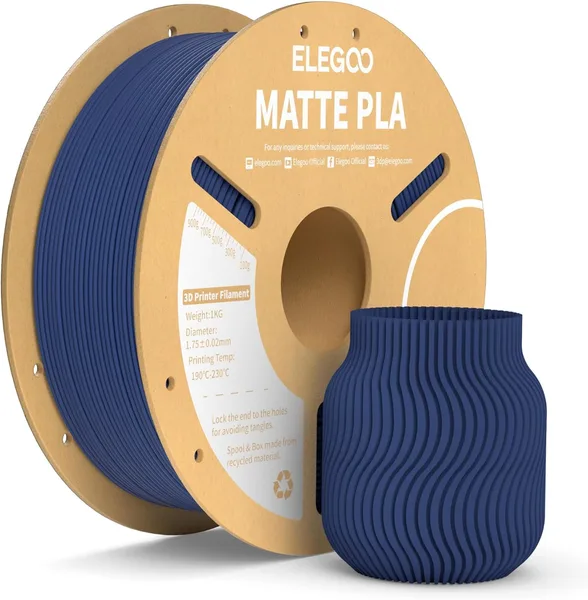
ELEGOO Matte PLA Navy Blue Review: Does the Matte Finish Actually Hold Up?
ELEGOO Matte PLA Navy Blue is a plain-vanilla PLA in terms of chemistry, but a genuinely well-executed matte one: deep navy color with zero shine, and it prints without drama on any FDM machine, direct-drive or Bowden. Get it if you want a finished part you never have to paint or sand. Skip it if you need mechanical strength or you're printing load-bearing functional parts — this is a looks-first plastic, not an engineering one.
Matte filament is one of the rare cases in 3D printing where the promise on the spool actually matches what comes off the nozzle. How many times has this happened: you buy a "matte" filament, and the finished part comes out shiny as a Christmas ornament, because the cooling layer laid down wrong or the temperature ran a couple degrees hot. With ELEGOO Matte PLA Navy Blue, none of that bait-and-switch happened — which is exactly why it's worth writing up on its own instead of filing it under "yet another PLA."
What happens when you actually print it
First impression: the color. Navy Blue here isn't blue-ish or purple-adjacent — it's a genuine deep navy, close to a sailor's uniform or a well-cut suit jacket. On a matte surface it reads richer and more expensive than the same paint would on gloss — an optical trick designers have used for years, now available straight off a spool.
The plastic prints predictably. Nozzle temps sit in the typical PLA range, roughly 190–220°C, the bed can run cold or lightly warmed, and the part cooling fan can go full blast without any risk of layer delamination. Matteness doesn't complicate the process in any way I noticed — speeds, retraction, and flow tune exactly like a standard glossy PLA from ELEGOO or any other established brand. If you already have a dialed-in PLA profile in Cura or Bambu Studio, copy it over and barely touch a thing.
What matte filament genuinely does differently is hide flaws. Layer lines on glossy plastic are visible to the naked eye under almost any light, while a matte texture scatters that reflection and mutes them. So the small print artifacts — a bit of ghosting, minor flow inconsistency — become nearly invisible on this surface. For anyone who doesn't want to hand-finish every single print, that's a real bonus, not a marketing line.
How it stacks up against the usual suspects
The closest comparison points are Polymaker PolyTerra and Sunlu Matte PLA, both popular with people past the "first printer, first glossy PLA" phase. Polymaker's matte finish is a touch more aggressive, almost sandy to the touch, and some users report it costs a bit of tensile strength versus standard PLA. ELEGOO's texture is softer, more velvety, and looks less "industrial" — closer to the soft-touch coating you see on consumer electronics.
Standard glossy PLA is, of course, cheaper and usually the better call for functional parts — brackets, holders, anything that has to carry load. Matte isn't about strength here; it's about presentation: figurines, dioramas, gift pieces, enclosures that sit out on a shelf instead of hiding in a drawer. If you print to sell on Etsy-style marketplaces or for your own portfolio, the difference in how a buyer perceives the finish is real, and navy is a smart pick precisely because it isn't as overused as black or white.
Instead of quoting one price tag in one currency, the honest move here is to check the full landed cost on dede.sh — item, forwarding, and import duty rolled into a single number for your own country, since that final figure swings a lot depending on where you live. Broadly speaking, this spool sits in the mid-premium PLA bracket: pricier than a no-name generic filament, noticeably cheaper than specialty engineering materials like PETG-CF or ASA.
Who should buy it, and who shouldn't
If you're doing decorative prints, cosplay parts, architectural models, or you just want the finished piece to look like a retail product without priming or paint — this is exactly the niche where matte PLA earns its keep. Navy also happens to be a versatile color: it works with a "tech" aesthetic just as easily as it works with something more classic.
Don't bother if you need a part to survive mechanical load, moisture, or temperature swings — look at PETG or ABS instead. And honestly, if color is all you care about and texture isn't, paying extra for matte doesn't make sense — a regular glossy blue PLA is cheaper and gives you the same shade, just with shine.
One real annoyance: the winding. Some matte filament spools — and this isn't unique to ELEGOO — arrive with tangled loops, especially if the spool got jostled in transit. Unwind a bit by hand before your first print and make sure the strand feeds freely; it's a small thing, but it saves you from a failed print at 2am.
ELEGOO Matte PLA Navy Blue isn't a materials revolution — it's a well-executed product in a niche where a lot of brands promise matte and deliver semi-gloss instead. Here, the promise and the result actually line up, and for the price that's already worth a look.
FAQ
Yes, and it's not a myth. Diffused light on a matte surface softens the visibility of layer lines and small flow artifacts. It won't save you from bad calibration, but minor imperfections genuinely become harder to spot with the naked eye.
Barely. Nozzle and bed temperatures match standard PLA. You might want to slow down the outer perimeter a touch if you're chasing the smoothest possible matte finish without banding.
For figurines and decor, matte wins on looks: it reads more expensive, photographs with fewer glare spots, and hides small seams. For functional parts there's essentially no difference, and glossy is cheaper.
For one or two medium figurines, or a handful of small parts, a kilogram goes a long way. If you're planning a large diorama or a production run of identical pieces to sell, grab two spools upfront so you don't end up chasing a color-match between batches.