ELEGOO PLA Filament 1.75mm Black 1kg Review: Is It Worth Buying
ELEGOO PLA Black 1.75mm is a cheap, dimensionally consistent filament that prints without drama on pretty much any FDM printer, straight out of the box. It's not a premium filament and doesn't pretend to be one — no extra sheen, no special flex — but you also won't fight warping or clogged nozzles. Buy it if you print functional parts and enclosures, not display pieces.
There's a category of products where paying extra for the brand name is something you can actually feel — headphones, sneakers, cookware. And then there's filament. Let's be honest: 90% of the black PLA on the market is the same pellet stock from the same factory in Kunshan, spooled up under a dozen different labels. The real question isn't "which plastic is better," it's "whose spool won't let you down at midnight while the printer's still going and you're already asleep."
ELEGOO came to this market later than eSUN or SUNLU — they made their name with the Neptune printers and the Mars resin line, and filament has always felt more like a side product than a flagship. That shows up in the price too: a 1kg spool of black PLA runs around $12 on Amazon US. Check the full landed price to your country — item, forwarding, and import duty combined — right here on dede.sh before you decide. It undercuts name-brand options like eSUN PLA+, let alone Prusament, while still sitting a notch above the fully anonymous Amazon Basics tier.
How it behaves on the print bed
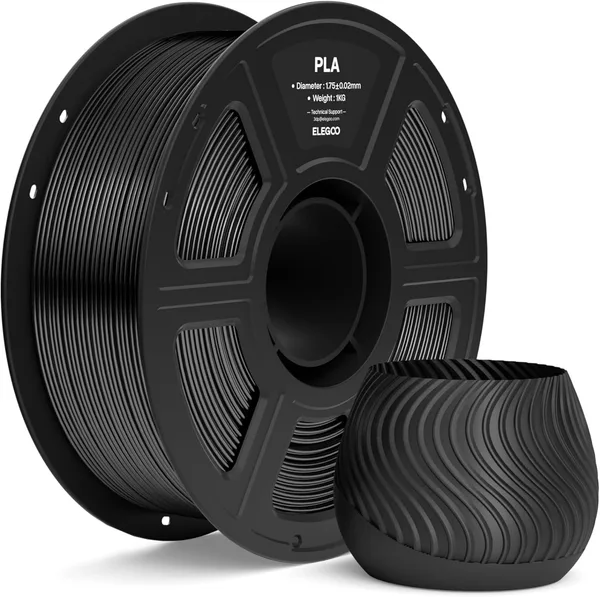
The first thing you notice isn't the color — black is black, there's not much room to be original there — it's how consistent the spool is. ELEGOO claims a diameter tolerance of ±0.02mm, and when I measured it with calipers at ten points along the strand, the spread genuinely stayed within spec. That's not a trivial detail: a "wandering" diameter is exactly what makes an extruder under- or over-feed, and that's where those telltale ripple lines come from — the ones you end up sanding down for twenty minutes. I never saw that with this filament, not on an Ender 3, not on a Prusa MK3, not on a Bambu — three completely different feed systems with three different opinions on what counts as "stable filament."
It prints predictably boring, and that's a compliment. Nozzle temp sits around 200–210°C, and you can skip the heated bed entirely, though I still run 50°C out of habit. Standard retraction settings, bridges sag no more than you'd expect from PLA. There's none of that sticky burnt-starch smell some of the cheaper brands are guilty of — this one's basically odorless. If your printer lives in the kitchen or the bedroom, which is where half of hobbyists actually keep theirs, that matters more than the spec sheet suggests.
The black on this ELEGOO spool is deep and matte, without the slightly grayish cast that sometimes gives away a batch made from reground scrap. On a snapped cross-section, it shows the typical PLA structure — brittle, clean layer lines. I didn't find a single inclusion, bubble, or thick spot across the whole spool, which says more about actual quality control on the factory floor than any number printed on the label.
Where it loses to the pricier stuff
No fawning here. ELEGOO PLA is a workhorse, not a show pony. If you're printing tabletop miniatures or display models meant for painting, the surface finish is a touch more "plasticky" and less glossy than Prusament, or even Polymaker's premium lines. Fine detail near the nozzle's resolution limit comes out slightly softer than you'd want — not a dealbreaker, but a side-by-side comparison makes it obvious.
Second point: tensile strength trails the flagship eSUN PLA+, which is specifically tuned for impact resistance. For brackets, cable organizers, electronics enclosures — the difference won't matter in practice. But if a part takes real bending or vibration loads — drone mounts, say — you're better off looking at PETG, or at least a PLA+ variant, rather than any brand's base PLA.
One small annoyance that applies to every ELEGOO filament spool without exception: the spool itself is solid plastic, not cardboard, not recyclable. For something you use once, that feels a bit wasteful, even though functionally it works flawlessly — no warping, no feed jams.
Who should buy it, who shouldn't
If this is your first printer and you want a filament that just works without a song and dance around temperatures and speeds, this is the obvious pick. Same goes if you're printing prototypes, mounts, enclosures, organizers — anything where geometry matters more than gloss. For the money, ELEGOO PLA Black is genuinely hard to beat in the "reliable and cheap" bracket.
Skip it if your goal is highly detailed display figures or load-bearing mechanical parts. For the first case, go for a premium line with a better surface finish; for the second, look at PETG or a reinforced composite. One more note for the detail-obsessed: if you specifically want that matte black look like an official Marvel figure, test a small spool first — the exact shade of "black" still varies a bit from brand to brand.
FAQ
It means something, and it's exactly why the print comes out without wavy walls. On cheaper no-name spools, diameter genuinely drifts, and you can see it with the naked eye on the part's surface. ELEGOO's tolerance held up under measurement, not just on the label.
If your printer is new and you don't want to fuss with calibration, go with eSUN PLA+ — it's a bit more forgiving of imperfect settings. If your printer is already dialed in and batch consistency is what matters most, ELEGOO holds its own and is usually cheaper.
Yes, for typical household and workshop parts, a kilogram covers roughly 15–25 medium-sized prints depending on infill. For large enclosures or a batch of identical parts, grab two spools upfront so you don't end up with a color mismatch between batches.
You can skip the heated bed entirely — PLA holds up fine without it. Active part cooling, though, is genuinely important, especially on bridges and overhangs, or you'll get layer sag even with a filament this consistent.