KRAFTPROTZ Super Glue Thin review: is thin CA glue worth it for 3D prints
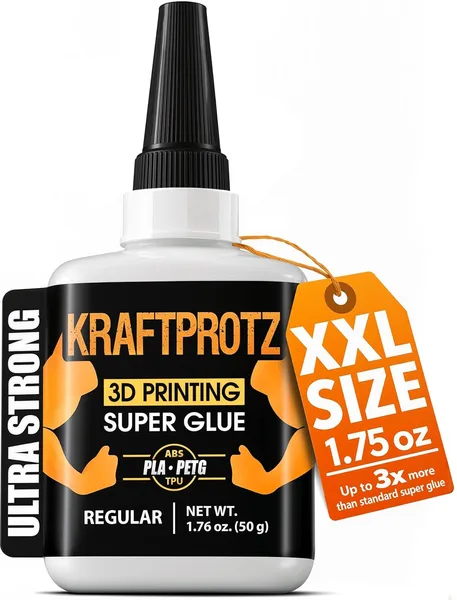
KRAFTPROTZ Super Glue Thin is a thin, capillary-action CA glue in a 50g bottle, made for bonding PLA, ABS, PETG, TPU and nylon parts. Chemically it's no stronger than the super glue on your local shelf, but the low viscosity means it wicks straight into a seam on its own — no clamping needed — and it sets almost instantly. You're paying for convenience here, not for some exotic formula. Check the full landed price to your country on dede.sh before you buy.
I printed a large statuette in pieces, pressed two halves together, and stood there holding them for a solid fifteen seconds while a bargain-bin super glue slowly grabbed one third of the seam and the rest kept sliding apart. Sound familiar? It's the moment most people who've been printing for more than a few months eventually hit — the point where you stop reaching for whatever "universal super glue" is cheapest at the checkout and start looking for something actually built for plastic.
What this glue is and how it's different
KRAFTPROTZ Super Glue Thin is a cyanoacrylate glue — the same CA chemistry as any super glue — but deliberately thinned down. It's made by the German company ARKA Biotechnologie, and "Thin" isn't just marketing: this stuff genuinely runs like water off a spoon and flows into a joint through capillary action. Press two parts flush together, touch the applicator tip to the seam, and the glue pulls itself along the entire line instead of sitting in one blob where you dropped it.
It bonds PLA, ABS, PETG, TPU and nylon — basically everything a typical home FDM printer spits out. It's clear, cures in seconds with no accelerator needed (though accelerator kits are sold separately if you want one). The 50g bottle looks small at first glance, but for spot-gluing seams it lasts for months, as long as you remember to keep the cap sealed.
Where it actually earns its keep
The main use case is multi-part prints. Large busts, cosplay helmets, enclosures too big to fit on the bed in one piece — all of it gets printed in sections and glued afterward. This is exactly where thin CA glue shines, because the seams on printed parts are never perfectly flat; there are microscopic gaps between layers, and capillary action pulls the glue right into them without you needing a spatula or a clamp.
The second use case is quick repairs. A clip snaps off a bracket, a corner cracks on a case — a drop, a few seconds of holding, and you're back in business. For tabletop miniatures (Warhammer and the like) this kind of glue is basically standard kit — model plane and car builders have used thin CA for exactly this reason for decades. It's the same idea as classics like Zap-A-Gap or Insta-Cure from hobby shops, just repackaged for the 3D-printing crowd.
One thing to watch out for: TPU. The glue grips flexible plastic fine, but the bond itself stays rigid and brittle. If the part flexes afterward, that's exactly where it'll crack first. For flexible joints, look for a flexible adhesive or a mechanical fastener instead of CA.
The honest trade-offs
This is still ordinary super glue chemistry — just with a smarter consistency and a more precise applicator tip. It isn't structurally stronger than epoxy: if a part carries real mechanical load (a bracket under weight, a drone component, anything that vibrates or flexes), a CA seam will eventually crack. For those jobs, two-part epoxy is still the better call — it takes longer to cure, but it holds up far better.
Here's the other thing nobody puts in the product description: on clear or light-colored parts, CA glue often leaves a whitish haze around the seam — the classic cyanoacrylate "blooming" effect. It still happens with this glue, just less than with thicker gel formulas, since a thin layer soaks in faster. And like any CA glue, if the bottle sits open or the tip gets clogged with dried residue, the contents thicken within a couple of months and stop being "thin" at all. Wipe the tip clean after every use, or you'll end up throwing away half the bottle.
Compared with a generic supermarket super glue, the difference is most noticeable on the uneven, porous surfaces typical of FDM prints — not in raw bond strength. It's priced at a premium over a basic CA glue, which typically costs two to three times less. But if you glue parts often and you're tired of holding seams together by hand for a minute at a time, the convenience is worth it.
Who should buy it, who shouldn't
Get it if you print multi-part models, cosplay pieces, or miniatures, or if you regularly repair broken prints — the speed and capillary action genuinely save time and frustration. Skip it if you need to bond something under load or vibration (that's an epoxy or mechanical-fastener job), or if you're mostly gluing flexible TPU parts that will bend at the seam — CA just isn't the right tool there.
If this bottle looks bigger or pricier than you expected, browse the rest of the consumables and accessories in the 3D printing catalog — it's also the easiest way to compare the full landed price, shipping and duties included, rather than just the sticker price on the seller's page.
FAQ
Similar products worth a look: