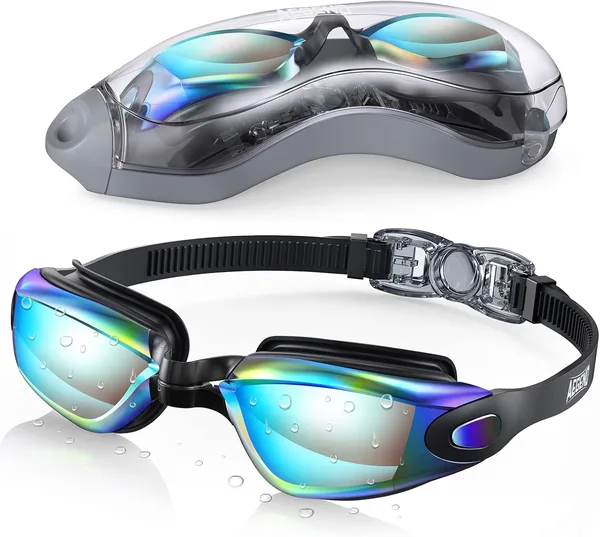
Aegend Swim Goggles Review: Do They Actually Stop Leaking?
Aegend goggles cost about what you'd pay for a energy drink, and they do their one job honestly: they keep the water out and don't leave a raccoon-eye bruise after an hour-long session. They're not optically brilliant, and they're not built for competition, but they're nearly impossible to get wrong — which is exactly why they're worth considering as your first pair, or as the backup you keep in your bag for the day your favorite goggles go missing.
You know the drill: you walk into the pool, strap on your goggles, dive in — and within five minutes there's a lake forming under your left lens. You surface, adjust, dive again, and it leaks again. The whole session turns into counting how many times you had to stop instead of counting laps. If that sounds painfully familiar, Aegend Swim Goggles are worth a look — they're built to solve exactly that problem, and they don't really promise much beyond it.
What these goggles actually are
Aegend isn't a premium brand, and it never pretends to be one. This is the segment where the manufacturer takes a standard silicone frame, doubles up the soft gaskets around the eye sockets, and adds a strap you can adjust one-handed without taking the goggles off your head. It sounds unremarkable, but that's exactly why it works. The gaskets press evenly against your face instead of digging in at one spot — and uneven pressure is precisely why cheap no-name goggles start leaking by your second swim.
The lenses have an anti-fog coating that genuinely works for the first few weeks of regular use — after that, like almost every pair of goggles in this price bracket, the effect fades. That's not some unique flaw of Aegend's; it's just how coatings age. They wear down from contact with water, sweat, and how you towel them off after a workout. Rub them with your fingers or a rough towel and the coating disappears even faster — true of any goggles, not just these.
How they hold up in a real pool
I wouldn't compare Aegend to something like a Speedo Vanquisher — a fairer comparison is the goggles most beginners grab: the cheapest pair at the corner sports shop, bought just "to have something." The difference shows up right away. The strap doesn't slide down the back of your head, and the gaskets don't press hard enough on the bridge of your nose that you need to take them off every ten minutes. Speedo or TYR will usually give you sharper optics and a wider field of peripheral vision — that's refined engineering, and you pay extra for it. Aegend doesn't promise any of that, and honestly, for casual swimming three or four times a week, the difference between "I can clearly see the bottom of the pool" and "I can very clearly see the bottom of the pool" isn't a dealbreaker.
Open water — a lake, the sea, a canal — is a different story. Aegend's field of view is narrower than goggles built specifically for triathlon or open-water swimming, where seeing buoys and landmarks off to the side without a sharp head turn actually matters. If you only swim in a pool with clearly marked lanes, this is a non-issue. If you're planning a kilometer-plus swim in the ocean, look at something with a wider field of view instead, and keep Aegend as the spare pair in your bag.
One thing reviews rarely mention: the frame size doesn't fit everyone equally well. People with narrower faces and more pronounced temples tend to get leaks more often than the average buyer — and that's not a defect, it's a fit issue. The box usually includes a spare set of gaskets, which solves the problem about half the time.
Who should buy these, and who shouldn't
If you swim for fitness, hit the pool two or three times a week, and are tired of goggles that start leaking after a month — buy these without overthinking it. They're priced at roughly a coffee-and-a-sandwich, and even if you end up buying a second pair over the season, you still come out ahead compared to goggles twice the price that leak just as often. Parents shopping for a teenager's swim class will find them a solid fit too — the sizing is fairly universal, "adult" in the name won't be a problem for a slightly smaller face, and the adjustment range is generous.
But if you're racing, chasing splits, or training seriously for open water, these aren't for you. Look at specialized models with a wider field of view and a firmer seal that won't shift at speed instead. Aegend is built for relaxed, casual swimming, not for fighting over seconds on the clock.
There are really two trade-offs here. First, the anti-fog coating won't last forever — accept that going in rather than hoping for a miracle. Second, optical clarity is middling: not the worst you'll find, but not what you're paying for when you buy premium-segment goggles. For what they cost — check dede.sh for the full landed price to your country, item plus shipping plus any import duty rolled into one number — it's an honest deal with no hidden letdowns.
FAQ
The name oversells it a bit, as most products in this segment do. The more accurate claim: they hold up better than budget no-name goggles, provided they actually fit your face shape. No goggles at this price promise 100% watertight sealing.
For casual swimming the difference is minimal, and Aegend wins on value for money. Speedo and similar brands offer slightly sharper optics and a better seal, but that premium only really pays off in competition or serious training.
For short swims near shore, absolutely. For longer distances in the sea or in a triathlon, get a model built with a specifically wider field of view — the lens angle on those is designed for spotting buoys.
Realistically, a few weeks of regular use before the effect fades — same as with any goggles in this price range. You can extend its life by not rubbing the lenses with your fingers or a rough towel.
Worth browsing similar gear for active workouts and training before you commit — comparing shape, material, and price never hurts.