AESUB Blue Review: Anti-Glare Scanning Spray for Glossy and Clear Surfaces
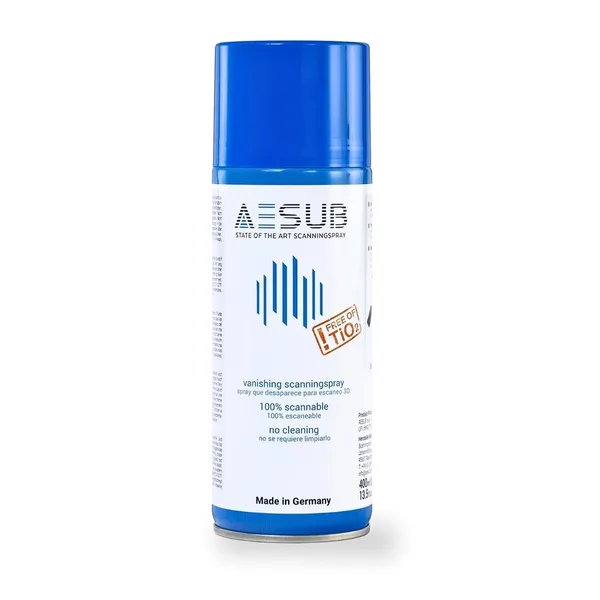
AESUB Blue is an aerosol that turns a shiny, transparent, or black surface matte for a few hours so structured-light and laser scanners can actually read it — then it vanishes on its own without a trace. It genuinely beats talcum powder or old-school developer spray, but it's a consumable for a specific job, not something you grab "just in case."
Try scanning a chrome bathroom faucet with any structured-light scanner and you'll understand this review within about a minute. Instead of a clean mesh, you get a mess of holes, flares, and stray points floating in space where nothing should be. Lasers and structured light simply can't read a mirror. Same story with glass, black rubber, glossy plastic — anything that either bounces light straight back or swallows it instead of scattering it evenly.
People have been hacking around this for years. Some dust the part with baby powder — cheap, but it lands unevenly, drifts everywhere, and coats the scanner lens. Others reach for dry shampoo because at least it sprays more consistently. Industrial quality control and flaw detection have leaned on classic developer sprays like Magnaflux for decades — except that stuff leaves a stubborn white film you then have to scrub off with solvent, and it lingers on your fingers and clothes for a week. AESUB took a different route: you don't wash their spray off, you just wait for it to disappear. The tech is called sublimation — the coating literally evaporates into the air, like dry ice, without leaving a film or a greasy residue.
The difference between AESUB Blue and the same maker's white version basically comes down to how long the coating lasts. White fades in an hour or two, so it's fine for a single quick scan. Blue holds on for roughly six to eight hours depending on the temperature and humidity in the room, which is exactly why people reach for it when they need to scan an object from multiple angles, step away for coffee, come back, and keep going without recoating. For one small screw, that's overkill. But once you're scanning a larger part across several passes, or prepping a batch of objects for reverse engineering, that's precisely why people deliberately pay more for the blue can instead of grabbing the cheapest option on the shelf.
The difference is obvious the moment you use it. Take that same chrome faucet, hold the can about 20-30 cm away, give it a light pass, and the mirror finish turns into an even blue-white matte — almost like it's been sandblasted, minus the dust cloud in your shop. After that, structured light reads the geometry with zero holes. Same story with a bottle or any clear plastic: uncoated, the scanner just "doesn't see" the glass — the beam passes through or scatters wrong — and after a light coat the object suddenly reads as cleanly as an ordinary ceramic mug. Even on black rubber gasketing, which normally eats the whole signal thanks to low reflectivity, a thin layer adds just enough contrast that the point cloud stops looking like noise.
There are honest caveats, though. First, this is a consumable, not a one-time purchase. A can lasts through a decent number of sessions if you spray thin and targeted, but if you're running daily scans of dozens of parts on a production line, budget for it as a recurring cost, not a single line item. Second, the layer is thin but it's still physically there — irrelevant if you're scanning something to 3D-print a keepsake, but in metrology work where hundredths of a millimeter matter, that's a factor you need to account for or calibrate out. Third — obvious, but people try it anyway — this is not for skin or living subjects; it's for hard surfaces in a workshop or on a production floor. And last: if you need texture and true surface color alongside geometry (photogrammetry followed by texturing), the spray works against you — it paints everything uniformly blue, and you can forget about the real surface color until the coating disappears.
Who actually buys this on purpose? Reverse-engineering shops, jewelers scanning metal and gemstones, dental labs, and custom 3D-printing services that constantly run into clients' glossy or transparent parts. If you scan matte plastic toys for your own printer twice a year, honestly, this is overkill — talcum powder or even ordinary dry shampoo will do almost as well, for free, with stuff already sitting in your bathroom cabinet. But the moment chrome, glass, polished metal, or black rubber shows up in your work on a regular basis, the calculus changes, and AESUB genuinely saves you the time you'd otherwise burn washing off developer spray or rerunning failed scans.
On price: check the full landed cost — item plus shipping plus any import duty for your country — on dede.sh rather than going by the sticker price alone, since that final number varies a lot depending on where you're ordering from. For a one-off experiment that adds up. For a shop with a steady stream of scanning jobs, it's a perfectly reasonable line item next to the time saved on redos.

FAQ
Yes, it really disappears — that's the whole point of sublimation coatings, unlike classic flaw-detection developer. Within a few hours (roughly six to eight for Blue) the surface returns to its original state, no film, no solvent needed. If you need to hand the part back to a client right away, just wipe it with a soft cloth — that's faster than waiting for it to fully evaporate.
If your scan is quick and one-off, go with White — it's cheaper and clears faster. If you're planning multiple passes on the same object, working on larger parts, or just don't want to be racing the clock after an hour, Blue lasts longer and is more forgiving of your pace.
For printing models, presentations, or everyday reverse engineering — no, the difference is negligible. For metrology work with tolerances in the hundredths of a millimeter, you should account for it or calibrate with an offset — the coating does physically add a thickness, however minimal.
You can, and plenty of people have for years. But the layer goes on unevenly, drifts past the object, and doesn't disappear on its own — you'll be wiping it off by hand. For a one-off home experiment that's a fine trade-off; for regular work with glossy or transparent parts, AESUB simply saves you time and hassle.
Depends on the size of your objects and how often you scan. For hobby use, a single can goes a long way; for daily work in a shop, plan on it as a recurring purchase rather than a one-time buy.