Aimoh #10 Security Self-Seal Envelopes (100 Count) Review: Are They Worth It?
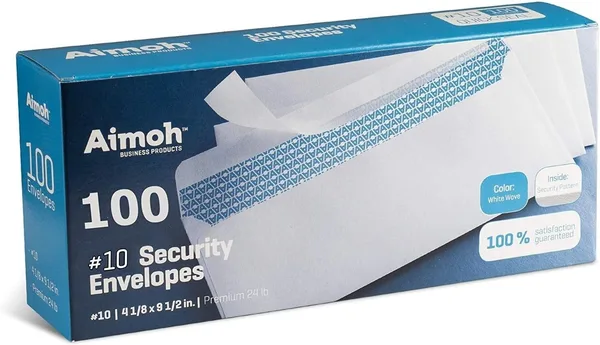
These are standard white #10 envelopes (the US "business" format) featuring self-seal strips instead of licking glue and a blue-grey security tint inside to prevent anyone from reading your checks or invoices through the paper. At a fraction of a cent per unit, if you regularly mail physical documents to the US, they are a no-brainer. If you only need one or two a year, don't bother.
Try licking an envelope in the middle of a summer heatwave when the glue is on your tongue rather than the paper. Gross, right? That’s why the civilized office world moved to self-seal ages ago—peel the strip, press it down, and you're done. The Aimoh #10 envelopes are exactly that, and honestly, it's one of those rare cases where the product is so simple there isn't much to say—though there are a couple of nuances to keep in mind before you buy.
Who are these for?
The thing is, a #10 envelope isn't just a generic "postal envelope"; it’s a specific US business standard, measuring 4 x 9 inches. These are used for bills, checks, contracts—basically anything sent through the standard US mail. This makes them essential for a very specific audience: anyone running a US LLC or using a virtual US address for freelancing, Etsy, or Amazon FBM. When you need to mail a signed contract to a partner or documents to the IRS, you need this exact size, and ideally a non-window version so you can either handwrite the address or use a label.
The second category is small offices or accounting departments that still move physical mail (yes, it still exists in 2026, congrats). This is where Aimoh’s best feature comes in: the EnveGuard security tint. A standard white envelope, when held up to bright light, often becomes translucent enough to reveal check amounts or account numbers. It seems like a small detail, but when dealing with financial documents, it’s worth paying a tiny premium for a "security" envelope rather than the cheapest one from the corner store.
Real-world performance
The adhesive strip here isn't the kind that peels off itself in a hot warehouse; it holds well—just press it and forget it. However, a heads-up: if these envelopes sit in a damp basement for a long time (which can happen in some forwarding warehouses), the adhesive can "tire out" and lose its grip. This isn't unique to Aimoh—it's just how self-seal works—so just don't buy a five-year supply all at once.
To be blunt, the EnveGuard tint isn't exactly "fancy." The blue-grey pattern inside gives off a bit of a "government document" vibe. If aesthetics matter to you—say, if you're sending greeting cards to clients—this isn't the product for you. For strictly professional correspondence where nobody is looking at the envelope's design, it doesn't matter at all.
Compared to alternatives like Quality Park (the US office classic) or generic Staples envelopes, Aimoh isn't reinventing the wheel. It’s a functional, no-frills, unbranded option that simply does its job. If you specifically need a window to print the address via a laser printer, these aren't for you—look for a windowed model, because these are solid.
Price and value
A pack of 100 costs roughly $8.73—meaning less than ten cents per envelope. For a US-sourced product, that's a very fair price. Since this is a small, lightweight item, it makes the most sense to add them to a larger order of office supplies or tech rather than shipping them as a standalone package; otherwise, the shipping costs will dwarf the value of the paper.
See the full landed price to your country on dede.sh
The Verdict
Buy them if you have a steady stream of physical mail going to the US—checks, contracts, official letters where privacy is key, and you're tired of licking envelopes. Don't buy them if: a) you need a window for the address, b) you want something "pretty" for client marketing, or c) you only need to send one single letter—in that case, a hundred envelopes will just gather dust in your drawer. The main trade-off here is aesthetics for functionality: they look a bit "bureaucratic," but they get the job done reliably.

FAQ
No. Without a window, the printer won't automatically show the recipient's address through the envelope. You'll either have to handwrite the address or use an adhesive label. If you need automation via a window, look for a "#10 windowed" version.
Because you don't have to lick glue or carry a damp sponge around the office. You peel the strip, press it, and you're done. It's faster and, frankly, more hygienic, especially if you're sealing dozens at a time.
If you're just sending a standard letter without account numbers or sensitive data, the tint is purely decorative—you can save money by going for the simplest envelope. But for checks, contracts, or any document with account details, it's not a luxury; it's smart insurance against someone seeing your contents through the light.
No. For an item this light and inexpensive, a separate shipment is economically inefficient—the shipping will eat up any savings. It's much smarter to add a pack to a larger order of office supplies or electronics that you're already having forwarded.