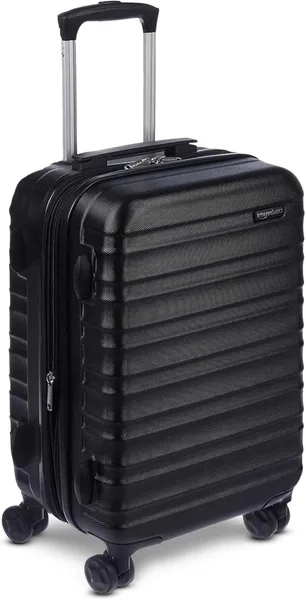
Amazon Basics 21\" Hardside Carry-On Review: Is It Worth Buying?
The Amazon Basics 21" Hardside Carry-On is for people who fly a few times a year, not every week, and don't want to pay a brand tax for the privilege. It's light, the spinner wheels do their job, and the 25% expansion zipper is genuinely useful — but the plastic feels cheap up close, and the lock and wheels are the first things that'll give out after a couple of years of real use. Flying occasionally? Buy it. Living out of a suitcase? Look elsewhere.
You're at the check-in counter for some budget airline, wrestling your carry-on with one hand while stuffing a jacket into it with the other, because the gate agent is eyeing your bag's dimensions like it owes them money. Sound familiar? That's exactly the situation carry-on luggage exists for — and it's also why so many people are buying suitcases right now not as a "someday" purchase, but because their airline just quietly shrank the cabin-bag allowance to something absurd.
The Amazon Basics 21" Hardside is exactly the kind of suitcase people buy without dreaming of some grand trip — they buy it to answer the much smaller question of "what am I taking on this weekend flight." And to be fair, for that job, it does fine.
What actually stands out once you use it
First impression: it's lighter than the price tag suggests. The hard shell, textured like faux alligator skin, doesn't scuff the moment it meets a curb, which already puts it ahead of plenty of budget luggage that looks beaten-up after a single flight. At least on the outside, it holds itself together.
The 360-degree spinner wheels roll easily on smooth airport floors — you can steer it with one finger and it glides along obediently. On cobblestones or rough pavement, though, you immediately notice these aren't premium bearings: a bit of rattle, a bit of wobble. Nothing dealbreaking, but next to something like the SWISSGEAR Sion, which rolls smoothly even on gravel, the difference is obvious.
The 25% expansion zipper is one of those features you underrate until you actually need it. You fly out with an almost-empty case, then come home with souvenirs, a bottle of wine, and a few things you "couldn't not buy" — and suddenly that zipper is a lifesaver. Unzip it, and twice the space appears. Simple, and it works.
Where it gets shakier is the lock. It looks TSA-compliant, but the latch feels flimsy, and if the case gets tossed into a cargo hold without much care — which happens plenty on regional flights and bus terminals alike — that plastic clasp might not survive a third trip. The handle isn't thrilling either: it extends, it works, but it lacks the satisfying click you get used to on pricier models.
What to compare it against
There are basically three types of buyers shopping this category right now. The first flies once or twice a year and just wants a suitcase that works without drama. The second travels regularly and has already been burned by cheap plastic cracking on the second baggage carousel it ever met. The third would honestly rather have a softside bag, because it flexes more easily into those shrinking budget-airline size limits.
If you're in that third group, look at the SWISSGEAR Sion — softside, psychologically easier to squeeze into a sizing frame at the gate, and it has a somewhat longer track record for durability, precisely because fabric bends under impact instead of cracking.
If you want to stay hardside but want a shell that feels a touch sturdier and less "generic," it's worth comparing against the Travelers Club Chicago. It sits in the same price bracket, also hardside with spinner wheels, but the design is a bit less cookie-cutter — useful if you don't want your bag disappearing into a lineup of twenty identical black clones on the carousel.
Sitting between those two, the Amazon Basics is the no-frills middle ground: not the prettiest, not the toughest, but predictable — and once you check the full landed price to your country on dede.sh (item, forwarding, and import duty all in one number), it looks like an honest deal without a logo markup.
Who should buy it, and who shouldn't
Buy it if you fly a few times a year, don't drag your suitcase over cobblestones daily, and your main requirement is that it fits carry-on limits and survives more than one season. For a student heading home on breaks, or a family taking one vacation a year, this is a perfectly sensible choice. The price is low, and even after forwarding and import costs to your country, it typically still comes in well below the average suitcase at a local shop.
Skip it if you're a business traveler flying monthly or more — the cheap plastic and weak lock will become the weak link sooner or later, and repairing or replacing it will cost more than the gap between this and something sturdier. Also skip it if you're the type who tosses luggage into a trunk with real force — the shell can take that once or twice, but cracks will start showing up at the corners after that.
The trade-off here is straightforward: you pay less and get a suitcase that looks and performs well in year one, but isn't built for years of heavy use. That's not false advertising — it's an honest budget product, and it should be judged on those terms, not measured against a Samsonite that costs twice as much.
FAQ
21 inches is right at the edge. It'll clear most standard cabin-bag allowances, but with the strictest budget airlines — the ones with limits below the usual 55 cm — measure it yourself before you fly, because a gate-side size penalty stings.
If your bag regularly ends up in a bus cargo hold or out in the rain, hardside protects the contents better. If you're mostly carrying it yourself and squeezing it into an overstuffed overhead bin, a softside option like the SWISSGEAR Sion flexes more and forgives tight spaces.
Honestly, probably not. For two or three trips a year it'll last a good while, but with monthly flights the lock and the shell's corners will become the weak spot sooner than you'd like.
Yes — it's one of the rare cases where an extra feature genuinely earns its place. Empty, the case packs down compact; on the way home, the expansion gives you room for souvenirs or shopping without needing to buy a second bag.