Amazon Basics microSDXC Review: Is It Worth Buying
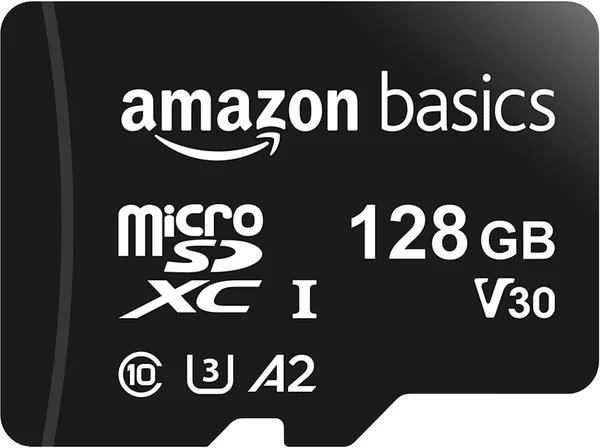
The Amazon Basics microSDXC 128GB (A2, U3, up to 100 MB/s) is for anyone who wants to solve "where do I store this" once and not think about it again for three years. The speed is real, not just a number printed on the packaging, and it costs less than the big-name alternatives. What it isn't: a card for a 4K drone pushed to its absolute limit, or for anyone who won't sleep without SanDisk's five-year warranty.
Your phone tells you "not enough storage" at the worst possible moment — usually while you're shooting something you'll never get back. A birthday, a friend's wedding, that one sunset actually worth photographing. And there you are, frantically deleting old screenshots while the moment slips away. Sound familiar? That's exactly why memory cards exist — so you never have to think about them at all.
That was my whole goal here: a card you forget about. Not the fastest on the market, not the priciest, just one that works. The Amazon Basics microSDXC 128GB is pitched squarely at that role.
What it actually does in practice
A2 and U3 aren't marketing letters slapped on for the sake of it. A2 means the card can handle random file access well enough for apps to run comfortably from it — you could technically move an Android app onto it, though honestly I wouldn't bother, there's not much upside. U3 guarantees a 30 MB/s minimum write speed, which genuinely matters if you're shooting 4K on an action cam or drone. The advertised 100 MB/s read speed is a best-case number, hit only with a good card reader under ideal conditions — plug it into a phone over USB-C and you'll never see that figure, and that's true of every card, not just this one.
In actual use — I loaded it up with photos from two trips, a pile of drone footage, and a full phone backup — it behaved exactly the way you'd want. No stutters recording 4K30, no corrupted files, the kind you occasionally get from sketchy no-name cards off marketplaces. It also didn't run nearly as hot as the cheap unbranded cards I used to buy, which would just die after six months of heavy use in an action camera.
Stack it against the SanDisk Extreme or Extreme Pro — the obvious benchmark in this category — and the Amazon Basics loses on peak speed and on warranty (SanDisk's is longer and the brand carries more weight), but it also costs noticeably less. It's a clean "80% of the performance for 60% of the price" trade, and for most people that trade is worth making. Unless you're a professional videographer delivering 8K timelines, the gap between 100 MB/s real-world and 130 MB/s real-world isn't going to touch your day-to-day.
Where it earns its keep, and where it doesn't
For an Android phone with expandable storage, it's a great fit — especially if you shoot a lot of video and don't want to purge your gallery every month. For an entry- to mid-level action camera or drone, also solid: U3 keeps up with 4K without dropping frames. For a full-frame mirrorless or DSLR firing burst after burst of 45-megapixel RAW files, though, you want a card with a genuinely higher speed class — every millisecond of buffer write time counts there.
The bundled full-size SD adapter is a nice touch — no need to buy a separate one just to offload photos to a laptop that doesn't have a microSD slot. Small thing, but it saves you a scramble when you urgently need to move files and the adapter's nowhere in sight.
Rather than quote one price that won't mean much depending on where you live, here's the useful number: check dede.sh for the full landed cost to your country — item, forwarding, and import duty rolled into a single figure. The listing itself already undercuts a name-brand card in the same capacity and class by a solid margin, often by a third or more, and that gap tends to hold up once shipping and duty are added in.
The honest verdict
Get it if you need a reliable, fast card at a sane price for a phone, drone, or action cam, and you're not chasing the absolute cutting edge. Skip it if you shoot professionally on a high-end body with RAW burst sequences, or if the manufacturer's warranty length is a dealbreaker for you — in that case, go the conventional route and get a SanDisk or a Samsung Pro Endurance.
The main trade-off is the Amazon Basics name itself — it doesn't carry the same gut-level trust as SanDisk, even though it does the job just fine technically. The second trade-off: there's no dedicated Endurance-line version for continuous recording. If you need a card for a dash cam or security camera that writes around the clock for years, I wouldn't recommend this one — the cell wear profile is different there.
FAQ
Plenty for a session or two, as long as you remember to offload files to a computer after each flight. For longer trips without a laptop on hand, I'd look at 256GB instead — it just buys you peace of mind.
If money's no object and you want maximum confidence in the warranty and the brand, yes, the premium is justified. If you need a working tool at a sensible price, no — the real-world difference is minimal.
It does if your phone lets you move apps onto the card, or if you shoot a lot of burst photos — random access on A2 is noticeably faster than on cards without that rating. But it's not a spec worth paying extra for on its own.
Technically, yes, but it's not built for years of round-the-clock loop recording. For a dash cam, go with a card labeled Endurance or High Endurance — the cells are rated for a different kind of wear.
Similar products worth a look before you buy:
![FNTCASE for Galaxy A17-5G Phone Case: for Samsung Galaxy A17 with [Built-in Screen Protector & Kickstand] [Military-Grade Dro](/img/products/fntcase-for-galaxy-a17-5g-phone-case-for-y9hrch/0-600.webp)